Results by title
60 books match the query 'Visions' and 4 start with a
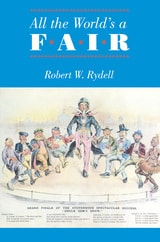
All the World's a Fair
Visions of Empire at American International Expositions, 1876-1916Robert W. Rydell
University of Chicago Press, 1985
A groundbreaking account of the ways the United States used world's fairs to extend its empire abroad and racial hierarchies at home
In All the World's a Fair, Robert W. Rydell argues that America's nineteenth-century world's fairs served to legitimate racial exploitation at home and the creation of an empire abroad. He looks in particular to the "ethnological" displays of nonwhites—set up by showmen but endorsed by prominent anthropologists—which lent scientific credibility to popular racial attitudes and helped build public support for domestic and foreign policies. Rydell's lively and thought-provoking study draws on archival records, newspaper and magazine articles, guidebooks, popular novels, and oral histories to tell a new story of American history and empire.
In All the World's a Fair, Robert W. Rydell argues that America's nineteenth-century world's fairs served to legitimate racial exploitation at home and the creation of an empire abroad. He looks in particular to the "ethnological" displays of nonwhites—set up by showmen but endorsed by prominent anthropologists—which lent scientific credibility to popular racial attitudes and helped build public support for domestic and foreign policies. Rydell's lively and thought-provoking study draws on archival records, newspaper and magazine articles, guidebooks, popular novels, and oral histories to tell a new story of American history and empire.
[more]
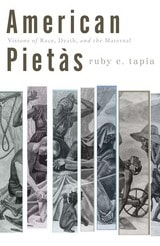
American Pietàs
Visions of Race, Death, and the MaternalRuby C. Tapia
University of Minnesota Press, 2010
In American Pietàs, Ruby C. Tapia reveals how visual representations of racialized motherhood shape and reflect national citizenship. By means of a sustained engagement with Roland Barthes’s suturing of race, death, and the maternal in Camera Lucida, Tapia contends that the contradictory essence of the photograph is both as a signifier of death and a guarantor of resurrection.
Tapia explores the implications of this argument for racialized productions of death and the maternal in the context of specific cultural moments: the commemoration of Princess Diana in U.S. magazines; the intertext of Toni Morrison’s and Hollywood’s Beloved; the social and cultural death in teen pregnancy, imaged and regulated in California’s Partnership for Responsible Parenting campaigns; and popular constructions of the “Widows of 9/11” in print and televisual journalism.
Taken together, these various visual media texts function in American Pietàs as cultural artifacts and as visual nodes in a larger network of racialized productions of maternal bodies in contexts of national death and remembering. To engage this network is to ask how and toward what end the racial project of the nation imbues some maternal bodies with resurrecting power and leaves others for dead. In the spaces between these different maternities, says Tapia, U.S. citizen-subjects are born—and reborn.
[more]
Anthropology and Politics
Visions, Traditions, and TrendsJoan Vincent
University of Arizona Press, 1990
In considering how anthropologists have chosen to look at and write about politics, Joan Vincent contends that the anthropological study of politics is itself a historical process. Intended not only as a representation but also as a reinterpretation, her study arises from questioning accepted views and unexamined assumptions. This wide-ranging, cross-disciplinary work is a critical review of the anthropological study of politics in the English-speaking world from 1879 to the present, a counterpoint of text and context that describes for each of three eras both what anthropologists have said about politics and the national and international events that have shaped their interests and concerns. It is also an account of how intellectual, social, and political conditions influenced the discipline by conditioning both anthropological inquiry and the avenues of research supported by universities and governments. Finally, it is a study of the politics of anthropology itself, examining the survival of theses or schools of thought and the influence of certain individuals and departments.
[more]

Arnold Wesker
Fragments and VisionsEdited by Anne Etienne and Graham Saunders
Intellect Books, 2021
After his death, Arnold Wesker (1932–2016) was hailed as one of the great overlooked figures of British drama. Despite his engagement in British cultural politics of the 1960s and an international career, only a fraction of Wesker’s dramatic output has been thoroughly studied.
Edited by leading scholars in the field and with contributions from important scholars of postwar theater, this volume considers, for the first time, the whole body of Wesker’s work. It includes chapters on Wesker’s reception in Europe, his representation of and attitude towards women, his relationship to his Jewish origins and identity, and his attitude toward politics and community. Building on existing scholarship, drawing extensively from the Arnold Wesker archive at the Harry Ransom Center at the University of Texas at Austin, and introducing new insights and perspectives, this important new essay collection remedies the recent critical neglect of the dramatist.
Edited by leading scholars in the field and with contributions from important scholars of postwar theater, this volume considers, for the first time, the whole body of Wesker’s work. It includes chapters on Wesker’s reception in Europe, his representation of and attitude towards women, his relationship to his Jewish origins and identity, and his attitude toward politics and community. Building on existing scholarship, drawing extensively from the Arnold Wesker archive at the Harry Ransom Center at the University of Texas at Austin, and introducing new insights and perspectives, this important new essay collection remedies the recent critical neglect of the dramatist.
[more]