Results by title
3 books match the query 'Visual Cultures'
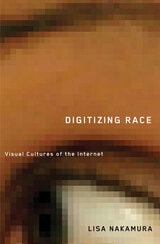
Digitizing Race
Visual Cultures of the InternetLisa Nakamura
University of Minnesota Press, 2007
In the nineties, neoliberalism simultaneously provided the context for the Internet’s rapid uptake in the United States and discouraged public conversations about racial politics. At the same time many scholars lauded the widespread use of text-driven interfaces as a solution to the problem of racial intolerance. Today’s online world is witnessing text-driven interfaces such as e-mail and instant messaging giving way to far more visually intensive and commercially driven media forms that not only reveal but showcase people’s racial, ethnic, and gender identity.
Lisa Nakamura, a leading scholar in the examination of race in digital media, uses case studies of popular yet rarely examined uses of the Internet such as pregnancy Web sites, instant messaging, and online petitions and quizzes to look at the emergence of race-, ethnic-, and gender-identified visual cultures.
While popular media such as Hollywood cinema continue to depict nonwhite nonmales as passive audiences or consumers of digital media rather than as producers, Nakamura argues the contrary—with examples ranging from Jennifer Lopez music videos; films including the Matrix trilogy, Gattaca, and Minority Report; and online joke sites—that users of color and women use the Internet to vigorously articulate their own types of virtual community, avatar bodies, and racial politics.
Lisa Nakamura is associate professor of speech communication and Asian American studies at the University of Illinois, Urbana-Champaign. She is the author of Cybertypes: Race, Ethnicity, and Identity on the Internet and coeditor, with Beth Kolko and Gilbert Rodman, of Race in Cyberspace.

Visual Cultures
Edited by James Elkins
Intellect Books, 2010
Visual Cultures is the first study of the place of visuality and literacy in specific nations around the world, featuring authoritative, insightful essays on the value accorded to the visual and the verbal in Japan, Poland, China, Russia, Ireland, and Slovenia.
Focusing on the national instead of the global, distinguished art critic James Elkins offers a critique of general histories of visuality, such as those of Martin Jay or Jean Baudrillard, as well as a critique of local histories of visuality, as in Third Text and other postcolonial studies. The content is not only analytic, but also historical, tracing changes in the significance of visual and verbal literacy in each nation. Visual Cultures also explores questions of national identity and the many issues Elkins raises suggest a wealth of promising avenues for future research.

Visual Cultures of Japanese Imperialism, Volume 8
Gennifer Weisenfeld, ed.
Duke University Press, 0
The articles, contributed by scholars in the fields of art history, cultural history, and Japanese literature, address the interactions between Japan, the West, and the rest of Asia. Costumes, architecture, tourism propaganda, pottery, and a host of other sources provide the raw materials for Visual Cultures of Japanese Imperialism, and the incisive essays built from these sources will change readers’ understanding of the visual culture(s) of imperialism.
Contributors. Kim Brandt, Leo Ching, Carol Ann Christ, Christine Guth, Jordan Sand, Gennifer Weisenfeld, Cherie Wendelken