Results by title
3 books match the query 'Visual perception in art'

Mirror Affect
Seeing Self, Observing Others in Contemporary ArtCristina Albu
University of Minnesota Press, 2016
For decades, contemporary artworks with reflective properties have stimulated public forms of spectatorship. According to Cristina Albu, these artworks, which can include elements such as mirrors, live video feedback, or sensors, draw attention to affective interdependence and mechanisms of social control.
In Mirror Affect, Albu provides a historical account of mirroring processes in contemporary art and offers insight into the phenomenological and sociopolitical concerns that have inspired artists to stage processes of affective, perceptual, and behavioral mirroring between art viewers. Beginning with the 1960s, Albu charts the rise of interpersonal modes of art spectatorship. She reveals contemporary artists’ strategic use of reflective and responsive interfaces to instill doubt in visual representation and appeal to active scrutiny of the changing social dynamics. She suggests that the mirroring processes envisioned by contemporary artists such as Joan Jonas, Dan Graham, Lynn Hershman Leeson, Olafur Eliasson, and Rafael Lozano-Hemmer trigger visual disjunctions to upset narcissistic inclinations. They invite viewers to see themselves in relation to others and to ponder their role within complex social systems.
From sculpture and performance to art and technology projects, video art, and installation art, Mirror Affect analyzes forms of interpersonal spectatorship, revising and expanding current historiographies of participatory art.
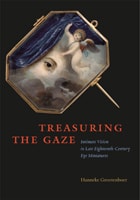
Treasuring the Gaze
Intimate Vision in Late Eighteenth-Century Eye MiniaturesHanneke Grootenboer
University of Chicago Press, 2013
Vector Media
Leonardo Impett
University of Minnesota Press, 2026
Dispelling the notion of “generative” AI
Neural networks are designed to dissolve all media into the vector space—a universal space of commensurability. In Vector Media, Leonardo Impett and Fabian Offert parse theories of automatic vision to trace contemporary artificial intelligence’s technical ideology of epistemic reduction, where sensory data is turned into abstracted forms of meaning. Under this regime, bias is not just a question of what is represented but of the logic of representation itself. Drawing on Phil Agre’s notion of a critical technical practice, Vector Media reveals how artificial intelligence systems embed new epistemologies of media beneath the surface of their architectures.
Analyzing the techniques underpinning large multimodal artificial intelligence models like DALL-E, Midjourney, Flux, or Stable Diffusion, Impett and Offert offer the concept of neural exchange value: the value cultural artifacts acquire not through meaning or context but through their capacity to function as vectors. In such a system, commensurability becomes a condition of existence: what matters is not what something is but that it can be embedded. Rather than focusing solely on datasets, Vector Media proposes a critical study of vector spaces—and the machine cultures they produce—as a necessary complement to prevailing approaches in AI critique.
Retail e-book files for this title are screen-reader friendly with images accompanied by short alt text and/or extended descriptions.