Results by title
11 books match the query 'Visuality'
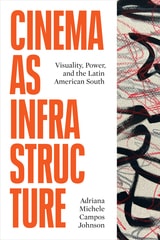
Cinema as Infrastructure
Visuality, Power, and the Latin American SouthAdriana Michele Campos Johnson
University of Texas Press, 2027
Examining the interplay of visuality and infrastructure in Latin American films.
Images do far more than we realize. They do not simply represent or depict; they run our world. Surveillance cameras and drones, medical imaging, social media platforms, market-data visualization––these and other technologies make the image an infrastructure of power, a tool for organizing and governing, impressing labor and extracting value.
Adriana Johnson draws on the medium of film to sensitize us to the logics of visuality as a technology of power. In particular, Latin American cinema presents a key site for both crystallizing and retreating from these logics. Through close readings of Argentine, Paraguayan, and Brazilian movies—including the documentary Bus 174, the dystopian sci-fi The Aerial,and the farcical The Gold Bug—Johnson shows how filmmakers can amplify or attenuate the infrastructural reach of visuality. They also reveal visuality’s otherwise-submerged power, and even engage in something like piracy: hacking into, rerouting, and deconstituting the workings of visual infrastructures. A deeply insightful and theoretically rich account, Cinema as Infrastructure reframes the political stakes of filmmaking in an era when visual forms have become means of production and order.

ConFiguring America
Iconic Figures, Visuality, and the American IdentityEdited by Klaus Rieser, Michael Fuchs, and Michael Phillips
Intellect Books, 2013
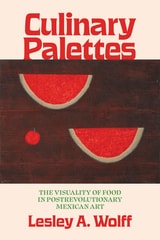
Culinary Palettes
The Visuality of Food in Postrevolutionary Mexican ArtLesley A. Wolff
University of Texas Press, 2025
2026 Mejor libro Humanidades, Mexico Section of the Latin American Studies Association
2026 Honorable Mention, First Book Prize, Cultural Studies Association
2025 Excellence in Scholarly Research and Publication Award, SECAC (formerly the Southeastern College Art Conference)
How the visual culture of food, cookery, and consumption played a central role in the making of postrevolutionary Mexico.
Postrevolutionary Mexico City was a site of anxious nation-building, as rampant modernization converged and clashed with the nation’s growing nostalgia for its pre-Columbian heritage. During this volatile period, food became a meaningful symbol for a Mexican citizenry seeking new modes of national participation.
Culinary Palettes explores how the artistic invocation of food cultures became an arena in which to negotiate the political entanglements of postrevolutionary Mexico. Lesley Wolff casts a nuanced eye on the work of visual artists such as Tina Modotti, Carlos González, and Rufino Tamayo, who nurtured the symbolic and performative power of iconic foods such as pulque, mole poblano, and watermelon. Through analysis of a wide array of visual evidence, including paintings, architecture, vintage postcards, menus, and cookbooks, Culinary Palettes demonstrates how these artists positioned their work within a broad visual landscape that relied upon the power of Mexican foodways in the urban and national imagination. In the studios of modernists, Wolff argues, artistic production, foodways, and Indigeneity proved to be mutually constitutive—and at times weaponized—agents in articulating competing claims to a new nationhood.
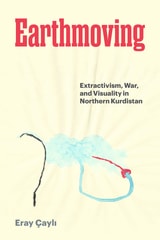
Earthmoving
Extractivism, War, and Visuality in Northern KurdistanEray Çayli
University of Texas Press, 2025
Focuses on contemporary art and media to examine the role of visuals in environmental violence and war in Northern Kurdistan.
Extractivism—exploiting the earth for resources—has long driven racial capitalism and colonialism. And yet, how does extractivism operate in a world where ecological and humanitarian sensibilities are unprecedentedly widespread? Eray Çaylı argues it does so by mobilizing these sensibilities in new ways. Extractivism is no longer only about moving the earth—displacing peoples, fossils, minerals, and waters—but also leaving those who witness this violent displacement sentimentally moved.
Earthmoving conceptualizes this duality. Derived from Çaylı’s years-long work in Northern Kurdistan, home to the world’s largest stateless nation—rendered stateless by colonial policies since the nineteenth century—Earthmoving focuses on the 2010s, a decade that began with peace talks between Turkey and the Kurdish liberation movement but ended with war. The decade saw extractivism intensify in the region and images of its harm proliferate across art and media. Together with contemporary artists, Çaylı shows that images challenge extractivism both by making its harm visible and by fostering self-reflexive and reciprocal collaboration that breaks with its valuation of the colonized and the racialized only in quantifiable and marketable terms.
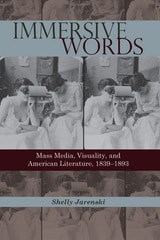
Immersive Words
Mass Media, Visuality, and American Literature, 1839–1893Shelly Jarenski
University of Alabama Press, 2015
The middle of the nineteenth century witnessed the emergence of numerous visual technologies and techniques: the daguerreotype, immersive exhibition spaces such as cycloramas and panoramas, mechanized tourism, and large-scale exhibitions and spectacles such as the World’s Fair. In closely argued chapters devoted to these four visual forms, Jarenski demonstrates that the popularity of these novelties catalyzed a shift by authors of the period beyond narratives that merely described images to ones that invoked aesthetic experiences.
Jarenski describes how Herman Melville adapts the aesthetic of the daguerreotype through his use of dramatic point-of-view and unexpected shifts that disorient readers. Frederick Douglass is shown to appropriate a panoramic aesthetic that severs spatial and temporal narratives from standard expectations. Jarenski traces how Nathaniel Hawthorne’s The Marble Faun found success as a travel guide to Rome, though intended as a work of serious fiction. Finally, Sarah Orne Jewett is shown to simulate the interactivity of the World Columbian Exposition to promote racialized and gendered forms of aesthetic communication. These techniques and strategies drawn from visual forms blur the just-so boundary critics and theorists have traditionally drawn between text and image.
In the mid-nineteenth century, the national identity of the United States remained fluid and hinged upon matters of gender, sexuality, and, crucially, race. Authors both reflected that evolving identity and contributed to its ongoing evolution. In demonstrating how the aesthetic and visual technologies of the nineteenth century changed the fundamental aesthetics of American literature, the importance of Immersive Words goes far beyond literary criticism.
Picturing Worlds
Visuality and Visual Sovereignty in Contemporary Anishinaabe LiteratureDavid Stirrup
Michigan State University Press, 2020

Seeing Witness
Visuality and the Ethics of TestimonyJane Blocker
University of Minnesota Press, 2009
Unearthing the meaning of witnessing in contemporary art and politics
The act of bearing witness can reveal much, but what about the figure of the witness itself? As contemporary culture is increasingly dominated by surveillance, the witness—whether artist, historian, scientist, government official, or ordinary citizen—has become empowered in realms from art to politics.
In Seeing Witness, Jane Blocker challenges the implicit authority of witnessing through the examination of a series of contemporary artworks, all of which make the act of witnessing visible, open to inspection and critique. Considering such artists as Marina Abramović, James Luna, Felix Gonzalez-Torres, Eduardo Kac, and Ann Hamilton, Blocker investigates the artists and spectators who look, the technologies they look with, and the forms of power and moral authority that permit their viewing. Going beyond particular traumatic or sensational events, Blocker contemplates the politics of witnessing and argues that the witness represents a morally unique—and even problematic—position of privilege. Separating Seeing Witness from previous literature on the subject, she finds that the visual is inherent in witnessing and asserts that contemporary art is integral to questioning and understanding how witnessing is mobilized in culture today.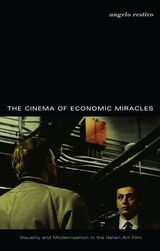
The Cinema of Economic Miracles
Visuality and Modernization in the Italian Art FilmAngelo Restivo
Duke University Press, 2002
Restivo studies numerous films of the period, focusing mainly on the works of Pier Paolo Pasolini and Michelangelo Antonioni. He finds that these auteurs’ films reworked the neorealist aesthetic developed in the 1940s and 1950s, explored issues brought to the fore by the subsequent consumer boom, and presaged developments central to both critical theory and the visual arts in the 1980s and 1990s. Drawing on the theories of Lacan, Zizek, Benjamin, Foucault, Jameson, and Deleuze, he shines new light on such films as Pasolini’s Accattone and Teorema, and Antonioni’s Red Desert and Blow-Up. Restivo’s model for understanding the relationship of the 1960s Italian art film to its cultural contexts also has implications that extend to the developing national cinemas of countries such as Brazil and Taiwan.
The Cinema of Economic Miracles will interest scholars and students in all areas of film studies, especially those studying theories of the image, national cinema theory, and Italian cinema, and to those engaged in poststructuralist theory, philosophy, and comparative literature.
The Right to Look
A Counterhistory of VisualityNicholas Mirzoeff
Duke University Press, 2011
Troubling Vision
Performance, Visuality, and BlacknessNicole R. Fleetwood
University of Chicago Press, 2010
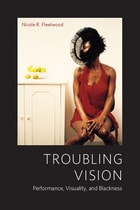
Troubling Vision addresses American culture’s fixation on black visibility, exploring how blackness is persistently seen as a problem in public culture and even in black scholarship that challenges racist discourse. Through trenchant analysis, Nicole R. Fleetwood reorients the problem of black visibility by turning attention to what it means to see blackness and to the performative codes that reinforce, resignify, and disrupt its meaning. Working across visual theory and performance studies, Fleetwood asks, How is the black body visualized as both familiar and disruptive? How might we investigate the black body as a troubling presence to the scopic regimes that define it as such? How is value assessed based on visible blackness?
Fleetwood documents multiple forms of engagement with the visual, even as she meticulously underscores how the terms of engagement change in various performative contexts. Examining a range of practices from the documentary photography of Charles “Teenie” Harris to the “excess flesh” performances of black female artists and pop stars to the media art of Fatimah Tuggar to the iconicity of Michael Jackson, Fleetwood reveals and reconfigures the mechanics, codes, and metaphors of blackness in visual culture.
“Troubling Vision is a path-breaking book that examines the problem of seeing blackness—the simultaneous hyper-visibility and invisibility of African Americans—in US visual culture in the last half century. Weaving together critical modes and methodologies from performance studies, art history, critical race studies, visual culture analysis, and gender theory, Fleetwood expands Du Bois’s idea of double vision into a broad questioning of whether ‘representation itself will resolve the problem of the black body in the field of vision.’ With skilled attention to historical contexts, documentary practices, and media forms, she takes up the works of a broad variety of cultural producers, from photographers and playwrights to musicians and visual artists and examines black spectatorship as well as black spectacle. In chapters on the trope of ‘non-iconicity’ in the photographs of Charles (Teenie) Harris, the ‘visible seams’ in the digital images of the artist Fatimah Tuggar, and a coda on the un-dead Michael Jackson, Fleetwood's close analyses soar. Troubling Vision is a beautifully written, original, and important addition to the field of American Studies.”—Announcement of the American Studies Association for the 2012 Lora Romero First Book Publication Prize
Visuality of Violence
Witnessing the Policing of RaceOfelia Ortiz Cuevas
Temple University Press, 2025
Addressing the frequently ignored experiences of Asian and Native Americans, among others, in its comparative undertaking, Visuality of Violence exceeds intersectional mapping to uniquely charge the spectacle of racial violence as a foundational practice in its continued presence in contemporary society. Cuevas argues that the visual presentations of the racial body throughout history requires a reckoning and acknowledgement of the material and legal effects of the images, narratives, and practices used to maintain hegemonic racial order and inequality.
In holding a theoretical mirror to history, Visuality of Violence reveals liberal mythical reliance on the ideals of western law and its rationalities as the location of justice and freedom, thereby presenting its readers with a new understanding in the quest for peace and liberation.
In the series Critical Race, Indigeneity, and Relationality