Results by title
4 books match the query 'Visualization'
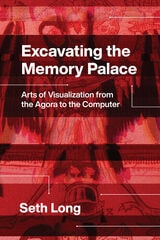
Excavating the Memory Palace
Arts of Visualization from the Agora to the ComputerSeth Long
University of Chicago Press, 2020
In Excavating the Memory Palace, Seth David Long mines the history of Europe’s arts of memory to find the origins of today’s data visualizations, unearthing how ancient constructions of cognitive pathways paved the way for modern technological interfaces. Looking to techniques like the memory palace, he finds the ways that information has been tied to sensory and visual experience, turning raw data into lucid knowledge. From the icons of smart phone screens to massive network graphs, Long shows us the ancestry of the cyberscape and unveils the history of memory as a creative act.
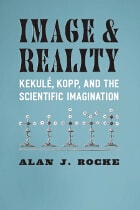
Image and Reality
Kekulé, Kopp, and the Scientific ImaginationAlan J. Rocke
University of Chicago Press, 2010
Nineteenth-century chemists were faced with a particular problem: how to depict the atoms and molecules that are beyond the direct reach of our bodily senses. In visualizing this microworld, these scientists were the first to move beyond high-level philosophical speculations regarding the unseen. In Image and Reality, Alan Rocke focuses on the community of organic chemists in Germany to provide the basis for a fuller understanding of the nature of scientific creativity.
Arguing that visual mental images regularly assisted many of these scientists in thinking through old problems and new possibilities, Rocke uses a variety of sources, including private correspondence, diagrams and illustrations, scientific papers, and public statements, to investigate their ability to not only imagine the invisibly tiny atoms and molecules upon which they operated daily, but to build detailed and empirically based pictures of how all of the atoms in complicated molecules were interconnected. These portrayals of “chemical structures,” both as mental images and as paper tools, gradually became an accepted part of science during these years and are now regarded as one of the central defining features of chemistry. In telling this fascinating story in a manner accessible to the lay reader, Rocke also suggests that imagistic thinking is often at the heart of creative thinking in all fields.
Image and Reality is the first book in the Synthesis series, a series in the history of chemistry, broadly construed, edited by Angela N. H. Creager, John E. Lesch, Stuart W. Leslie, Lawrence M. Principe, Alan Rocke, E.C. Spary, and Audra J. Wolfe, in partnership with the Chemical Heritage Foundation.
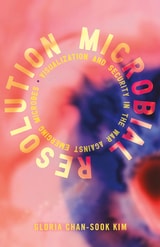
Microbial Resolution
Visualization and Security in the War against Emerging MicrobesGloria Chan-Sook Kim
University of Minnesota Press, 2024
An interdisciplinary study charting the war against microbial futures leads to a new theory of contemporary vision and visuality
In 1989, a group of U.S. government scientists met to discuss some surprising findings: new diseases were appearing around the world, and viruses that they thought long vanquished were resurfacing. Their appearance heralded a future perpetually threatened by unforeseeable biological risks, sparking a new concept of disease: the “emerging microbe.” With the Cold War nearing its end, American scientists and security experts turned to confront this new “enemy,” redirecting national security against its risky horizons. In order to be fought, emerging microbes first needed to be made perceptible; but how could something immaterial, unknowable, and ever mutating be coaxed into visibility, knowability, and operability?
Microbial Resolution charts the U.S.-led war on the emerging microbe to show how their uncertain futures were transformed into objects of global science and security. Moving beyond familiar accounts that link scientific knowledge production to optical practices of visualizing the invisible, Gloria Chan-Sook Kim develops a theory of “microbial resolution” to analyze the complex problematic that arises when dealing with these entities: what can be seen when there is nothing to see? Through a syncretic analysis of data mining, animal-tracking technologies, media networks, computer-modeled futures, and global ecologies and infrastructures, she shows how a visual impasse—the impossibility of seeing microbial futures—forms the basis for new modes of perceiving, knowing, and governing in the present.
Timely and thought provoking, Microbial Resolution opens up the rich paradoxes, irreconcilabilities, and failures inherent in this project and demonstrates how these tensions profoundly animate twenty-first-century epistemologies, aesthetics, affects, and ecologies.

Picturing Empire
Photography and the Visualization of the British EmpireJames R. Ryan
University of Chicago Press, 1997
But as James R. Ryan argues in Picturing Empire, Victorian photographs reveal as much about the imaginative landscapes of imperial culture as they do about the "real" subjects captured within their frames. Ryan considers the role of photography in the exploration and domestication of foreign landscapes, in imperial warfare, in the survey and classification of "racial types," in "hunting with the camera," and in teaching imperial geography to British schoolchildren.
Ryan's careful exposure of the reciprocal relation between photographic image and imperial imagination will interest all those concerned with the cultural history of the British Empire.