Results by title
4 books match the query 'Viveiros de Castro, Eduardo'

Cannibal Metaphysics
Eduardo Viveiros de Castro
University of Minnesota Press, 2017
The iconoclastic Brazilian anthropologist and theoretician Eduardo Viveiros de Castro, well known in his discipline for helping initiate its “ontological turn,” offers a vision of anthropology as “the practice of the permanent decolonization of thought.” After showing that Amazonian and other Amerindian groups inhabit a radically different conceptual universe than ours—in which nature and culture, human and nonhuman, subject and object are conceived in terms that reverse our own—he presents the case for anthropology as the study of such “other” metaphysical schemes, and as the corresponding critique of the concepts imposed on them by the human sciences. Along the way, he spells out the consequences of this anthropology for thinking in general via a major reassessment of the work of Claude Lévi-Strauss, arguments for the continued relevance of Deleuze and Guattari, dialogues with the work of Philippe Descola, Bruno Latour, and Marilyn Strathern, and inventive treatments of problems of ontology, translation, and transformation. Bold, unexpected, and profound, Cannibal Metaphysics is one of the chief works marking anthropology’s current return to the theoretical center stage.
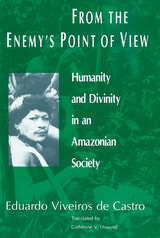
From the Enemy's Point of View
Humanity and Divinity in an Amazonian SocietyEduardo Viveiros de Castro
University of Chicago Press, 1992
Building upon ethnographic description and interpretation, Viveiros de Castro addresses the central aspect of the Arawete's concept of divinity—consumption—showing how its cannibalistic expression differs radically from traditional representations of other Amazonian societies. He situates the Araweté in contemporary anthropology as a people whose vision of the world is complex, tragic, and dynamic, and whose society commands our attention for its extraordinary openness to exteriority and transformation. For the Araweté the person is always in transition, an outlook expressed in the mythology of their gods, whose cannibalistic ways they imitate. From the Enemy's Point of View argues that current concepts of society as a discrete, bounded entity which maintains a difference between "interior" and "exterior" are wholly inappropriate in this and in many other Amazonian societies.
The Inconstancy of the Indian Soul
The Encounter of Catholics and Cannibals in 16-century BrazilEduardo Viveiros de Castro
Prickly Paradigm Press, 2011
In the mid-sixteenth century, Jesuit missionaries working in what is now Brazil were struck by what they called the inconstancy of the people they met, the indigenous Tupi-speaking tribes of the Atlantic coast. Though the Indians appeared eager to receive the Gospel, they also had a tendency to forget the missionaries’ lessons and “revert” to their natural state of war, cannibalism, and polygamy. This peculiar mixture of acceptance and rejection, compulsion and forgetfulness was incorrectly understood by the priests as a sign of the natives’ incapacity to believe in anything durably.
In this pamphlet, world-renowned Brazilian anthropologist Eduardo Viveiros de Castro situates the Jesuit missionaries’ accounts of the Tupi people in historical perspective, and in the process draws out some startling and insightful implications of their perceived inconstancy in relation to anthropological debates on culture and religion.
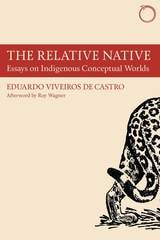
The Relative Native
Essays on Indigenous Conceptual WorldsEduardo Viveiros de Castro
HAU, 2015
This volume is the first to collect the most influential essays and lectures of Eduardo Viveiros de Castro. Published in a wide variety of venues, and often difficult to find, the pieces are brought together here for the first time in a one major volume, which includes his momentous 1998 Cambridge University Lectures, “Cosmological Perspectivism in Amazonia and Elsewhere.”
Rounded out with new English translations of a number of previously unpublished works, the resulting book is a wide-ranging portrait of one of the towering figures of contemporary thought—philosopher, anthropologist, ethnographer, ethnologist, and more. With a new afterword by Roy Wagner elucidating Viveiros de Castro’s work, influence, and legacy, The Relative Native will be required reading, further cementing Viveiros de Castro’s position at the center of contemporary anthropological inquiry.