Results by title
3 books match the query 'Vocal groups'
Powerful Voices
The Musical and Social World of Collegiate A CappellaJoshua S. Duchan
University of Michigan Press, 2016
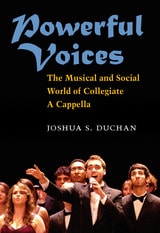
Collegiate a cappella, part of a long tradition of unaccompanied singing, is known to date back on American college campuses to at least the colonial era. Considered in the context of college glee clubs, barbershop quartets, early-twentieth-century vocal pop groups, doo-wop groups, and contemporary a cappella manifestations in pop music, collegiate a cappella is an extension of a very old tradition of close harmony singing---one that includes but also goes beyond the founding of the Yale Whiffenpoofs. Yet despite this important history, collegiate a cappella has until now never been the subject of scholarly examination.
In Powerful Voices: The Musical and Social World of Collegiate A Cappella, Joshua S. Duchan offers the first thorough accounting of the music's history and reveals how the critical issues of sociability, gender, performance, and technology affect its music and experience. Just as importantly, Duchan provides a vital contribution to music scholarship more broadly, in several important ways: by expanding the small body of literature on choruses and amateur music; by addressing musical and social processes in a field where the vast majority of scholarship focuses on individuals and their products; and by highlighting a musical context long neglected by musicologists---the college campus. Ultimately, Powerful Voices is a window on a world of amateur music that has begun to expand its reach internationally, carrying this uniquely American musical form to new global audiences, while playing an important role in the social, cultural, and musical education of countless singers over the last century.
The Mistakes of Yesterday, the Hopes of Tomorrow
The Story of the PrisonairesJohn Dougan
University of Massachusetts Press, 2012
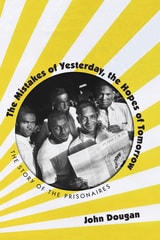
Early in the morning on June 1, 1953, five African American men boarded a van to make the 200-mile trip from Nashville to Memphis for a daylong recording session at the legendary Sun Studios, to be overseen by Sun founder Sam Phillips. One of the two tracks cut that day, “Just Walkin' in the Rain,” would go on to become a regional R&B hit, Sun Records' biggest record of the pre-Elvis era. It would, however, be the group's only hit. They were the Prisonaires, a vocal quintet who had honed their skills while inmates at the Tennessee State Penitentiary in Nashville.
In this book, John Dougan tells the story of the Prisonaires, their hit single, and the afterlife of this one remarkable song. The group and the song itself represent a compelling concept: imprisoned men using music as a means of cultural and personal survival. The song was re-recorded by white singer Johnnie Ray, who made it a huge hit in 1956. Over the years, other singers and groups would move the song further away from its origins, recasting the deep emotions that came from creating music in a hostile, controlled environment.
The story of the Prisonaires, for all of its triumphs, reflects the disappointment of men caught in a paradoxical search for personal independence while fully cognizant of a future consigned to prison. Their brief career and the unusual circumstances under which it flourished sheds light on the harsh realities of race relations in the pre–Civil Rights South. The book also provides a portrait of Nashville just as it was gaining traction as a nationally recognized music center.
When Colleges Sang
The Story of Singing in American College LifeJ. Lloyd Winstead
University of Alabama Press, 2013