Results by title
3 books match the query 'Volodine, Antoine'
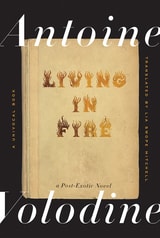
Living in Fire
A Post-Exotic NovelAntoine Volodine
University of Minnesota Press, 2026
A soldier engulfed in napalm suspends his death by composing a family saga in which he learns to live within the flames
Do not remain on the fire’s edge, find your way to the heart of the fire and do not leave. . . . Death does not exist as long as you reject it. A soldier watches an airplane dropping napalm on his position. In the instant before his fiery death, he does not see his life flash before his eyes. Instead, he improvises a novel, one that screams out of him at high speed.
In his story, Sam wanders a postapocalyptic landscape of broken cities and empty steppes for days, years, centuries. Through a series of blackly comic, dreamlike, bizarre scenes, he gleans lessons imparted by the weird and violent members of his family, including sorceress Aunt Yoanna, doomed Uncle Slutov, and two sharp-shooting cousins who try to persuade him to kill their mother. Sam’s clan teaches him how to accept his fate and live in the world of flames with no fear for the future.
The forty-ninth novel in the post-exotic series and the last to appear under the name Antoine Volodine, Living in Fire includes an interview with the writer about this book’s place in his overall project, its literary and cinematic influences, and its thematic connections with other works in the sequence. A triumphant conclusion to an epic experiment, Living in Fire cuts through a world aflame using dark humor, flights of fantasy, and radical acceptance.
Retail e-book files for this title are screen-reader friendly.
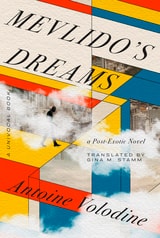
Mevlido's Dreams
A Post-Exotic NovelAntoine Volodine
University of Minnesota Press, 2024
A postapocalyptic noir that asks if love and political ideals can survive civilizational collapse
A meditative, postapocalyptic noir, Mevlido’s Dreams is an urgent communiqué from a far-future reality of irreversible environmental damage and civilizational collapse. Mevlido is a double agent working for the police and living in the last habitable city on the planet, a sprawling abyssal ruin marked by war and ruled by criminals. Suspended in the bardo between his loyalty to the surveillance state and to the anarchists, communists, and other rebels he monitors, Mevlido clings to life and hope—barely—in the city’s vast slums, haunted by the memory of the wife he failed to save during the last war and dreaming of a mysterious mission he is told he must accomplish. At the same time, an enigmatic organization existing elsewhere—the Organs—observes Mevlido’s actions and debates its responsibility to him and to humanity as a whole.
Asking what it means to love and care for others at the end of the world, this dense, brilliantly detailed postcollapse reality imagined by Antoine Volodine is one that grows ever more relevant amidst intensifying climate and political catastrophes. A key work in Volodine’s post-exotic fictional universe, Mevlido’s Dreams envisions a world changed beyond recognition and ruled under irrational authoritarianism in which dreams nest within dreams and the boundaries between life and death are fluid and uncertain.
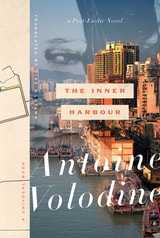
The Inner Harbour
A Post-Exotic NovelAntoine Volodine
University of Minnesota Press, 2025
A beguiling, perspective-shifting story of obsession and loss set in the grimy, late-colonial decadence of Macau at the end of the twentieth century
In The Inner Harbour, Antoine Volodine focuses his literary investigations away from dystopian futures to a specific place at a particular historical moment: Macau on the eve of the Portuguese colony’s transfer to China. In a seedy flat in one of the city’s slums, a hired assassin named Kotter interrogates Breughel, a writer on the run from a mysterious organization code-named Paradise. Breughel has been hiding out in Macau with his lover, Gloria Vancouver, and a significant sum of the organization’s money. But Gloria is dead and the money spent—or so Breughel claims—and now he lives alone in humid squalor.
With increasing severity, Kotter extracts Breughel’s confessions, but are they truth or subterfuge? Or are the confessions an elaborate work of fiction by a writer aware that they are no longer able to differentiate between memory and fantasy? Volodine brilliantly blurs the levels of narration—between what Breughel tells his interrogator, what he remembers or invents, and the stories he has written, including his accounts of Gloria’s hallucinatory visions of an apocalyptic war between military forces and the “chrysalids.”
Interweaving threads of fiction and truth, lies and hallucinations, The Inner Harbour evokes many of the themes found in Volodine’s other “post-exotic” works: the slippage between dreams and reality, the nightmares of history, the exhaustion of literature and politics, and questions about what it means to be faithful to people or ideas long since vanished. But Volodine also uses the setting of Macau’s late-colonial decadence to explore new sensations of foreignness, alienation, and resignation, all of which coalesce into a nesting doll of narrative that houses an unconventional and tragic love story.
Retail e-book files for this title are screen-reader friendly.