Results by title
4 books match the query 'Volume 105'
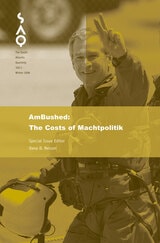
AmBushed
A Critique of Machtpolitik, Volume 105Dana D. Nelson
Duke University Press, 0
One essay argues that the Left has ceded its political vision—forgoing active political organization in favor of simply voicing political criticism of the president—allowing its activist sensibilities and abilities to atrophy. Others explore the Bush administration, its masterful machtpolitik (power politics), its strategic feminization of its opposition, its aggressive expansion of executive-branch powers, and its flirtation with what some have labeled American fascism or totalitarianism; still others reflect on how the Left has insulated itself from both reality and politics. A contributor from South Africa draws parallels between apartheid proponents and their tactics and President Bush. Others analyze “Bush II” as the leader of the Christian Right, as a skillful exploiter and manipulator of the mainstream media, as the chief spokesman for “evangelical capitalism,” and as the world’s most powerful lobbyist for corporate interests.
Contributors. Wendell Berry, Michael Bérubé, Timothy Brennan, Sharad Chari, Matthew A. Crenson, Ariel Dorfman, Thomas L. Dumm, Keya Ganguly, Benjamin Ginsberg, Pierre Guerlain, Stephen Hartnett, Dana D. Nelson, Chris Newfield, Melissa A. Orlie, Stanley G. M. Ridge, Larry Schehr, Nikhil Singh, Neil Smith, Laura Ann Stengrim

Double Critique
Knowledges and Scholars at Risk in Post-Soviet Societies, Volume 105Walter Mignolo and Madina Tlostanova
Duke University Press, 0

The Last Frontier
The Contemporary Configuration of the U.S.-Mexico Border, Volume 105Jane Juffer, ed.
Duke University Press, 0
Covering a range of disciplinary perspectives—geography, political science, anthropology, American studies, literary studies, and environmental studies—these essays contend that U.S. policies to curtail immigration and drug trafficking along the Mexican border are ineffective. George W. Bush’s call for a volunteer security force has legitimized a vigilante presence through the formation of Minutemen civilian border patrols, in addition to larger numbers of Border Patrol agents and expanded detention centers. One contributor argues that, due to the increasingly dangerous border-crossing conditions, more undocumented immigrants are remaining in the United States year-round rather than following the traditional seasonal pattern of work and returning to Mexico. Another contributor interviews drug smugglers and government officials, revealing the gap between reality and the claims of success by the U.S. government in the “war on drugs.” Focusing on the social justice movement Ni Una Mas (Not One More), one essay delves into the controversy over the unsolved murders of hundreds of young women in the border town of Ciudad Juárez and the refusal of the government to investigate these murders properly. Other essays consider instances of resistance and activism—ranging from political movements and protests by NGOs to artistic expression through alternative narratives, poetry, and photography—against the consequences of neoliberalism on the border and its populations.
Contributors. Ana M. Manzanas Calvo, Alicia Schmidt Camacho, Arturo Dávila, Sarah Hill, Jane Juffer, Laura Lewis, Alejandro Lugo, Tony Payan, Claudia Sadowski-Smith, Santiago Vaquera, Melissa Wright
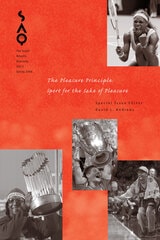
The Pleasure Principle
Sport for the Sake of Pleasure, Volume 105David L. Andrews, ed.
Duke University Press, 0
Ranging from the humorous to the ironic, from the personal to the theoretical, and from sports as dissimilar as baseball and rugby, gambling and karate, this issue explains fandom itself and explores the intersections of sport and politics, sport and class, and sport and identity. One timely essay addresses the use of Native American imagery and nicknames and the recent NCAA ban on these references. Another classifies gambling as a popular American sport, one that in 2003 attracted three times as many attendees as all Major League Baseball franchises combined. Another essay delves into the history of the golfing mecca of Pinehurst, North Carolina, discussing the resort’s roots in the age of Jim Crow. Among the other topics addressed in this issue are how soccer fandom and commodity culture can be one and the same; why Liverpool’s 2005 victory in the European Champion’s League proves that God is red; and why the Olympic Games can represent performative nationalism.
Contributors. David L. Andrews, Amy Bass, Norman K. Denzin, Grant Farred, Keya Ganguly, John Hartley, Jane Juffer, Liz Moor, Jeffrey T. Nealon, Annie Paul, George Ritzer, Jim Shepard, Orin Starn, Kenneth Surin