Results by title
2 books match the query 'Volume 106'
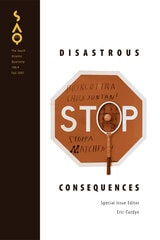
Disastrous Consequences, Volume 106
Eric Cazdyn, ed.
Duke University Press, 0
From the fields of anthropology, architecture, cultural studies, economics, epidemiology, journalism, and philosophy, the contributors argue that disasters do not only follow from things going horribly wrong (extreme weather, economic collapse, urban decay). Often they are the predictable results of things going according to plan. The meaning of disaster itself is challenged, theorized again, and reconceptualized.
One essay argues that media reports during Hurricane Katrina worked to deny or disguise institutionalized racism, suppressing potential dissent and controversy. Another examines how the state bureaucracy reinforces cycles of death, disease, and poverty in South Africa. A third explores the devastating conditions of everyday life in Detroit that no longer register in the political imaginary of the United States. Still another investigates the connection between unusual weather events and the workings of the Communist Party in Poland. Finally, the renowned architect Isozaki Arata plays with the idea of urban planning in two short fables introduced by Fredric Jameson.
Contributors. Eric Cazdyn, Isobel S. Frye, Jerry Herron, Peter Hitchcock, Isozaki Arata, Fredric Jameson, Walter Kalaidjian, Leszek Koczanowicz, Leah Schinasi, Neil Smith, Carol A. Stabile, Imre Szeman, Steve Wing

Late Derrida, Volume 106
Ian Balfour , ed.
Duke University Press, 0
The essays address a wide array of Derrida’s concerns: human rights, justice, religion, the performative, “the gift of death,” mourning, and sovereignty. They often put Derrida’s texts in conjunction with the works of others—Wordsworth, Agamben, Schelling, and Benjamin, to name a few—that resonate with and on occasion resist Derrida’s own thinking and writing. One essay offers a reading of Wordsworth’s elegy “Distressful gift!” as a dialogue with questions posed by Derrida, using as its frame the kind of nonnormative mourning that Derrida advocated, together with a haunting analysis of the character of survival. Other essays look at Derrida’s theory of performativity as advanced in his late works, continuing his emphasis on the power of language, and in general they emulate his vigilance in attending to force and violence everywhere.
Contributors. Ian Balfour, David L. Clark, Mary Jacobus, David E. Johnson, David Lloyd, J. Hillis Miller, Marc Redfield, Rei Terada, Elisabeth Weber