Results by title
4 books match the query 'Volume 38'
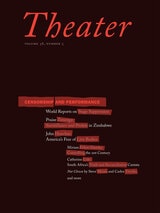
Contemporary Censorship and Performance, Volume 38
Miriam Felton-Dansky and Tom Sellar, eds.
Duke University Press, 0
The collection includes an essay that explores the function of live performance in recent freedom-of-expression debates, such as those featuring Janet Jackson and Don Imus, and persistent national anxieties about performers’ bodies. The issue also features an international censorship forum that brings together reports of incidents from Burma, Singapore, Germany, Italy, and the United States. A special report from Zimbabwe provides an in-depth look at the repression of oppositional theater by one of Africa’s most dictatorial regimes while another article looks at REwind: A Cantata for Voice, Tape and Testimony, a new musical composition that takes once-silenced voices recorded for South Africa’s Truth and Reconciliation Commission and transforms them into a hymn for a postapartheid nation. The issue also includes the first publication of an inventive new play that is a satirical as well as chilling look at suppression and dissent in post-9/11 America.
Contributors: Howard Barker, Reverend Billy, Catherine Cole, Mike Daisey, Dean Damjanovski, Miriam Felton-Dansky, Jacob Gallagher-Ross, John Houchin, Rabih Mroué, Freddie Rokem, Tom Sellar, Fadi Toufiq, Praise Zenenga
Crime and Justice, Volume 38
A Review of ResearchEdited by Michael Tonry
University of Chicago Press Journals, 2009
Since 1979, Crime and Justice has presented an annual review of the latest international research, providing expertise to enhance the work of sociologists, psychologists, criminal lawyers, justice scholars, and political scientists. The series explores a full range of issues concerning crime, its causes, and its cure. Volume 38 covers a range of criminal justice issues, from the effects of parental imprisonment on children to economists and crime.
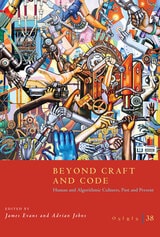
Osiris, Volume 38
Beyond Craft and Code: Human and Algorithmic Cultures, Past and PresentEdited by James Evans and Adrian Johns
University of Chicago Press Journals, 2023
Perceptively explores the shifting intersections between algorithmic systems and human practices in the modern era.
How have algorithmic systems and human practices developed in tandem since 1800? This volume of Osiris deftly addresses the question, dispelling along the way the traditional notion of algorithmic “code” and human “craft” as natural opposites. Instead, algorithms and humans have always acted in concert, depending on each other to advance new knowledge and produce social consequences. By shining light on alternative computational imaginaries, Beyond Craft and Code opens fresh space in which to understand algorithmic diversity, its governance, and even its conservation.
The volume contains essays by experts in fields extending from early modern arithmetic to contemporary robotics. Traversing a range of cases and arguments that connect politics, historical epistemology, aesthetics, and artificial intelligence, the contributors collectively propose a novel vocabulary of concepts with which to think about how the history of science can contribute to understanding today’s world. Ultimately, Beyond Craft and Code reconfigures the historiography of science and technology to suggest a new way to approach the questions posed by an algorithmic culture—not only improving our understanding of algorithmic pasts and futures but also unlocking our ability to better govern our present.
Tax Policy and the Economy, Volume 38
Edited by Robert A. Moffitt
University of Chicago Press Journals, 2024
Tax Policy and the Economy publishes current academic research on taxation and government spending with both immediate bearing on policy debates and longer-term interest.
This volume presents new research on taxation and public expenditure programs, with particular focus on how they affect economic behavior. John Guyton, Kara Leibel, Dayanand Manoli, Ankur Patel, Mark Payne, and Brenda Schafer study the disallowance of Earned Income Tax Credit (EITC) benefits as a result of IRS audits, and find that in post-audit years, audited taxpayers are less likely than similar non-audited taxpayers to claim EITC benefits. Janet Holtzblatt, Swati Joshi, Nora Cahill, and William Gale provide new empirical evidence on racial differences in the income tax penalty, or bonus, associated with a couple being married. Haichao Fan, Yu Liu, Nancy Qian, and Jaya Wen evaluate how computerizing value-added tax transactions in China affected the tax revenue collected from large manufacturing firms. Niels Johannesen, Daniel Reck, Max Risch, Joel Slemrod, John Guyton, and Patrick Langetieg study data on the ownership of foreign bank accounts and other financial accounts as reported on income tax returns. They find that many of these accounts are in tax havens, and they discuss the impact of the Foreign Account Tax Compliance Act on tax compliance and government revenue. Louis Kaplow integrates charitable giving into an optimal income tax framework, and shows that the externalities associated with such giving are key to determining its optimal tax treatment. Finally, Roger Gordon compares caps or quantity targets on emissions with carbon taxes and points out that which one dominates can be situation-specific and depend on a number of features of the economy.