Results by title
21 books match the query 'Volume 8'

Adolescent Psychiatry, Volume 8
Developmental and Clinical StudiesEdited by Sherman C. Feinstein and Peter L. Giovacchini
University of Chicago Press, 1981
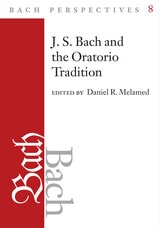
Bach Perspectives, Volume 8
J.S. Bach and the Oratorio TraditionEdited by Daniel R. Melamed
University of Illinois Press, 2011

Caring for Each Other
Family Caregiving Across the Generations: Groves Monographs on Marriage and Family (Volume 8)Christine A. Readdick
Michigan Publishing Services, 2023
Catalogus Translationum et Commentariorum, Volume 8
Virginia Brown
Catholic University of America Press, 1960
Common Knowledge (Inaugural issue marking return to publication), Volume 8
Jeffrey M. Perl, ed.
Duke University Press, 0
Described by the New York Times as one of two American journals in which public intellectuals and other scholars prefer to publish, the highly acclaimed Common Knowledge has returned to publication after a two-year hiatus. In an effort to place itself in the ferment of intellectual life and broaden its geographical range, the journal has moved to the Middle East, to Israel. Born in an attempt to moderate and get past the "culture wars" of the 90s, Common Knowledge has moved, literally, to a war zone, and accordingly its editorial interests have broadened to include culture wars of a less metaphorical kind.
Its mission is both incredibly ambitious and shockingly simple: to open up lines of communication between the academy and the community of thoughtful people outside its walls. Common Knowledge was created to form a new intellectual model, one based on conversation or cooperation rather than on metaphors adopted from sports and war, of "sides" that one must "take." The journal will collect work from a variety of fields and specialties, including philosophy, religion, psychology, literary criticism, cultural studies, art history, political science, and social, cultural, and intellectual history.
Scholars such as Richard Rorty, Bruno Latour, Clifford Geertz, Julia Kristeva, Karma Nabulsi, and J. G. A. Pocock will cross paths with political figures like Prince Hassan of Jordan and President Arpad Goncz of Hungary, novelists like Susan Sontag, poets like Yves Bonnefoy, composers like Alexander Goehr, and journalists like Adam Michnik. The pages of Common Knowledge are sure to challenge the ways we think about theory and its relevance to humanity. The first volume will feature the beginning of a Seriatim Symposium, “Disagreement, Enmity, and Dispute,” which will include discussions of the title concepts from a variety of theoretical perspectives. The Symposium asks why, in an intellectual context in which “true” and “real” are words that can be used only in condescending scare quotes, there is so much absolute conflict. If truth and reality are constructions, then why aren’t we constructing consensual orders (metaphysical and social) that are conducive to peace, calm, and cooperation?
Contributors for forthcoming issues include: Manfred Frank, Jacques Le Goff, Vicki Hearne, Sissela Bok, Edward Cardinal Cassidy, Linda Hutcheon, G. Thomas Tanselle, Arlette Farge, Marcel Detienne, Caryl Emerson, Stanley Katz, and Peter Laslett.

Crime and Justice, Volume 8
Communities and CrimeEdited by Albert J. Reiss Jr. and Michael Tonry
University of Chicago Press Journals, 1987
Examining the ways in which communities both affect crime and are affected by it, this volume seeks to explain the wide variation of crime levels among different communities. As it attempts to redress the bias toward describing crime in terms of individuals, Communities and Crime brings concentrated attention to crime at a community level, suggesting ways in which neighborhoods can change their crime patterns.

Flora Zambesiaca
Volume 8, Part 6: Acanthaceae: Barleria to HypoestesEdited by J. R. Timberlake
Royal Botanic Gardens, Kew, 2014
Volume 8 part 6 covers the Acanthaceae family, from Barleria to Hypoestes.
Mediterranean Security at the Cross Roads, Volume 8
Nikolaos Stavrou and Raymond C. Ewing
Duke University Press, 0
The potential role of NATO is controversial but crucial to the future of the Mediterranean. Some contributors suggest that the southward expansion of NATO could be an important first step toward stability, while others argue that the Mediterranean should be treated as an integrated geostrategic region, with a central place in Western security considerations.
Highlighting this issue is a foreword by former U.S. Secretary of State George P. Schultz, and a piece focusing on NATO in the Mediterranean by Javier Solana, the Secretary General of NATO. Other essays discuss the comparative experience of UNPROFOR and IFOR in the former Yugoslavia; the role of Italy in the future of the Mediterranean; the economic challenges facing the Middle East; and the role of Israel and its relationship to its neighbors. Mediterranean Security at the Crossroads is one of the first in-depth looks at this region from a strictly post—Cold War perspective.
Ocean Yearbook, Volume 8
Edited by Elisabeth Mann Borgese, Norton Ginsburg, and Joseph R. Morgan
University of Chicago Press, 1990
Osiris, Volume 8
Research Schools: Historical ReappraisalsEdited by Gerald L. Geison and Frederic L. Holmes
University of Chicago Press, 1993

Playwrights for Tomorrow
A Collection of Plays, Volume 8Arthur H. Ballet, EditorIntroduction by Arthur H. Ballet
University of Minnesota Press, 1972
Playwrights for Tomorrow was first published in 1972. Minnesota Archive Editions uses digital technology to make long-unavailable books once again accessible, and are published unaltered from the original University of Minnesota Press editions.
Three playwrights are represented in this, the eighth volume of the continuing series Playwrights for Tomorrow, which makes available the work of playwrights who have been sponsored by the University of Minnesota Office for Advanced Drama Research. Under the program of the O.A.D.R., which is aided by a grant from the Rockefeller Foundation, writers are given the opportunity to work on their scripts and have their plays produced by cooperating theater companies. The program is directed by Arthur H. Ballet, the series editor.
The three plays in this volume are A Gun Play by Yale M. Udoff, Anniversary on Weedy Hill by Allen Joseph, and The Nihilist by William N. Monson. Professor Ballet provides an introduction in which he explains the purpose and scope of the O.A.D.R. program, recounts some of its history and accomplishments, and tells a little about the O.A.D.R. productions of each of the plays included here.
A Gun Play was produced by the Hartford Stage Company in Hartford, Connecticut, under the direction of Paul Weidner. Later it had an off-Broadway run in New York City, staged by commercial producers. The author, Yale Udoff, is a professional writer primarily involved in the mass media.
Anniversary on Weedy Hill was produced by Theatre West, a professional company in West Hollywood, California. Allen Joseph, the author, a professional actor in film and television, turned to playwriting in the midst of a well-established career in the theater.
The Nihilist was the second play of the O.A.D.R. offered through the facilities of the University of California at Davis Theatre under the direction of Alfred Rossi. William Monson, the playwright, is from the world of academe.

Queer Tourism
Geographies of Globalization, Volume 8Jasbir K. Puar, ed.
Duke University Press, 0
Essays explore a range of geographical areas and cover topics that include an autoethnographic account of a queer traveler in Cuba, the development of gay and lesbian tourism in Madrid and Mexico, and gay and lesbian tourist events such as World Pride 2001 in Rome. The collection also includes an essay focusing on lesbian tourism—a study of the history of lesbian tourism on Eresos, Lesvos.
Contributors. Lionel Cantú, Gabriel Giorgi, Venetia Kantsa, Lawrence La Fountain-Stokes, Michael Luongo, Kevin Markwell, Jasbir Kaur Puar, Dereka Rushbrook

The Best American Newspaper Narratives, Volume 8
Gayle Reaves
University of North Texas Press, 2021

The Collected Letters of Thomas and Jane Welsh Carlyle
January 1835–June 1836, Volume 8Charles Richard Sanders
Duke University Press, 0

The Diary of Calvin Fletcher, Volume 8
1863-1864Gayle Thornbrough
Indiana Historical Society Press, 1981

The Mahabharata, Volume 8
Book 12, The Book of Peace, Part 2Translated and Edited by James L. Fitzgerald
University of Chicago Press, 2026
A remarkable composition of 100,000 couplets, The Mahābhārata is the second-longest poem in world literature. In this volume, James L. Fitzgerald completes his translation of the twelfth of The Mahābhārata’s eighteen books, the vast Shanti Parvan, or The Book of Peace. Covering a wide range of ancient Indian intellectual history, The Book of Peace was intended to serve as a comprehensive, brahmin-inspired basis for living a Good Life in a Good Society in a Good Polity and is one of the most important and complex books of the poem.
Fitzgerald’s previous contribution to the Chicago edition of The Mahābhārata, volume 7, opened with Book 11, The Book of the Women, which movingly portrayed the grief of the wives, mothers, and sisters of the many warriors slain in the epic’s central war narrative. The crises of grief presented in The Book of the Women give particular poignancy and depth to the shanti, or pacification, that is the theme of Book 12, The Book of Peace. Volume 7 included the first half of The Book of Peace, and volume 8 now completes it with the second half, which is focused particularly on the ways people can escape the cycle of rebirth and realize sublime beatitude by way of saving knowledge or yoga meditation or devotion to God Viṣṇu-Nārāyaṇa. Supported by an extensive introduction and notes, this publication will be greeted as a major event in Sanskrit studies.
The Talmud of the Land of Israel, Volume 8
Maaser SheniJacob Neusner, General Editor
University of Chicago Press, 1993
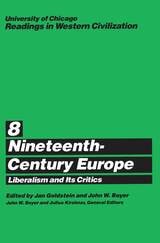
University of Chicago Readings in Western Civilization, Volume 8
Nineteenth-Century Europe: Liberalism and its CriticsEdited by Jan E. Goldstein and John W. Boyer
University of Chicago Press, 1987
Individual volumes provide essential background reading for courses covering specific eras and periods. The complete nine-volume series is ideal for general courses in history and Western civilization sequences.

Visual Cultures of Japanese Imperialism, Volume 8
Gennifer Weisenfeld, ed.
Duke University Press, 0
The articles, contributed by scholars in the fields of art history, cultural history, and Japanese literature, address the interactions between Japan, the West, and the rest of Asia. Costumes, architecture, tourism propaganda, pottery, and a host of other sources provide the raw materials for Visual Cultures of Japanese Imperialism, and the incisive essays built from these sources will change readers’ understanding of the visual culture(s) of imperialism.
Contributors. Kim Brandt, Leo Ching, Carol Ann Christ, Christine Guth, Jordan Sand, Gennifer Weisenfeld, Cherie Wendelken
Winterthur Portfolio, Volume 8
Edited by Ian M. G. Quimby
University of Chicago Press, 1978
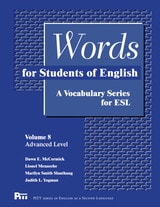
Words for Students of English, Volume 8
A Vocabulary Series for ESLDawn E. McCormick, Lionel Menasche, Marilyn Smith Slaathaug, and Judith L. Yogman
University of Michigan Press, 2004