Results by title
15 books match the query 'Volume IV'

A History of Missouri (V4)
Volume IV, 1875 to 1919Lawrence O. Christensen & Gary R. Kremer
University of Missouri Press, 2004
Drawing on original research in primary sources, this comprehensive study covers such topics as the Constitution of 1875, the impact of railroad expansion, the 1904 World's Fair, the Populist and Progressive movements, and World War I. It also deals with less familiar topics, such as the state's use of convict labor to save taxpayers money, the emergence of women's clubs, the arrival of moving pictures, and the terrible conditions under which coal miners worked and lived.
Research on the weekly newspapers of such towns as Edina, Bethany, Boonville, Mount Vernon, and Kennett provides a comparative regional and rural perspective on events that took place around the turn of the century, giving the reader a unique glimpse of what small-town life was like. The rapid growth of Missouri's cities is also discussed in detail. St. Louis's development as one of the nation's leading cities is fully recorded, as is the rise of smaller towns such as St. Joseph, Joplin, Springfield, and Sedalia. Kansas City's City Beautiful Movement and the rise of the Pendergast Machine are also treated.
Significant attention is given to World War I. The authors document Missourians' reliance on voluntarism to support the war effort, and they also explain how government officials mobilized the citizens of the state to support the war, especially Missourians of German ancestry. The book fully details the experiences of African Americans and women who lived in Missouri during the period.
This extensive and balanced coverage of Missouri as it moved into the twentieth century will be the authoritative volume on the subject for decades to come. Anyone with an interest in Missouri history will treasure this informative new resource.

A History of the Crusades, Volume IV
The Art and Architecture of the Crusader StatesSeries Edited by Kenneth M. Setton, Volume Edited by Harry W. Hazard
University of Wisconsin Press, 1977

African Successes, Volume IV
Sustainable GrowthEdited by Sebastian Edwards, Simon Johnson, and David N. Weil
University of Chicago Press, 2016
The fourth volume in the series, African Successes: Sustainable Growth combines informative case studies with careful empirical analysis to consider the prospects for future African growth.

After the Nobel Prize 1989-1994
The Non-fiction Writing of Naguib Mahfouz, Volume IVNaguib Mahfouz
Gingko, 2015
In carefully crafted short texts, his social conscience is revealed as he highlights political shortcomings, economic injustice, and corruption in Egypt and the wider Arab world. His philosophical sensitivity comes to the fore as he contemplates the meaning of a historic events, contributions of an influential people, and what is required to lead a good life. The collapse of the Soviet Union, the Oslo peace accords, the spread of terrorism, the Cairo earthquake, the passing of Louis Awad, Yusuf Idris, Yahya Hakki, the third term of Hosni Mubarak, climate change, and more come under Naguib Mahfouz’s fine scrutiny. For any fan of Mahfouz’s fiction, this collection opens a window on a different side of his intellect, and it offers insights from one of the region’s greatest modern minds.

Constitutional History of the American Revolution, Volume IV
The Authority of LawJohn Phillip Reid
University of Wisconsin Press, 1993
This is the first comprehensive study of the constitutionality of the Parliamentary legislation cited by the American Continental Congress as a justification for its rebellion against Great Britain in 1776. The content and purpose of that legislation is well known to historians, but here John Phillip Reid places it in the context of eighteenth-century constitutional doctrine and discusses its legality in terms of the intellectual premises of eighteenth-century Anglo-American legal values.
The Authority of Law is the last of a four-volume work, preceded by The Authority to Tax, The Authority of Rights, and The Authority to Legislate. In these previous volumes, Reid argued that there would have been no rebellion had taxation been the only constitutional topic of controversy, that issues of rights actually played a larger role in the drafting of state and federal constitutions than they did in instigating a rebellion, and that the American colonists finally took to the battlefield against the British because of statutes that forced Americans to either concede the authority to legislate or leave the empire.
Expanding on the evidence presented in the first three volumes, The Authority of Law determines the constitutional issues dividing American whigs from British imperialists. Reid summarizes these issues as “the supremacy issue,” “the Glorious Revolution issue,” “the liberty issue,” and the “representation issue.” He then raises a compelling question: why, with so many outstanding lawyers participating in the debate, did no one devise a constitutionally legal way out of the standoff? Reid makes an original suggestion. No constitutional solution was found because the British were more threatened by American legal theory than the Americans were by British theory. British lawyers saw the future of liberty in Great Britain endangered by the American version of constitutional law.
Considered as a whole, Reid’s Constitutional History of the American Revolution contributes to an understanding of the central role of legal and constitutional standards, especially concern for rule by law, in the development of the American nation.

Imago Musicae, Volume IV
Tilman Seebass, ed.
Duke University Press, 1988

Ozark Folksongs
Volume IV, Religious Songs and Other ItemsVance Randolph
University of Missouri Press, 1980
Originally published in 1949, this comprehensive gathering of folksongs is being reissued after many years out of print. The renewed interest in folklore among the general public as well as the scholarly community has prompted this publication.
The collection comprises four volumes including more than eight hundred songs, indexed by title, by first line, and by contributor and town. Each song is thoroughly annotated. In addition to lyrics, the compiler furnished scores and variant lyrics and titles for each song and listed similarities to other songs along with whatever historical information was available to him.
The songs are presented in four volumes. The fourth volume is an assortment of religious songs, hymns, and revival tunes along with sentimental ballads and journalistic pieces.
Characteristic of the compiler's careful work is the painstaking accuracy with which dialect peculiarities are preserved. Randolph scrupulously avoided correcting pronunciation or adding missing words or forgotten lines. Because, as he explains in his introduction, many of the people who sang for him were reluctant to have their voices recorded, his texts represent the best possible reproduction of this priceless American folk art.
A new introduction by W. K. McNeil, folklorist for the Ozark Folklore Center and book review editor for the Journal of American Folklore, comments on Randolph's importance to the field of American folklore and the significance of this work in particular.

Prehistory of the Ayacucho Basin, Peru
Volume IV: The Preceramic Way of LifeRichard S. MacNeish, Angel Garcia Cook, Luis G. Lumbreras, Robert K. Vierra, and Antoinette Nelken-Terner
University of Michigan Press, 1983

Public Debate in the Civil War Era
A Rhetorical History of the United States, Volume IVDavid Zarefsky
Michigan State University Press, 2023

Remarks on Mathematics and Logic
Volume IV, 1941–1943Ludwig Wittgenstein
University of Chicago Press, 0
In 1956, a significant but abridged portion of Ludwig Wittgenstein’s 1937–1944 writings for a continuation of what became Philosophical Investigations was published as Remarks on the Foundations of Mathematics. Now, in the five German-English facing pages volumes of Remarks on Mathematics and Logic, these writings are presented in full as Wittgenstein wrote them: in chronological order, without editorial omissions, selections, or rearrangements.
Volume IV contains materials from 1941 to 1943, including one previously unpublished manuscript and three manuscripts from which selections were made for the previous abridgment. The topics covered in this volume include the philosophy of mathematics, mathematical foundationalism, surveyability in mathematics, language-games and proof-networks, Gödelian undecidability, pictures in mathematics, Cantorian diagonal proofs, applied mathematics without pure mathematics, and mathematics and chess, among others.
This German-English facing pages edition presents Wittgenstein’s writings in their original context—as Wittgenstein wrote them, in chronological order, and without editorial omissions, selections, or rearrangements.

The Collected Works of William Howard Taft, Volume IV
Presidential Messages to CongressDavid H. Burton
Ohio University Press, 2002
“A time when panics seem far removed is the best time to prepare our financial system to withstand a storm. The most crying need this country has is a proper banking and currency system. The existing one is inadequate, and everyone who has studied the question admits it.”—William Howard Taft
The interaction between President William Howard Taft and the Congress provides a window on his leadership. Volume IV of The Collected Works of William Howard Taft is devoted to his messages to the legislative branch and concerns some of the pressing issues of the day, issues that have relevance still.
Oftentimes President Taft was at odds with a somewhat reactionary Congress, causing him to veto legislation that he thought unwise. For example, his commitment to the independence of elected judges led him to reject statehood for Arizona until its constitution was altered to address his objection.
His messages also touched on subjects for which he led the way over the objections of Congress, such as his recommendation of a federal law to protect resident aliens against denial of their civil rights and his advocacy of free trade with Canada.
In his commentary to the volume, Professor Burton points out: “There is exhibited time after time concern for the American people, for men and women from different walks of life. Taft comes across less as a judge, which he had been, or the chief justice he was to become, and more as a sitting president of all the people.”
Taft’s Presidential Messages to Congress provides the documentary evidence to support that claim.
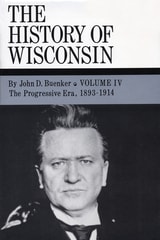
The History of Wisconsin, Volume IV
The Progressive Era, 1893-1914John D. Buenker
Wisconsin Historical Society Press, 1998
Published in Wisconsin's Sesquicentennial year, this fourth volume in The History of Wisconsin series covers the twenty tumultuous years between the World's Columbian Exposition and the First World War when Wisconsin essentially reinvented itself, becoming the nation's "laboratory of democracy."
The period known as the Progressive Era began to emerge in the mid-1890s. A sense of crisis and a widespread clamor for reform arose in reaction to rapid changes in population, technology, work, and society. Wisconsinites responded with action: their advocacy of women's suffrage, labor rights and protections, educational reform, increased social services, and more responsive government led to a veritable flood of reform legislation that established Wisconsin as the most progressive state in the union.
As governor and U.S. Senator from Wisconsin, Robert M. La Follette, Sr., was the most celebrated of the Progressives, but he was surrounded by a host of pragmatic idealists from politics, government, and the state university. Although the Progressives frequently disagreed over priorities and tactics, their values and core beliefs coalesced around broad-based participatory democracy, the application of scientific expertise to governance, and an active concern for the welfare of all members of society-what came to be known as "the Wisconsin Idea."
The The Complete Works of Robert Browning, Volume IV
Browning, Robert
Ohio University Press, 1973
Tolkien Studies
An Annual Scholarly Review, Volume IVMichael D.C. Drout
West Virginia University Press, 2007

WORKS OF APHRA BEHN
VOLUME IV, SENECA UNMASQUEDAphra Behn
The Ohio State University Press, 1994