Results by title
6 books match the query 'Volume Three'

Engaging the Intersection of Housing and Health
Volume ThreeEdited by Mina Silberberg
University of Minnesota Press, 2021
Researchers often hope that their work will inform social change. The questions that motivate them to pursue research careers in the first place often stem from observations about gaps between the world as we wish it to be and the world as it is, accompanied by a deep curiosity about how it might be made different. Researchers view their profession as providing important information about what is, what could be, and how to get there. However, if research is to inform social change, we must first change the way in which research is done.
Engaging the Intersection of Housing and Health offers case studies of research that is interdisciplinary, stakeholder-engaged and intentionally designed for “translation” into practice. There are numerous ways in which housing and health are intertwined. This intertwining—which is the focus of this volume—is lived daily by the children whose asthma is exacerbated by mold in their homes, the adults whose mental illness increases their risk for homelessness and whose homelessness worsens their mental and physical health, the seniors whose home environment enhances their risk of falls, and the families who must choose between paying for housing and paying for healthcare.

Mardi and a Voyage Thither
Volume ThreeHerman Melville
Northwestern University Press, 1998
This scholarly edition aims to present a text as close to the author's intention as surviving evidence permits. Based on collations of all editions publishing during Melville's lifetime, it incorporates author corrections and many emendations made by the present editors. This edition of Mardi is an Approved Text of the Center for Editions of American Authors (Modern Language Association of America).

Mardi and a Voyage Thither
Volume Three, Scholarly EditionHerman Melville
Northwestern University Press, 1970
This scholarly edition aims to present a text as close to the author's intention as surviving evidence permits. Based on collations of all editions publishing during Melville's lifetime, it incorporates author corrections and many emendations made by the present editors. This edition of Mardi is an Approved Text of the Center for Editions of American Authors (Modern Language Association of America).

Open Access Musicology
Volume ThreeEdited by Daniel Barolsky and Trudi Wright
Lever Press, 2025
These essays are intended for undergraduates, graduate students, and interested readers without any particular expertise. The topics introduce and explore a variety of subjects, practices, and methods but, above all, seek to stimulate classroom discussion on music history’s relevance to performers, listeners, and citizens. Open Access Musicology will never pretend to present complete histories, cover all elements of a subject, or satisfy the agenda of every reader. Rather, each essay provides an opening to further contemplation and study.
The third volume of Open Access Musicology presents provocative case studies and analyses through which readers can choose their own path while also putting these essays in conversations from those in previous volumes of OAM. This new volume challenges us to ask difficult questions about the place and function of music in our societies, on our stages, and in our institutions. The authors demonstrate ways in which the past can be re-imagined as well as the ways legacies of the past are inscribed in present-day practices, structures, histories, and beliefs. We invite readers to follow the thematic links between essays, pursue notes and other online resources, or simply repurpose the essay’s questions into new and exciting forms of research and creativity.
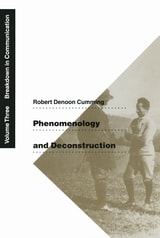
Phenomenology and Deconstruction, Volume Three
Breakdown in CommunicationRobert Denoon Cumming
University of Chicago Press, 2001
history of philosophy demonstrates how frequently one philosopher
misunderstands another. The most notorious such breakdown in
communication in twentieth-century philosophy was between Husserl and
Heidegger. In the third volume of his history of the phenomenological
movement, Robert Denoon Cumming argues that their differences involve
differences in method; whereas Husserl follows a "method of
clarification," with which he eliminates ambiguities by relying on an
intentional analysis that isolates its objects, Heidegger rejects the
criterion of "clarity" and embraces ambiguities as exhibiting
overlapping relations.
Cumming also explores the differences between how
deconstruction—Heidegger's procedure for dealing with other
philosophers—is carried out when Heidegger interprets Husserl versus
when Derrida interprets Husserl. The comparison enables Cumming to
show how deconstruction is associated with Heidegger's arrival at the
end of philosophy, paving the way for the deconstructionist movement.
Scarlet and Black, Volume Three
Making Black Lives Matter at Rutgers, 1945-2020Miya Carey
Rutgers University Press, 2021