Results by title
7 books match the query 'Volume VI'
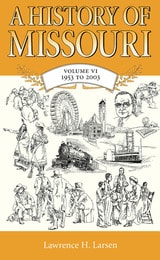
A History of Missouri (V6)
Volume VI, 1953 to 2003Lawrence H. Larsen
University of Missouri Press, 2004
A History of the Crusades, Volume VI
The Impact of the Crusades on EuropeSeries Edited by Kenneth M. Setton, Volume Edited by Hazard and Zacour
University of Wisconsin Press, 1990

The Collected Works of William Howard Taft, Volume VI
The President and His Powers and The United States and PeaceDavid H. Burton
Ohio University Press, 2003
Volume VI of The Collected Works of William Howard Taft follows the career of William Howard Taft upon his leaving the White House. It consists of two short publications from 1914 and 1915.
The first, The President and His Powers, is based on a series of lectures delivered at Columbia University and draws on Taft’s experience in the presidency and the executive branch. It speaks particularly to the nature of executive power and its place in the American system and is rooted in his disagreement with Theodore Roosevelt regarding presidential power. Taft believed all presidential power must be traced to some specific grant of power or be necessary to its exercise, while Roosevelt saw the presidency as a position of “steward of the people” limited only by some express provision of the Constitution.
The second, The United States and Peace, reflects Taft’s interest in foreign policy, which was intensified by his years as governor of the Philippines and as secretary of war, as well as by his presidency. Originally four lectures delivered in 1914, The United States and Peace discusses the Monroe Doctrine, the threat to peace presented by incidents of violence to foreigners in the United States, the maintenance of peace through international arbitration, and the trend toward federation in international affairs. Taft hoped to see the latter result in the establishment of an independent judiciary to resolve international disputes.
Taft’s reasoned arguments, supplemented by the commentaries of Professors McWilliams and Gerrity, will stimulate interest among historians, lawmakers, political activists, and the general public.
The Complete Works of Robert Browning, Volume VI
With Variant Readings and AnnotationsRobert Browning
Ohio University Press, 1996
In seventeen volumes, copublished with Baylor University, this acclaimed series features annotated texts of all of Robert Browning’s known writing. The series encompasses autobiography as well as influences bearing on Browning’s life and career and aspects of Victorian thought and culture.
The sixth in the projected seventeen-volume work, this volume covers the second half of Men and Women (1855), perhaps Browning’s most famous collection, and the entirety of Dramatis Personae (1864), the first book Browning produced after the death of Elizabeth Barrett Browning in 1861.
Men and Women II contains several great dramatic poems on which Browning’s reputation still depends, including “Andrea del Sarto,” “Saul,” and “Cleon.” It also includes the more intimate and personal works “The Guardian Angel” and “One Word More,” as well as the mysterious “Women and Roses.” The Brownings‘ shared interests in Renaissance art and nineteenth-century Italian politics inform the challenging “Old Pictures in Florence.”
The publication of Dramatis Personae was a key event in the rapid rise of Browning’s fame in the 1860s, though the collection is marked by a welter of conflicting impulses that arose after the poet left Italy and his married life behind. The classic monologues “Rabbi Ben Ezra” and “Abt Vogler” are here, but beside them Browning placed the nearly surreal “Caliban upon Setebos” and the achingly self-regarding “James Lee’s Wife,” one of the volume’s handful of dramatic lyrics about betrayed or failed relationships. Also included are “A Death in the Desert,” which contributed to the intense Victorian debate about scriptural validity and religious authority; and “Mr Sludge, ’The Medium,‘” Browning’s ferocious, pyrotechnic exposé of a spiritualist fraud.
As always in this acclaimed series, a complete record of textual variants is provided, as well as extensive explanatory notes.
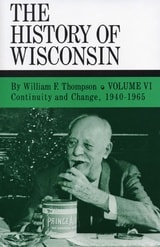
The History of Wisconsin, Volume VI
Continuity and Change, 1940-1965William F. Thompson
Wisconsin Historical Society Press, 1988
The sixth and final volume in the History of Wisconsin series examines the period from 1940-1965, in which state and nation struggled to maintain balance and traditions. Some of the major developments analyzed in this volume include: coping with three wars, racial and societal conflict, technological innovation, population shifts to and from cities and suburbs, and accompanying stress in politics, government, and society as a whole. Using dozens of photographs to visually illustrate this period in the state's history, this volume upholds the high standards set forth in the previous volumes.
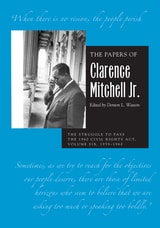
The Papers of Clarence Mitchell Jr., Volume VI
The Struggle to Pass the 1960 Civil Rights Act, 1959–1960Clarence Mitchell Jr.
Ohio University Press, 2021
The Civil Rights Act of 1960 aimed to close loopholes in its 1957 predecessor that had allowed continued voter disenfranchisement for African Americans and for Mexicans in Texas.
In early 1959, the newly seated Eighty-Sixth Congress had four major civil rights bills under consideration. Eventually consolidated into the 1960 Civil Rights Act, their purpose was to correct the weaknesses in the 1957 law. Mitchell’s papers from 1959 to 1960 show the extent to which congressional resistance to the passage of meaningful civil rights laws contributed to the lunch counter sit-ins in Greensboro, North Carolina, and to subsequent demonstrations. The papers reveal how the repercussions of these events affected the NAACP’s work in Washington and how, despite their dislike of demonstrations, NAACP officials used them to intensify the civil rights struggle.
Among the act’s seven titles were provisions authorizing federal inspection of local voter registration rolls and penalties for anyone attempting to interfere with voters on the basis of race or color. The law extended the powers of the US Commission on Civil Rights and broadened the legal definition of the verb to vote to encompass all elements of the process: registering, casting a ballot, and properly counting that ballot. Ultimately, Mitchell considered the 1960 act unsuccessful because Congress had failed to include key amendments that would have further strengthened the 1957 act. In the House, representatives used parliamentary tactics to stall employment protections, school desegregation, poll-tax elimination, and other meaningful civil rights reforms. The fight would continue.
The Papers of Clarence Mitchell Jr. series is a detailed record of the NAACP leader’s success in bringing the legislative branch together with the judicial and executive branches to provide civil rights protections during the twentieth century.
Tolkien Studies
An Annual Scholarly Review, Volume VIMichael D.C. Drout
West Virginia University Press, 2009