Results by title
4 books match the query 'Wacker, Grant'
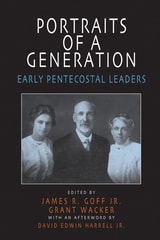
Portraits of a Generation
Early Pentecostal LeadersJames Goff
University of Arkansas Press, 2002
A spirit of religious revival blazed across the United States just after 1900. With a focus on Holy Spirit power, early adherents stirred an enthusiastic response, first at a Bible school in Topeka and then in a small mission on Asuza Street in Los Angeles. Almost immediately, the movement spread to Houston, Chicago, and then northeastern urban centers. By the early 1910s the fervor had reached most parts of the United States, Canada, and northern Mexico, and eventually the converts called themselves pentecostals. Today there are pentecostals all over the world. From the beginning the movement was unusually diverse: women and African Americans were active in many of the early fellowships, and although some groups were segregated, some were interracial. Everytwhere, ordinary people passionately devoted themselves to salvation, Holy Ghost baptism evidenced by speaking in tongues, divine healing, and anticipation of the Lord’s imminent return.
This movement saw itself as leaderless, depending on individual conversion and a radical equality of souls — or, as early devotees would say, on the Holy Spirit. But a closer look reveals a host of forceful, clear-eyed leaders. This volume offers twenty biographical portraits of the first-generation pioneers who wove the different strands of Holy Spirit revivalism into a coherent and dramatically successful movement.
Recovering the Margins of American Religious History
The Legacy of David Edwin Harrell Jr.B. Dwain Waldrep
University of Alabama Press, 2012

THE AMERICAN QUEST FOR THE PRIMITIVE CHURCH
Richard T. Hughes
University of Illinois Press, 1988
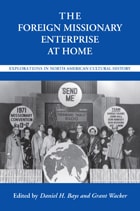
The Foreign Missionary Enterprise at Home
Explorations in North American Cultural HistoryEdited by Daniel H. Bays and Grant Wacker
University of Alabama Press, 2010
This volume is the first to examine at length and in detail the impact of the missionary experience on American cultural, political, and religious history.
This collection of 15 essays provides a fully developed account of the domestic significance of foreign missions from the 19th century through the Vietnam War. U.S. and Canadian missions to China, South America, Africa, and the Middle East have, it shows, transformed the identity and purposes of their mother countries in important ways. Missions provided many Americans with their first significant exposure to non-Western cultures and religions. They helped to establish a variety of new academic disciplines in home universities—linguistics, anthropology, and comparative religion among them. Missionary women helped redefine gender roles in North America, and missions have vitalized tiny local churches as well as entire denominations, causing them to rethink their roles and priorities, both here and abroad. In fact, missionaries have helped define our own national identity by influencing our foreign, trade, military, and immigration policies over the last two centuries.
Topics in the collection range from John Saillant's essay on the missions of free African Americans to Liberia in the 19th century to Grant Wacker's essay on the eventual disillusionment of noted writer Pearl S. Buck. Kathryn T. Long’s essay on the “Auca martyrs” offers a sobering case study of the missionary establishment's power to, in tandem with the evangelical and secular press, create and record the stories of our time. William L. Svelmoe documents the improbable friendship between fundamentalist Bible translator William Cameron Townsend and Mexico’s secular socialist president Lázaro Cárdenas. And Anne Blue Wills details the ways many American groups—black, Protestant, Catholic, and Mormon—sought to convert one another, stead-
fastly envisioning “others” as every bit as “heathen” as those in far-off lands.
The Foreign Missionary Enterprise at Home is an insightful, provocative collection that will stimulate much discussion and debate. It is valuable for academic libraries and seminaries, scholars of religious history and American studies, missionary groups, cultural historians and ethnographers, and political scientists.