Results by title
4 books match the query 'Waldrep, G.C.'
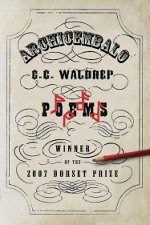
ARCHICEMBALO
G.C. Waldrep
Tupelo Press, 2009
Poetry. G.C. Waldrep, always a startlingly original, appealing poetic voice, uses music theory and history to explore the interweaving of language and music. In fiercely intelligent, passionate verse, the poet seeks the delicate point between the voice of a singer (music) and that of a poet (language). An archicembalo (pronounced ark-e-Chem-ball-o) was a complex sixteenth-century instrument, a successor to the harpsichord. The book is structured after a gamut, a nineteenth-century musical primer. Originally a single note on the scale, a gamut later came to mean a whole range-as in a singer or actor's ability to "cover the whole gamut."
[more]

The Earliest Witnesses
G.C. Waldrep
Tupelo Press, 2020
In the poems of The Earliest Witnesses, witnesses need a place to begin-they spiral off from a walk, a church, an orchard, to go into deeper meditation about faith, earth, restraint, desire, and violence. Waldrep’s seventh collection begins where his prior collection, feast gently, left off: “This / is how the witness ends: touch, withdraw; touch again,” according to the opening poem. The status of witnesses is never constant and never settled in this book: sometimes, witnesses “foster,” “touch,” and “stain” the places they inhabit; other times, they befriend, or document, or think. Sometimes, witnesses forget themselves-in questions of blame and responsibility-and sometimes they feel forgotten and unknown. If these are poems of witness, then they are also testators to the craft of seeing: “Can you see this,” the ophthalmologist in “A Mystic’s Guide to Arches” asks over and over again. Here, sight facilitates and impedes desire; it colludes with language itself. “She said, When you say pear, I see p-e-a-r for a second before I see, in my mind’s eye, a pear,” Waldrep carefully records in “[West Stow Orchard Poem (II)].” The desire-poems in The Earliest Witnesses want the thing itself, its image of the mind, and the language that transmutes both thing and image into song.
[more]
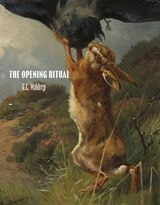
The Opening Ritual
G.C. Waldrep
Tupelo Press, 2024
The conclusion of G. C. Waldrep’s trilogy exploring chronic illness.
In The Opening Ritual, G. C. Waldrep contends with the failure of the body, the irreducible body, in the light of faith. What can or should “healing” mean when it can’t ever mean “wholeness” again? And what kind of architecture is “mercy” when we live inside damage? These are poems that take both the material and the spiritual seriously, that cast their unsparing glances toward “All that is not / & could never be a parable.”
The collection concludes with a sequence of truly grand meditations on spiritual consciousness—in one the poet notes how, in the stillness of contemplation, the world begins to hum and resound with music. The Opening Ritual attends to and fashions its song from that music.
[more]
feast gently
G.C. Waldrep
Tupelo Press, 2018
In his most autobiographically transparent (and most comical) collection to date, Waldrep explores the intersections between body and spirit, faith and action. These are lyrics of incarnation, of method and meat-hood, of illness and the vicissitudes of love, earthly as well as heavenly, occupying the space between desire and gratification, between pain and praise.
[more]