Results by title
3 books match the query 'Walker, Andrew'

An Extraordinary Scandal
The Westminster Expenses Crisis and Why It Still MattersEmma Crewe and Andrew Walker
Haus Publishing, 2019
Featuring interviews with the members of parliament, journalists, and officials close to the center of the turmoil, An Extraordinary Scandal tells the story of what really happened. Andrew Walker, the tax expert who oversaw the parliamentary expenses system, and Emma Crewe, a social scientist specializing in the institutions of parliament, bring fascinating perspectives—from both inside and outside parliament—to this account. Far from attempting provide a defense of any the parties involved, An Extraordinary Scandal explains how the parliament fell out of step with the electorate and became a victim of its own remote institutional logic, growing to become at odds with an increasingly open, meritocratic society.
Charting the crisis from its 1990s origins—when Westminster began, too slowly, to respond to wider societal changes—to its aftermath in 2010, the authors examine how the scandal aggravated the developing crisis of trust between the British electorate and Westminster politicians that continues to this day. Their in-depth research reveals new insight into how the expenses scandal acted as a glimpse of what was to come, and they reveal where the scandal’s legacy can be traced in the new age of mistrust and outrage, in which politicians are often unfairly vulnerable to being charged in the court of public opinion by those they represent.
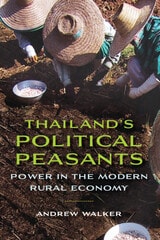
Thailand’s Political Peasants
Power in the Modern Rural EconomyAndrew Walker
University of Wisconsin Press, 2012
When a populist movement elected Thaksin Shinawatra as prime minister of Thailand in 2001, many of the country’s urban elite dismissed the outcome as just another symptom of rural corruption, a traditional patronage system dominated by local strongmen pressuring their neighbors through political bullying and vote-buying. In Thailand’s Political Peasants, however, Andrew Walker argues that the emergence of an entirely new socioeconomic dynamic has dramatically changed the relations of Thai peasants with the state, making them a political force to be reckoned with. Whereas their ancestors focused on subsistence, this generation of middle-income peasants seeks productive relationships with sources of state power, produces cash crops, and derives additional income through non-agricultural work. In the increasingly decentralized, disaggregated country, rural villagers and farmers have themselves become entrepreneurs and agents of the state at the local level, while the state has changed from an extractor of taxes to a supplier of subsidies and a patron of development projects.
Thailand’s Political Peasants provides an original, provocative analysis that encourages an ethnographic rethinking of rural politics in rapidly developing countries. Drawing on six years of fieldwork in Ban Tiam, a rural village in northern Thailand, Walker shows how analyses of peasant politics that focus primarily on rebellion, resistance, and evasion are becoming less useful for understanding emergent forms of political society.

The Shan Rebellion
Siam’s Colonial Struggle to Secure LannaAndrew Walker
National University of Singapore Press, 2026
A gripping account of how the Shan rebellion influenced the colonial struggle between Siam, Britain, and France to expand their power in northern Thailand.
Moving beyond the familiar story of Siam fending off European colonialism, TheShan Rebellion reveals a new historical subject: Siam as colonizer. As European powers expanded their presence in Southeast Asia at the end of the nineteenth century, Siam launched its own colonial project to assert control over tributary states that lay outside the Siamese heartland. Most important was Lanna (now northern Thailand), a region where Siamese, British, and French colonial ambitions intersected. The outbreak of the Shan Rebellion in 1902 began with the violent dismantling of the Siamese colonial administration in Phrae, one of Lanna’s principal towns. As the rebels began moving towards other centers, they tested the limits of Siamese power in Lanna. With the British having valuable commercial interests to protect and the French itching for an opportunity to expand their reach, Siam’s colonial project faced a dangerous moment. Drawing on rich archival sources from Thailand, Burma, India, France, and England, this outstanding study provides the first detailed account of the rebellion and its impact on competitive colonialism in mainland Southeast Asia.