Results by title

4 books match the query 'Walker, Charles F.'
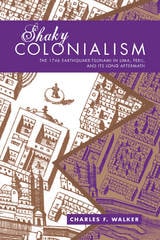
cover of Shaky Colonialism: The 1746 Earthquake-Tsunami in Lima, Peru, and Its Long Aftermath

Shaky Colonialism

The 1746 Earthquake-Tsunami in Lima, Peru, and Its Long Aftermath

Charles F. Walker

Duke University Press, 2008

Contemporary natural disasters such as Hurricane Katrina are quickly followed by disagreements about whether and how communities should be rebuilt, whether political leaders represent the community’s best interests, and whether the devastation could have been prevented. Shaky Colonialism demonstrates that many of the same issues animated the aftermath of disasters more than 250 years ago. On October 28, 1746, a massive earthquake ravaged Lima, a bustling city of 50,000, capital of the Peruvian Viceroyalty, and the heart of Spain’s territories in South America. Half an hour later, a tsunami destroyed the nearby port of Callao. The earthquake-tsunami demolished churches and major buildings, damaged food and water supplies, and suspended normal social codes, throwing people of different social classes together and prompting widespread chaos. In Shaky Colonialism, Charles F. Walker examines reactions to the catastrophe, the Viceroy’s plans to rebuild the city, and the opposition he encountered from the Church, the Spanish Crown, and Lima’s multiracial population.

Through his ambitious rebuilding plan, the Viceroy sought to assert the power of the colonial state over the Church, the upper classes, and other groups. Agreeing with most inhabitants of the fervently Catholic city that the earthquake-tsunami was a manifestation of God’s wrath for Lima’s decadent ways, he hoped to reign in the city’s baroque excesses and to tame the city’s notoriously independent women. To his great surprise, almost everyone objected to his plan, sparking widespread debate about political power and urbanism. Illuminating the shaky foundations of Spanish control in Lima, Walker describes the latent conflicts—about class, race, gender, religion, and the very definition of an ordered society—brought to the fore by the earthquake-tsunami of 1746.
[more]
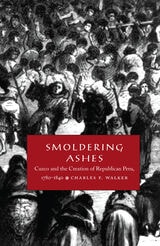
cover of Smoldering Ashes: Cuzco and the Creation of Republican Peru, 1780-1840

Smoldering Ashes

Cuzco and the Creation of Republican Peru, 1780-1840

Charles F. Walker

Duke University Press, 1999

In Smoldering Ashes Charles F. Walker interprets the end of Spanish domination in Peru and that country’s shaky transition to an autonomous republican state. Placing the indigenous population at the center of his analysis, Walker shows how the Indian peasants played a crucial and previously unacknowledged role in the battle against colonialism and in the political clashes of the early republican period. With its focus on Cuzco, the former capital of the Inca Empire, Smoldering Ashes highlights the promises and frustrations of a critical period whose long shadow remains cast on modern Peru.
Peru’s Indian majority and non-Indian elite were both opposed to Spanish rule, and both groups participated in uprisings during the late colonial period. But, at the same time, seething tensions between the two groups were evident, and non-Indians feared a mass uprising. As Walker shows, this internal conflict shaped the many struggles to come, including the Tupac Amaru uprising and other Indian-based rebellions, the long War of Independence, the caudillo civil wars, and the Peru-Bolivian Confederation. Smoldering Ashes not only reinterprets these conflicts but also examines the debates that took place—in the courts, in the press, in taverns, and even during public festivities—over the place of Indians in the republic. In clear and elegant prose, Walker explores why the fate of the indigenous population, despite its participation in decades of anticolonial battles, was little improved by republican rule, as Indians were denied citizenship in the new nation—an unhappy legacy with which Peru still grapples.
Informed by the notion of political culture and grounded in Walker’s archival research and knowledge of Peruvian and Latin American history, Smoldering Ashes will be essential reading for experts in Andean history, as well as scholars and students in the fields of nationalism, peasant and Native American studies, colonialism and postcolonialism, and state formation.

[more]
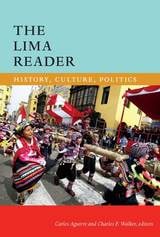
cover of The Lima Reader: History, Culture, Politics

The Lima Reader

History, Culture, Politics

Carlos Aguirre and Charles F. Walker, editors

Duke University Press, 2017
Covering more than 500 years of history, culture, and politics, The Lima Reader seeks to capture the many worlds and many peoples of Peru’s capital city, featuring a selection of primary sources that consider the social tensions and cultural heritages of the “City of Kings.”
[more]
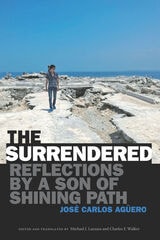
cover of The Surrendered: Reflections by a Son of Shining Path

The Surrendered

Reflections by a Son of Shining Path

José Carlos Agüero. Edited and Translated by Michael J. Lazzara and Charles F. Walker

Duke University Press, 2021

When Peruvian public intellectual José Carlos Agüero was a child, the government imprisoned and executed his parents, who were members of Shining Path. In The Surrendered—originally published in Spanish in 2015 and appearing here in English for the first time—Agüero reflects on his parents' militancy and the violence and aftermath of Peru's internal armed conflict. He examines his parents' radicalization, their lives as guerrillas, and his tumultuous childhood, which was spent in fear of being captured or killed, while grappling with the complexities of public memory, ethics and responsibility, human rights, and reconciliation. Much more than a memoir, The Surrendered is a disarming and moving consideration of what forgiveness and justice might mean in the face of hate. This edition includes an editors' introduction, a timeline of the Peruvian conflict, and an extensive interview with the author.
[more]