Results by title
3 books match the query 'Walker, William H.'
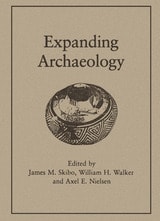
Expanding Archaeology
Axel E. Nielsen
University of Utah Press, 1995
Expanding Archaeology is the first attempt to define behavioral archaeology comprehensively and to establish its place among competing theoretical frameworks. Among other objectives, this volume demonstrates that a behavioral approach—the study of material objects regardless of time or space to describe and explain human behavior—provides a means whereby religion, gender, and other seemingly unknowable elements of prehistory can be inferred through systematic, empirical analysis.
Expanding Archaeology begins with three retrospective analyses by J. Jefferson Reid, William Rathje, and Michael Schiffer, followed by seven case studies exploring various avenues offered by this approach. A third section contains five critiques that serve as a counterpoint to the behavioral approach. Although the editors do not suggest that behavioral archaeology should be the universal archaeology, they do suggest that this approach permits pre-historians to expand into new areas of investigation.

Explorations in Behavioral Archaeology
William H. Walker and James M. Skibo
University of Utah Press, 2015
Behavioral archaeology, defined as the study of people-object interactions in all times and places, emerged in the 1970s, in large part because of the innovative work of Michael Schiffer and colleagues. This volume provides an overview of how behavioral archaeology has evolved and how it has affected the field of archaeology at large.
The contributors to this volume are Schiffer’s former students, from his first doctoral student to his most recent. This generational span has allowed for chapters that reflect Schiffer’s research from the 1970s to 2012. They are iconoclastic and creative and approach behavioral archaeology from varied perspectives, including archaeological inference and chronology, site formation processes, prehistoric cultures and migration, modern material culture variability, the study of technology, object agency, and art and cultural resources. Broader questions addressed include models of inference and definitions of behavior, study of technology and the causal performances of artifacts, and the implications of artifact causality in human communication and the flow of behavioral history.
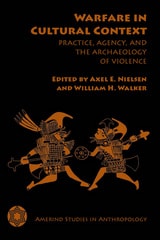
Warfare in Cultural Context
Practice, Agency, and the Archaeology of ViolenceEdited by Axel E. Nielsen and William H. Walker
University of Arizona Press, 2009
However, contributors argue, this model-and-evidence approach has given rise to multiple competing hypotheses and ambiguity rather than to full, coherent explanations of what turns out to be surprisingly complex acts of war. The chapters in Warfare in Cultural Context contend that agency and culture, inherited values and dispositions (such as religion and other cultural practices), beliefs, and institutions are always woven into the conduct of war.
This revealing book focuses on the ways that specific people construed their interests and life projects, and their problems and possibilities, and consequently chose among alternative courses of action. Using archaeological and ethnohistorical data from various parts of the world, the contributors explore the multiple avenues for the cultural study of warfare that these ideas make possible. Contributions focus on cultural aspects of warfare in Mesoamerica, South America, North America, and Southeast Asia. Case studies include warfare among the Maya, Inca, southwestern Pueblos, Mississippian cultures, and the Enga of Papua New Guinea.