Results by title
2 books match the query 'Wallace, David'
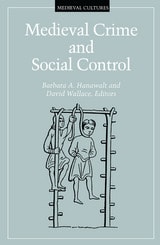
Medieval Crime and Social Control
Barbara A. Hanawalt
University of Minnesota Press, 1998
Uses historical and literary insights to consider crime and punishment in the Middle Ages.
Crime is a matter of interpretation, and never was this truer than in the Middle Ages, when societies faced with new ideas and pressures were continually forced to rethink what a crime was-and what was a crime. This collection undertakes a thorough exploration of shifting definitions of crime and changing attitudes toward social control in medieval Europe.
These essays-by leading specialists in European history and literature-reveal how various forces in medieval society interacted and competed in interpreting and influencing mechanisms for social control. They also demonstrate how well the different methods of history and literature combine to illuminate these developments.The essays show how the play with boundaries between legitimate and illegitimate actions took place not only in laws and courts, but also in the writing of social commentators such as John Fortescue and Jean Gerson, in the works of authors such as William Langland and Geoffrey Chaucer, and in popular literature such as sagas and romances. Drawing on a wide range of historical and literary sources-legal treatises, court cases, statutes, poems, romances, and comic tales-the contributors consider topics including fear of crime, rape and violence against women, revenge and condemnations of crime, learned dispute about crime and social control, and legal and political struggles over hunting rights. Their work shows how medieval society also defined its boundaries in contested spaces such as taverns and forests and in the different rules applying to the behavior and treatment of men and women.Contributors: Christopher Cannon, Oxford U; Elizabeth Fowler, Yale U; Louise O. Fradenburg, U of California, Santa Barbara; Claude Gauvard, Sorbonne; James H. Landman, U of North Texas; William Perry Marvin, Colorado State U; William Ian Miller, U of Michigan; Louise Mirrer, CUNY; Walter Prevenier, U of Ghent.ISBN 0-8166-3168-9 Cloth $49.95xxISBN 0-8166-3169-7 Paper $19.95x268 pages 5 7/8 x 9 JanuaryMedieval Cultures Series, volume 16Translation inquiries: University of Minnesota Press
Mutuality in the Rhetoric and Composition Classroom
David L. Wallace and Helen Rothschild Ewald
Southern Illinois University Press, 2000
In Mutuality in the Rhetoric and Composition Classroom, David L. Wallace and Helen Rothschild Ewald point out the centrality of rhetoric in the academy, asserting the intimate connection between language and knowledge making. They also stress the need for a change in the roles of teachers and students in today’s classroom. Their goal is mutuality, a sharing of authority among teachers and students in the classroom that would allow everyone an equal voice in the communication of ideas.
Arguing that the impetus to empower students by engaging them in liberatory and emancipatory pedagogies is simply not enough, Wallace and Ewald seek to “help readers identify, theorize, and work through problems faced by teachers who already value alternative approaches but who are struggling to implement them in the classroom." It is not the teacher’s job merely to convey a received body of knowledge, nor is knowledge a prepackaged commodity to be delivered by the teacher. It is “constituted in the classroom through the dialogic interaction between teachers and students alike.”
Wallace and Ewald see mutuality as potentially transformative, but they “do not believe that the nature or that transformation can be designated in advance.” Rather it is located in the interaction between teachers and students. Wallace and Ewald look at how the transformative notion of mutuality can be effected in classrooms in three important ways: reconstituting classroom speech genres, redesigning the architecture of rhetoric and writing courses, and valuing students’ interpretive agency in classroom discourse. Mutuality in alternative pedagogy, they assert, is neither a single approach nor a specific set of valued practices; it is a continuous collaboration between teachers and students.