Results by title

3 books match the query 'Walt Disney'
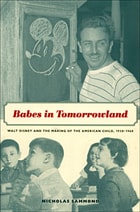
cover of Babes in Tomorrowland: Walt Disney and the Making of the American Child, 1930–1960

Babes in Tomorrowland

Walt Disney and the Making of the American Child, 1930–1960

Nicholas Sammond

Duke University Press, 2005

Linking Margaret Mead to the Mickey Mouse Club and behaviorism to Bambi, Nicholas Sammond traces a path back to the early-twentieth-century sources of “the normal American child.” He locates the origins of this hypothetical child in the interplay between developmental science and popular media. In the process, he shows that the relationship between the media and the child has long been much more symbiotic than arguments that the child is irrevocably shaped by the media it consumes would lead one to believe. Focusing on the products of the Walt Disney company, Sammond demonstrates that without a vision of a normal American child and the belief that movies and television either helped or hindered its development, Disney might never have found its market niche as the paragon of family entertainment. At the same time, without media producers such as Disney, representations of the ideal child would not have circulated as freely in American popular culture.

In vivid detail, Sammond describes how the latest thinking about human development was translated into the practice of child-rearing and how magazines and parenting manuals characterized the child as the crucible of an ideal American culture. He chronicles how Walt Disney Productions’ greatest creation—the image of Walt Disney himself—was made to embody evolving ideas of what was best for the child and for society. Bringing popular child-rearing manuals, periodicals, advertisements, and mainstream sociological texts together with the films, tv programs, ancillary products, and public relations materials of Walt Disney Productions, Babes in Tomorrowland reveals a child that was as much the necessary precursor of popular media as the victim of its excesses.
[more]
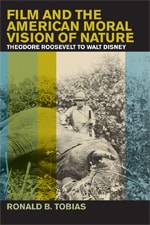
cover of Film and the American Moral Vision of Nature: Theodore Roosevelt to Walt Disney

Film and the American Moral Vision of Nature

Theodore Roosevelt to Walt Disney

Ronald B. Tobias

Michigan State University Press, 2011
With his square, bulldoggish stature, signature rimless glasses, and inimitable smile—part grimace, part snarl—Theodore Roosevelt was an unforgettable figure, imprinted on the American memory through photographs, the chiseled face of Mount Rushmore, and, especially, film. At once a hunter, explorer, naturalist, woodsman, and rancher, Roosevelt was the quintessential frontiersman, a man who believed that only nature could truly test and prove the worth of man. A documentary he made about his 1909 African safari embodied aggressive ideas of masculinity, power, racial superiority, and the connection between nature and manifest destiny. These ideas have since been reinforced by others—Jesse “Buff alo” Jones, Paul Rainey, Martin and Osa Johnson, and Walt Disney. Using Roosevelt as a starting point, filmmaker and scholar Ronald Tobias traces the evolution of American attitudes toward nature, attitudes that remain, to this day, remarkably conflicted, complex, and instilled with dreams of empire.
[more]
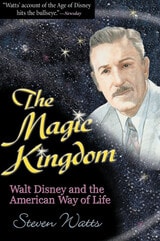
cover of The Magic Kingdom: Walt Disney and the American Way of Life

The Magic Kingdom

Walt Disney and the American Way of Life

Steven Watts

University of Missouri Press, 2001

The Magic Kingdom sheds new light on the cultural icon of "Uncle Walt."  Watts digs deeply into Disney's private life, investigating his roles as husband, father, and brother and providing fresh insight into his peculiar psyche-his genuine folksiness and warmth, his domineering treatment of colleagues and friends, his deepest prejudices and passions.  Full of colorful sketches of daily life at the Disney Studio and tales about the creation of Disneyland and Disney World, The Magic Kingdom offers a definitive view of one of the most influential Americans of the twentieth century.

[more]