Results by title
7 books match the query 'War in mass media'

Embracing Arms
Cultural Representation of Slavic and Balkan Women in WarYana Hashamova
Central European University Press, 2012
Discursive practices during war polarize and politicize gender: they normally require men to fulfill a single, overriding task—destroy the enemy—but impose a series of often contradictory expectations on women. The essays in the book establish links between political ideology, history, psychology, cultural studies, cinema, literature, and gender studies and addresses questions such as— what is the role of women in war or military conflicts beyond the well-studied victimization? Can the often contradictory expectations of women and their traditional roles be (re)thought and (re)constructed? How do cultural representations of women during war times reveal conflicting desires and poke holes in the ideological apparatus of the state and society?
[more]
Getting to War
Predicting International Conflict with Mass Media IndicatorsW. Ben Hunt
University of Michigan Press, 1997
This book shows how to predict wars. More specifically, it tells us how to anticipate in a timely fashion the scope and extent of interstate conflict. By focusing on how all governments--democratic or not--seek to secure public support before undertaking risky moves such as starting a war, Getting to War provides a methodology for identifying a regime's intention to launch a conflict well in advance of the actual initiation.
The goal here is the identification of leading indicators of war. Getting to War develops such a leading political indicator by a systematic examination of the ways in which governments influence domestic and international information flows. Regardless of the relative openness of the media system in question, we can accurately gauge the underlying intentions of those governments by a systematic analysis of opinion-leading articles in the mass media. This analysis allows us to predict both the likelihood of conflict and what form of conflict--military or diplomatic/economic--will occur.
Theoretically, this book builds on a forty-year-old insight by Karl Deutsch--that all governments seek to mobilize public opinion through mass media and that careful analysis of such domestic media activity could provide an "early warning network" of international conflict. By showing how to tap the link between conflict initiation and public support, this book provides both a useful tool for understanding crisis behavior as well as new theoretical insights on how domestic politics help drive foreign policy.
Getting to War will be of interest to political scientists who study international disputes and national security as well as social scientists interested in media studies and political communication. General readers with an interest in military or diplomatic history--particularly U.S. history--will find that Getting to War provides an entirely new perspective on how to understand wars and international crises.
W. Ben Hunt is Assistant Professor of Politics, New York University
[more]
In/visible War
The Culture of War in Twenty-first-Century AmericaJon Simons and John Louis Lucaites
Rutgers University Press, 2017
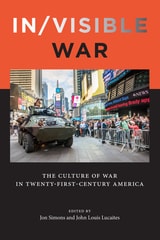
In/Visible War addresses a paradox of twenty-first century American warfare. The contemporary visual American experience of war is ubiquitous, and yet war is simultaneously invisible or absent; we lack a lived sense that “America” is at war. This paradox of in/visibility concerns the gap between the experiences of war zones and the visual, mediated experience of war in public, popular culture, which absents and renders invisible the former. Large portions of the domestic public experience war only at a distance. For these citizens, war seems abstract, or may even seem to have disappeared altogether due to a relative absence of visual images of casualties. Perhaps even more significantly, wars can be fought without sacrifice by the vast majority of Americans.
Yet, the normalization of twenty-first century war also renders it highly visible. War is made visible through popular, commercial, mediated culture. The spectacle of war occupies the contemporary public sphere in the forms of celebrations at athletic events and in films, video games, and other media, coming together as MIME, the Military-Industrial-Media-Entertainment Network.
Yet, the normalization of twenty-first century war also renders it highly visible. War is made visible through popular, commercial, mediated culture. The spectacle of war occupies the contemporary public sphere in the forms of celebrations at athletic events and in films, video games, and other media, coming together as MIME, the Military-Industrial-Media-Entertainment Network.
[more]
Killer Apps
War, Media, MachineJeremy Packer and Joshua Reeves
Duke University Press, 2020
In Killer Apps Jeremy Packer and Joshua Reeves provide a detailed account of the rise of automation in warfare, showing how media systems are central to building weapons systems with artificial intelligence in order to more efficiently select and eliminate military targets. Drawing on the insights of a wide range of political and media theorists, Packer and Reeves develop a new theory for understanding how the intersection of media and military strategy drives today's AI arms race. They address the use of media to search for enemies in their analyses of the history of automated radar systems, the search for extraterrestrial life, and the development of military climate science, which treats the changing earth as an enemy. As the authors demonstrate, contemporary military strategy demands perfect communication in an evolving battlespace that is increasingly inhospitable to human frailties, necessitating humans' replacement by advanced robotics, machine intelligence, and media systems.
[more]

The Weekly War
How the Saturday Evening Post Reported World War IChris Dubbs
University of North Texas Press, 2023
[more]
Through the Crosshairs
War, Visual Culture, and the Weaponized GazeStahl, Roger
Rutgers University Press, 2018
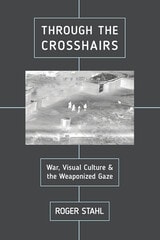
Now that it has become so commonplace, we rarely blink an eye at camera footage framed by the crosshairs of a sniper’s gun or from the perspective of a descending smart bomb. But how did this weaponized gaze become the norm for depicting war, and how has it influenced public perceptions?
Through the Crosshairs traces the genealogy of this weapon’s-eye view across a wide range of genres, including news reports, military public relations images, action movies, video games, and social media posts. As he tracks how gun-camera footage has spilled from the battlefield onto the screens of everyday civilian life, Roger Stahl exposes how this raw video is carefully curated and edited to promote identification with military weaponry, rather than with the targeted victims. He reveals how the weaponized gaze is not only a powerful propagandistic frame, but also a prime site of struggle over the representation of state violence.
Through the Crosshairs traces the genealogy of this weapon’s-eye view across a wide range of genres, including news reports, military public relations images, action movies, video games, and social media posts. As he tracks how gun-camera footage has spilled from the battlefield onto the screens of everyday civilian life, Roger Stahl exposes how this raw video is carefully curated and edited to promote identification with military weaponry, rather than with the targeted victims. He reveals how the weaponized gaze is not only a powerful propagandistic frame, but also a prime site of struggle over the representation of state violence.
[more]
War Games
Jonna Eagle
Rutgers University Press, 2020
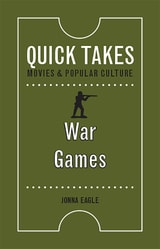
The word “wargames” might seem like a contradiction in terms. After all, the declaration “This is war” is meant to signal that things have turned deadly serious, that there is no more playing around. Yet the practices of war are intimately entangled with practices of gaming, from military videogames to live battle reenactments. How do these forms of play impact how both soldiers and civilians perceive acts of war?
This Quick Take considers how various war games and simulations shape the ways we imagine war. Paradoxically, these games grant us a sense of mastery and control as we strategize and scrutinize the enemy, yet also allow us the thrilling sense of being immersed in the carnage and chaos of battle. But as simulations of war become more integrated into both popular culture and military practice, how do they shape our apprehension of the traumatic realities of warfare?
Covering everything from chess to football, from Saving Private Ryan to American Sniper, and from Call of Duty to drone interfaces, War Games is an essential guide for anyone seeking to understand the militarization of American culture, offering a compact yet comprehensive look at how we play with images of war.
[more]