Results by title
5 books match the query 'Warren, Kenneth W.'

Black and White Strangers
Race and American Literary RealismKenneth W. Warren
University of Chicago Press, 1993
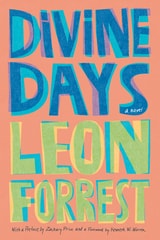
Divine Days
A NovelLeon Forrest; Foreword by Kenneth W. Warren, Preface by Zachary Price
Northwestern University Press, 2023
“I have an awful memory for faces, but an excellent one for voices,” muses Joubert Jones, the aspiring playwright at the center of Divine Days. A kaleidoscopic whorl of characters, language, music, and Black experience, this saga follows Jones for one week in 1966 as he pursues the lore and legends of fictional Forest County, a place resembling Chicago’s South Side. Joubert is a veteran, recently returned to the city, who works for his aunt Eloise’s newspaper and pours drinks at her Night Light Lounge. He wants to write a play about Sugar-Groove, a drifter, “eternal wunderkind,” and local folk hero who seems to have passed away. Sugar-Groove’s disappearance recalls the subject of one of Joubert’s earlier writing attempts—W. A. D. Ford, a protean, diabolical preacher who led a religious sect known as “Divine Days.” Joubert takes notes as he learns about both tricksters, trying to understand their significance.
Divine Days introduces readers to a score of indelible characters: Imani, Joubert’s girlfriend, an artist and social worker searching for her lost siblings and struggling to reconcile middle class life with her values and Black identity; Eloise, who raised Joubert and whose influence is at odds with his writerly ambitions; (Oscar) Williemain, a local barber, storyteller, and founder of the Royal Rites and Righteous Ramblings Club; and the Night Light’s many patrons. With a structure inspired by James Joyce and jazz, Leon Forrest folds references to African American literature and cinema, Shakespeare, the Bible, and classical mythology into a heady quest that embraces life in all its tumult and adventure.
This edition brings Forrest’s masterpiece back into print, incorporating hundreds of editorial changes that the author had requested from W. W. Norton, but were not made for their editions in 1993 and 1994. Much of the inventory from the original printing of the book by Another Chicago Press in 1992 had been destroyed in a disastrous warehouse fire.
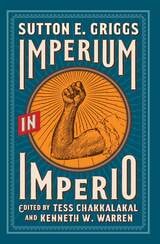
Imperium in Imperio
Sutton E. Griggs
West Virginia University Press, 2022
A new critical edition of Sutton Griggs’s turn-of-the-twentieth-century novel, which continues to shed light on understandings of Black politics.
Sutton E. Griggs’s first novel, originally published in 1899, paints a searing picture of the violent enforcement of disfranchisement and Jim Crow racial segregation. Based on events of the time, including US imperial policies, revolutionary movements, and racial protests, Imperium in Imperio introduces the fictional Belton Piedmont and Bernard Belgrave as “future leaders of their race” and uses these characters to make sense of the violence that marked the dawn of the twentieth century. Taking on contemporary battles over separatism and integration, Griggs’s novel continues to play a crucial role in understandings of Black politics.
Edited and introduced by Tess Chakkalakal and Kenneth W. Warren, this new critical edition offers not only an incisive biographical and historical introduction to the novel and its author but also a wealth of references that make the events and characters of Griggs’s Imperium in Imperio, and its aftermath, accessible to readers today.
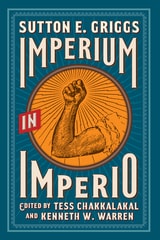
Imperium in Imperio
Tess Chakkalakal
University of Delaware Press, 0
Edited and introduced by Tess Chakkalakal and Kenneth W. Warren, this new critical edition offers not only an incisive biographical and historical introduction to the novel and its author but also a wealth of references that make the events and characters of Griggs’s Imperium in Imperio, and its aftermath, accessible to readers today.
So Black and Blue
Ralph Ellison and the Occasion of CriticismKenneth W. Warren
University of Chicago Press, 2003
What would it mean to read Invisible Man as a document of Jim Crow America? Using Ralph Ellison's classic novel and many of his essays as starting points, Kenneth W. Warren illuminates the peculiar interrelation of politics, culture, and social scientific inquiry that arose during the post-Reconstruction era and persisted through the Civil Rights movement. Warren argues that Ellison's novel expresses the problem of who or what could represent and speak for the Negro in an age of limited political representation.
So Black and Blue shows that Ellison's successful transformation of these limits into possibilities has also, paradoxically, cast a shadow on the postsegregation world. What can be the direction of African American culture once the limits that have shaped it are stricken down? Here Warren takes up the recent, ongoing, and often contradictory veneration of Ellison's artistry by black writers and intellectuals to reveal the impoverished terms often used in discussions about the political and cultural future of African Americans. Ultimately, by showing what it would mean to take seriously the idea of American novels as creatures of their moment, Warren questions whether there can be anything that deserves the label of classic American literature.