Results by title
2 books match the query 'Warren County'

Roots of Disorder
Race and Criminal Justice in the American South, 1817-80Christopher Waldrep
University of Illinois Press, 1998
Every white southerner understoodwhat keeping African Americans "down" meant and what it did not mean. It did not mean going to court; it did not mean relying on the law. It meant vigilante violence and lynching. Looking at Vicksburg, Mississippi,Roots of Disorder traces the origins of these terrible attitudes to the day-to-day operations of local courts. In Vicksburg, white exploitation of black labor through slavery evolved into efforts to use the law todefine blacks' place in society, setting the stage for widespread tolerance of brutal vigilantism. Fed by racism and economics, whites' violence grew in a hothouse of more general hostility toward law and courts. Roots of Disorder shows how the criminal justice system itself plays a role in shaping the attitudes that encourage vigilantism.
"Delivers what no other study has yet attempted. . . . Waldrep's book is one of the first systematically to use local trial data to explore questions of society and culture." -- Vernon Burton, author of "A Gentleman and an Officer": A Social and Military History of James B. Griffin's Civil War
"Delivers what no other study has yet attempted. . . . Waldrep's book is one of the first systematically to use local trial data to explore questions of society and culture." -- Vernon Burton, author of "A Gentleman and an Officer": A Social and Military History of James B. Griffin's Civil War
[more]
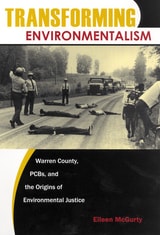
Transforming Environmentalism
Warren County, PCBs, and the Origins of Environmental JusticeMcGurty, Eileen
Rutgers University Press, 2006
Contemporary public policy circles are quick to acknowledge that environmental factors contribute to ill health and pose a particular threat to poor and minority communities. But public officials rarely examined the distribution of environmental hazards such as polluted air and contaminated water. In the 1980s, as toxic waste facilities proliferated, the environmental justice movement demanded that impoverished communities no longer be burdened by excessive environmental risks.
In Transforming Environmentalism, Eileen McGurty explores a moment central to the emergence of the environmental justice movement. In 1978, residents of predominantly African American Warren County, North Carolina, were horrified to learn that the state planned to build a landfill in their county to hold forty thousand cubic yards of soil that was contaminated with PCBs from illegal dumping. They responded to the state's plans with a four-year resistance, ending in a month of protests with over 500 arrests from civil disobedience and disruptive actions.McGurty traces the evolving approaches that residents took to contest "environmental racism" in their community and shows how activism in Warren County spurred greater political debate and became a model for communities across the nation. Transforming Environmentalism explores how the specific circumstances of the Warren County events shaped the formation of the environmental justice movement and influenced contemporary environmentalism.
In Transforming Environmentalism, Eileen McGurty explores a moment central to the emergence of the environmental justice movement. In 1978, residents of predominantly African American Warren County, North Carolina, were horrified to learn that the state planned to build a landfill in their county to hold forty thousand cubic yards of soil that was contaminated with PCBs from illegal dumping. They responded to the state's plans with a four-year resistance, ending in a month of protests with over 500 arrests from civil disobedience and disruptive actions.McGurty traces the evolving approaches that residents took to contest "environmental racism" in their community and shows how activism in Warren County spurred greater political debate and became a model for communities across the nation. Transforming Environmentalism explores how the specific circumstances of the Warren County events shaped the formation of the environmental justice movement and influenced contemporary environmentalism.
[more]