Results by title
3 books match the query 'Warrior'

A Wise One, a Warrior
Meena Kandasamy
Diaphanes, 2025
Meena Kandasamy writes about the Mithuna couple, a seventeenth-century ivory sculpture from Tamil Nadu, India, depicting lovers. Kandasamy unfurls a multi-layered, multi-directional narrative built from images, questions, and contradictions evoked by the sculpture. “How can we look at this work and not talk about who produced it?” Kandasamy asks and then examines how caste and class are carved into the object as indelibly as its physical details. Such knowledge complicates easy associations of love that may be evoked by the couple.
Refusing any impulse to idealize or exoticize, Kandasamy connects the carving to personal and political stories that expose painful realities of who gets to love whom, and how. She sets the intimate alongside the institutional to interrogate terms such as decolonize, restitution, and preservation. Through an astonishing stylistic mix, including Twitter, academic discourse, poetry, and memoir, she talks back, forward, and sideways with the object.
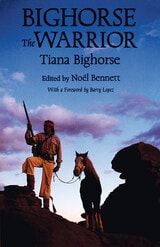
Bighorse the Warrior
Tiana Bighorse; Edited by Noël Bennett
University of Arizona Press, 1994
When the Navajos were taken from their land by the federal government in the 1860s, thousands lost their lives on the infamous Long Walk, while those who eluded capture lived in constant fear. These men and women are now dead, but their story lives on in the collective memory of their tribe.
Gus Bighorse lived through that period of his people's history, and his account of it—recalled by his daughter Tiana and retold in her father's voice—provides authentic glimpses into Navajo life and values of a century ago. Born around 1846, Gus was orphaned at sixteen when his parents were killed by soldiers, and he went into hiding with other Navajos banded together under chiefs like Manuelito. Over the coming years, he was to see members of his tribe take refuge in Canyon de Chelly, endure the Long Walk from Fort Defiance to Bosque Redondo in 1864, and go into hiding at Navajo Mountain. Gus himself was the leader of one of Manuelito's bands who fought against Kit Carson's troops.
After the Navajos were allowed to return to their land, Gus took up the life of a horseman, only to see his beloved animals decimated in a government stock reduction program.
"I know some people died of their tragic story," says Gus. "They think about it and think about how many relatives they lost. Their parents got shot. They get into shock. That is what kills them. That is why we warriors have to talk to each other. We wake ourselves up, get out of the shock. And that is why I tell my kids what happened, so it won't be forgot." Throughout his narrative, he makes clear those human qualities that for the Navajos define what it is to be a warrior: vision, compassion, courage, and endurance.
Befitting the oral tradition of her people, Tiana Bighorse draws on her memory to tell her father's story. In doing so, she ensures that a new generation of Navajos will know how the courage of their ancestors enabled their people to have their reservation today: "They paid for our land with their lives." Following the text is a chronology of Navajo history, with highlights of Gus Bighorse's life placed in the context of historical events.
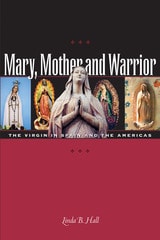
Mary, Mother and Warrior
The Virgin in Spain and the AmericasBy Linda B. Hall
University of Texas Press, 2004
A Mother who nurtures, empathizes, and heals... a Warrior who defends, empowers, and resists oppression... the Virgin Mary plays many roles for the peoples of Spain and Spanish-speaking America. Devotion to the Virgin inspired and sustained medieval and Renaissance Spaniards as they liberated Spain from the Moors and set about the conquest of the New World. Devotion to the Virgin still inspires and sustains millions of believers today throughout the Americas.
This wide-ranging and highly readable book explores the veneration of the Virgin Mary in Spain and the Americas from the colonial period to the present. Linda Hall begins the story in Spain and follows it through the conquest and colonization of the New World, with a special focus on Mexico and the Andean highlands in Peru and Bolivia, where Marian devotion became combined with indigenous beliefs and rituals. Moving into the nineteenth century, Hall looks at national cults of the Virgin in Mexico, Bolivia, and Argentina, which were tied to independence movements. In the twentieth century, she examines how Eva Perón linked herself with Mary in the popular imagination; visits contemporary festivals with significant Marian content in Spain, Peru, and Mexico; and considers how Latinos/as in the United States draw on Marian devotion to maintain familial and cultural ties.