Results by title
6 books match the query 'Wars of Independence, 1806-1830'
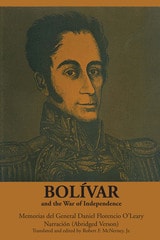
Bolívar and the War of Independence
Memorias del General Daniel Florencio O’Leary, NarraciónBy Daniel Florencio O'Leary
University of Texas Press, 1970
The overthrow of Spanish rule and the birth of new republican governments in northern South America at the beginning of the nineteenth century were in large part the work of one man—Simón Bolívar. Bolívar was not only the soldier who built a patriot army from a small band of exiles and led them victoriously across Venezuela and down the spine of the Andes as far as Potosí; he was also the statesman who framed the new republics that sprang to life after the defeat of the Spanish and who called the Congress of Panama in hopes of making real his dream of uniting all the South American republics in a single confederation. He was truly the Liberator.
The Narración, or narrative, of the Memorias of Daniel Florencio O’Leary has long been recognized by Spanish American scholars as one of the most important historical sources for a major part of Bolívar’s life. O’Leary took an active part in the wars for independence, first as a young officer, recruited in the British Isles to aid the patriot cause, and later as Bolívar’s chief aide, often entrusted with diplomatic missions. His firsthand knowledge of the stirring events of the period, his access to relevant documents, and his close association with the major figures in the struggle, as well as his friendship with Bolívar, made O’Leary a particularly valuable chronicler and biographer. Bolívar himself, shortly before his death, requested that O’Leary write the story of his life.
O’Leary’s meticulous attention to military and diplomatic maneuvers and his keen, sometimes acrid, comments on both men and events give the reader not only a vivid portrait of Bolívar—the man and his achievements—but also a remarkable insight into O’Leary’s own position as an autocratic-minded participant in the wars for independence. Although O’Leary’s devotion to, and admiration for, his Chief make for an occasionally partisan view, his stark account of the hardships and disappointments that Bolívar and his armies overcame against almost impossible odds does much to balance the narrative.
In his abridged translation, Robert McNerney has omitted the Apéndice, documents that O’Leary, had he lived, undoubtedly would have used as the source for completing his account of Bolívar’s life. Numerous letters and documents scattered through the original text also have been omitted, leaving a highly readable narrative.
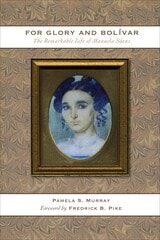
For Glory and Bolívar
The Remarkable Life of Manuela SáenzBy Pamela S. Murray
University of Texas Press, 2008
She was a friend, lover, and confidante of charismatic Spanish American independence hero Simón Bolívar and, after her death, a nationalist icon in her own right. Yet authors generally have chosen either to romanticize Manuela Sáenz or to discount her altogether. For Glory and Bolivar: The Remarkable of Life of Manuela Sáenz, by contrast, offers a comprehensive and clear-eyed biography of her. Based on unprecedented archival research, it paints a vivid portrait of the Quito-born "Libertadora," revealing both an exceptional figure and a flesh-and-blood person whose life broadly reflected the experiences of women during Spanish America's turbulent Age of Revolution.
Already married at the time of her meeting with the famous Liberator, Sáenz abandoned her husband in order to become not only Bolívar's romantic companion, but also his official archivist, a member of his inner circle, and one of his most loyal followers. She played a central role in Spanish South America's independence drama and eventually in developments leading to the consolidation of new nations. Pamela Murray, for the first time, closely examines Sáenz's political trajectory including her vital, often-overlooked years in exile. She exposes the myths that still surround her. She offers, in short, a nuanced and much-needed historical perspective, one that balances recognition of Sáenz's uniqueness with awareness of the broader forces that shaped this dynamic nineteenth-century woman.
Imperial Russia and the Struggle for Latin American Independence, 1808–1828
By Russell H. Bartley
University of Texas Press, 1978
This study, the first of its kind in English, examines Russian responses to the independence movement in Latin America during the early nineteenth century. From a strictly presentist perspective, the investigation of this subject contributes to the historiography of colonialism and of Latin America's relations with the major world powers. In addition, it rounds out the story of foreign interests in the emancipation of Spanish and Portuguese America, while at the same time shedding new light on the history of Russian overseas expansion.
The study probes the major determinants of Russian responses to the struggle for independence of colonial Latin America and evaluates, from a European perspective, the actual impact of tsarist policy on the course of those historic events. Drawing on a wide range of printed materials and on hitherto unused manuscript sources from the archives and libraries of Spain, Portugal, Brazil, and the USSR, it isolates Russian New World objectives during the first decades of the nineteenth century and relates those objectives to the formulation of tsarist policy toward the insurgent Iberian colonies.
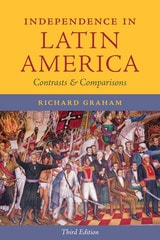
Independence in Latin America
Contrasts and ComparisonsBy Richard Graham
University of Texas Press, 2013
In the course of fifteen momentous years, the Spanish- and the Portuguese-American empires that had endured for three centuries came to an end in the mid-1820s. How did this come about? Not all Latin Americans desired such a change, and the independence wars were civil wars, often cruel and always violent. What social and economic groups lined up on one side or the other? Were there variations from place to place, region to region? Did men and women differ in their experience of war? How did Indians and blacks participate and how did they fare as a result? In the end, who won and who lost?
Independence in Latin America is about the reciprocal effect of war and social dislocation. It also demonstrates that the war itself led to national identity and so to the creation of new states. These governments generally acknowledged the novel principle of constitutionalism and popular sovereignty, even when sometimes carving out exceptions to such rules. The notion that society consisted of individuals and was not a body made up of castes, guilds, and other corporate orders had become commonplace by the end of these wars. So international politics and military confrontations are only part of the intriguing story recounted here.
For this third edition, Richard Graham has written a new introduction and extensively revised and updated the text. He has also added new illustrations and maps.
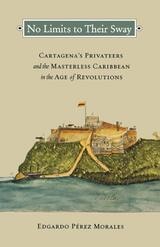
No Limits to Their Sway
Cartagena's Privateers and the Masterless Caribbean in the Age of RevolutionsEdgardo Pérez Morales
Vanderbilt University Press, 2018
Most of Cartagena's privateers were people of color and descendants of slaves who benefited from the relative freedom and flexibility of life at sea, but also faced kidnapping, enslavement, and brutality. Many came from Haiti and Guadeloupe; some had been directly involved in the Haitian Revolution. While their manpower proved crucial in the early Anti-Spanish struggles, Afro-Caribbean privateers were also perceived as a threat, suspected of holding questionable loyalties, disorderly tendencies, and too strong a commitment to political and social privileges for people of color. Based on handwritten and printed sources in Spanish, English, and French, this book tells the story of Cartagena's multinational and multicultural seafarers, revealing the Trans-Atlantic and maritime dimensions of South American independence.
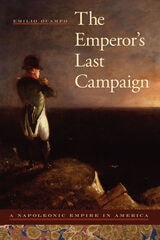
The Emperor's Last Campaign
A Napoleonic Empire in AmericaEmilio Ocampo
University of Alabama Press, 2009
WINNER OF THE 2009 LITERARY AWARD, SPONSORED BY THE INTERNATIONAL NAPOLEONIC SOCIETY/LA SOCIETE NAPOLEONIENNE INTERNATIONALE OF MONTREAL, QUEBEC'S LITERARY COMMITTEE
The fascinating story of the breakdown of the Spanish empire in America and the rise of the United States as a world power
Napoleon’s last campaign didn’t end at Waterloo. After that fateful day on June 1815, hundreds if not thousands of veterans of Napoleon’s army emigrated to America. Many went farther south and joined the rebels fighting for independence in the Spanish colonies, from Mexico to Buenos Aires. The Bonapartists roiled the Western World as they sought fortune, fame, and glory in the expanding United States and in the tumultuous Spanish Americas suffering from repression and civil disorder, and even in the states of Europe. They were joined by adventurers from other nations who shared their admiration for the fallen emperor.
This is the first full-length examination of the Bonapartists who emigrated from France after Napoleon’s defeat and exile, who formed a loose confederation with adventurers and romantics, and who contemplated a new empire in the Western Hemisphere. The scheme had the support and encouragement of the fallen emperor himself and his brother Joseph, former King of Spain, who lived in exile in the United States.
Emilio Ocampo has examined archives on three continents and sources in several languages to ferret out the evidence—a monumental task considering that conspirators tried to leave no evidence of their plans, and that a failed plot, like failure in general, leaves few claimants. Ocampo reinterprets Latin American independence as an international event that drew in all the major powers. By illuminating the complex connections between the shattered France of the Bourbon restoration; an England threatened by radical politician inspired by the French Revolution; Napoleon in exile at St. Helena; the United States, where home-grown adventurers and French émigrés alike saw opportunity; and the collapsing Spanish colonial empire, where revolutionaries were allying themselves with the veterans of Napoleon’s Grande Armée, Ocampo brings together two bodies of scholarship: Napoleonic history and Latin American independence. He does so by tracing the steps of four of the most fascinating characters of the era: two Britons disaffected with their own government—Lord Thomas Cochrane and Sir Robert Wilson—and two former generals of Napolean’s army named Charles Lallemand and Michel Brayer.
The Emperor’s Last Campaign is a fascinating story, well told, and peopled with all sorts of improbable characters and schemes that perhaps just missed coming to full fruition but that in the process contributed to one of the most important events of the nineteenth century: the breakdown of the Spanish empire in America and the rise of the United States as a world power.