Results by title
3 books match the query 'Warsaw Ghetto Uprising, 1943'
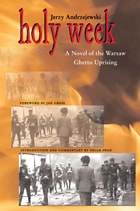
Holy Week
A Novel of the Warsaw Ghetto UprisingJerzy Andrzejewski
Ohio University Press, 2006
At the height of the Nazi extermination campaign in the Warsaw Ghetto, a young Jewish woman, Irena, seeks the protection of her former lover, a young architect, Jan Malecki. By taking her in, he puts his own life and the safety of his family at risk. Over a four-day period, Tuesday through Friday of Holy Week 1943, as Irena becomes increasingly traumatized by her situation, Malecki questions his decision to shelter Irena in the apartment where Malecki, his pregnant wife, and his younger brother reside. Added to his dilemma is the broader context of Poles’ attitudes toward the “Jewish question” and the plight of the Jews locked in the ghetto during the final moments of its existence.
Few fictional works dealing with the war have been written so close in time to the events that inspired them. No other Polish novel treats the range of Polish attitudes toward the Jews with such unflinching honesty.
Jerzy Andrzejewski’s Holy Week (Wielki Tydzien, 1945), one of the significant literary works to be published immediately following the Second World War, now appears in English for the first time.
This translation of Andrzejewski’s Holy Week began as a group project in an advanced Polish language course at the University of Pittsburgh. Class members Daniel M. Pennell, Anna M. Poukish, and Matthew J. Russin contributed to the translation; the instructor, Oscar E. Swan, was responsible for the overall accuracy and stylistic unity of the translation as well as for the biographical and critical notes and essays.
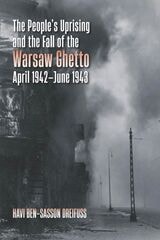
The People's Uprising and the Fall of the Warsaw Ghetto, April 1942–June 1943
Havi Ben-Sasson Dreifuss
Brandeis University Press, 2026
The People’s Uprising and the Fall of the Warsaw Ghetto, April 1942–June 1943 sheds light on the lives, choices, and experiences of the tens of thousands of Jews who were not part of the underground armed resistance but nonetheless supported the famed Warsaw Ghetto Uprising. This riveting and dramatic account focuses on the final year of the Warsaw ghetto, from the Great Deportation in the summer of 1942 through the suppression of the uprising in mid-1943. Drawing on powerful contemporary testimonies, diaries, and documents—many of them previously unexplored—Havi Ben-Sasson Dreifuss
reveals how members of the broader Jewish population struggled to survive, maintain family and community life, and make impossible moral decisions in the face of fear, hunger, and daily violence. Looking beyond the fighters themselves, the book offers a story of devastation, but also of resilience and human dignity.
Published in association with Yad Vashem.

The Subtenant / To Outwit God
Hanna Krall
Northwestern University Press, 1992