Results by title
8 books match the query 'Waste'

Amplifying Theatrical Horizons
Rethinking the Value of Waste in PerformanceLisa Hall
Intellect Books, 2026
A reexamination of the role of waste in theatrical practices, from escape rooms to traditional proscenium theater.
Amplifying Theatrical Horizons reimagines live performance through the lens of economy, value, excess, and waste, asking what it means to shower resources—material, sensory, and symbolic—on audiences beyond utilitarian calculation. It examines how waste operates within the theatrical relationship between audience, performer, genre, and space, focusing on excessive deployments of value.
Drawing on scholarship in theater studies, economics, philosophy, and performance practice, Lisa Hall proposes what she calls the Wasteful Theatre Equation, distinguishing waste as a surplus that amplifies experience rather than diminishing it. Case studies span immersive environments, haunted attractions, escape rooms, site-specific productions, and traditional proscenium theater, demonstrating how space, participation, sensation, and fear operate as sites of wasteful excess.
Key chapters pose practical questions for makers, reframing contracts of performance, proximity, and risk as tools for creating singular experiences. Across examples from Robert Wilson to Punchdrunk, Grand-Guignol to theme parks, the book positions waste as both disruptive and generative. Ultimately, it argues that wasteful excess enchants, reorienting theater toward presence, wonder, and transformative exchange.
Playing Dirty
Sexuality and Waste in Early Modern ComedyWill Stockton
University of Minnesota Press, 2010
Noting that psychoanalysis has traditionally operated in a paranoid framework that relentlessly produces evidence of the same “truths,” Stockton turns to a minority practice in psychoanalysis—associated with Jean Laplanche—to develop a more “playful” analytic for literary studies. This analytic brings together different discourses of sexuality and the body and allows individual writings to reform psychoanalytic wisdom about sexuality, waste, and comedy. Through original explorations of works by William Shakespeare, Ben Jonson, Sir John Harington, Thomas Nashe, and Geoffrey Chaucer, Stockton further encourages the reconciliation of psychoanalysis and queer historicism. He focuses in large part on the less-often-read texts of the early modern English canon, assessing the ways in which these books have been purged from the canon in the name of generic purity.
Playing Dirty builds on recent calls by Renaissance and medieval queer scholars for a method of literary analysis that is less constrained by the boundaries of periodicity and the supposed exigencies of historicism. To take Playing Dirty seriously is to accept its invitation to “play”—to queerly disrupt the modern divide in moving promiscuously between texts past and present.

Signs Of Danger
Waste, Trauma, and Nuclear ThreatPeter C. Van Wyck
University of Minnesota Press, 2004
Questions the literal burying of the nuclear threat and how it relates to expectations for our future
A rising ocean. A falling building. A toxic river. Species extinguished. A nuclear landscape. In a world so configured, the state of contemporary ecological thought and practice is woefully—and perilously—inadequate. Focusing on the government’s nuclear waste burial program in Carlsbad, New Mexico, Signs of Danger begins the urgent work of finding a new way of thinking about ecological threat in our time.
The Waste Isolation Pilot Plant in Carlsbad began receiving shipments in 1999. With a proposed closing date of 2030, this repository for nuclear waste must be secured with a sign, the purpose of which will be to keep people away for three hundred generations. In the official documents uncovered by Peter van Wyck, we encounter a government bureaucracy approaching the issue of nuclear waste as a technical problem only to find itself confronting a host of intractable philosophical issues concerning language, culture, and history. Signs of Danger plumbs these depths as it shows us how the problem raised in the desert of New Mexico is actually the problem of a culture grappling with ecological threats and with questions of the limits of meaning and representation in the deep future. The reflections at the center of this book—on memory, trauma, disaster, representation, and the virtual—are aimed at defining the uniquely modern status of environmental and nuclear threats. They offer invaluable insights into the interface of where culture ends and nature begins, and how such a juncture is closely linked with questions of risk, concepts of history, and the cultural experience of time.Winner of the 2005 Gertrude J. Robinson Book Prize of the Canadian Communication Association
Waste and Abundance
The Measure of Consumption: Special Issue of SubStance, Issue 116, 37:2 (2008)Susan Cahill
University of Wisconsin Press, 2008
This collection of articles relates to a research area currently developing in the Humanities, which calls for philosophical and historical approaches to questions of sustainable development and waste management. The title of the issue reflects the central questions raised by all contributors: how are waste and abundance represented, how may we conceptualize these representations, and what ethical problems do they raise?
Particular attention is paid to the cultural and moral factors that condition our attitudes to waste and the ways in which literature addresses the problematic relationship that binds production, consumption and waste to social and political systems.
Waste and the Wasters
Poetry and Ecosystemic Thought in Medieval EnglandEleanor Johnson
University of Chicago Press, 2023
While the scale of today’s crisis is unprecedented, environmental catastrophe is nothing new. Waste and the Wasters studies the late Middle Ages, when a convergence of land contraction, soil depletion, climate change, pollution, and plague subsumed Western Europe. In a culture lacking formal scientific methods, the task of explaining and coming to grips with what was happening fell to medieval poets. The poems they wrote used the terms “waste” or “wasters” to anchor trenchant critiques of people’s unsustainable relationships with the world around them and with each other. In this book, Eleanor Johnson shows how poetry helped medieval people understand and navigate the ecosystemic crises—both material and spiritual—of their time.
Waste of Timelessness and Other Early Stories
Anaïs Nin
Ohio University Press, 2017
Written when Anaïs Nin was in her twenties and living in France, the stories collected in Waste of Timelessness contain many elements familiar to those who know her later work as well as revelatory, early clues to themes developed in those more mature stories and novels. Seeded with details remembered from childhood and from life in Paris, the wistful tales portray artists, writers, strangers who meet in the night, and above all, women and their desires.
These experimental and deeply introspective missives lay out a central theme of Nin’s writing: the contrast between the public and private self. The stories are taut with unrealized sexual tension and articulate the ways that language and art can shape reality. Nin’s deft humor, ironic wit, and ecstatic prose display not only superb craftsmanship but also the author’s own constant balancing act between feeling and rationality, vulnerability and strength. Perhaps more than any other writer of the twentieth century, she mastered that act and wrote about it on her own terms, defying the literary and social norms of the time.
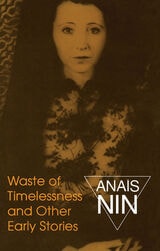
Waste of Timelessness and Other Early Stories
And Other Early StoriesAnaïs Nin
Ohio University Press, 1993
These stories precede all of Nin’s published work to date. In them are many sources of the more mature work that collectors and growing writers can appreciate.
Written when Anaïs Nin was in her twenties and living in Louveciennes, France, these stories contain many elements that will delight her readers: details remembered from childhood, of life in Paris, the cafés, theatres; characters including dancers, artists, writers, women who devote themselves to their work and visions as well as romance, strangers met in the night; themes such as the scruples of lovers, the search for brilliant, imaginative living; the writer’s experimentation with exotic words like “sybaritic” and “violaceous”. In the craft of these stories readers are treated to a deft sense of humor, ironic wit, much conversation as well as ecstatic prose, and surprise endings. Throughout all, the Nin personality shines, a wonderful mixture of feeling and rationality, of vulnerability and strength.
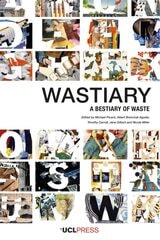
Wastiary
A Bestiary of WasteEdited by Michael Picard, Albert Brenchat-Aguilar, Timothy Carroll, Jane Gilbert, and Nicola Miller
University College London, 2023
Wastiary: A Bestiary of Waste is a creative exercise that occupies letters, numbers, and symbols of Western academic language to compose a list of thirty-five short entries on the uncomfortable but pressing topic of waste in the contemporary world. The collection is richly illustrated with artwork, photography, collage, and mixed media and conveys the message that various forms of waste and pollution have achieved a beast-like or untamable quality, at times pungently transferring to considerations of “the human,” or humans treated as waste.