Results by title
11 books match the query 'Waters'

Children of the Waters
By Ibtihal Salem
University of Texas Press, 2002
Ibtihal Salem's writing provides an excellent forum for studying both everyday life in Egypt and current literary experimentation in the Middle East. Her poignant pieces hover between the structure of story-telling, the visuality of vignettes, and the compression of poetry. They both record and evoke a literary ferment going on in Egypt today.
Salem's writing of the last thirty years is lauded for its social messages also. Finding the expression of sexuality necessary to explicate problems of Egyptian identity, Salem often links poverty to gender marginality. Her heroines, however, celebrate the heritages that have shaped them, even as they resist certain aspects of them. Like many writers in Egypt, Salem honors traditional folktales, even as she deals with contemporary problems from class and economic perspectives.
Marilyn Booth, one of the best translators of Arabic fiction working today, has dealt in her introduction to this collection with the unusual experimental form by examining Salem's craft as well as the contextual history surrounding the stories. Since Salem is writing "across genres," Booth helps the reader also by opening each piece with an explanatory comment, often quoting the author, and thus further illuminating Salem's portrayals of lives bounded by Egypt's waters—the Canal, the Nile, and the Mediterranean.
Command of the Waters
Iron Triangles, Federal Water Development, and Indian WaterDaniel C. McCool
University of Arizona Press, 1994
Mapping Neshnabé Futurity
Celestial Currents of Sovereignty in Potawatomi Skies, Lands, and WatersBlaire Morseau; Foreword by Grace L. Dillon
University of Arizona Press, 2025
In Mapping Neshnabé Futurity Blaire Morseau weaves together on-the-ground insights and Indigenous speculative fiction to illustrate the profound ways in which Anishinaabé/Neshnabé (Potawatomi, Odawa, and Ojibwe) communities are reclaiming their sovereignty and crafting vibrant futures. Morseau lays out how Neshnabék have marshaled dissent to hydrologic fracturing, oil pipelines, and other damaging infrastructures of capitalist settler futurity. The book positions these efforts as vital acts of nation building and visionary reclamation of space, both terrestrial and celestial.
Morseau also challenges the hegemonic narratives of settler futurism found in mainstream science fiction, which often perpetuate colonial fantasies and exclude marginalized voices. By fusing ethnography of tribal nation-building projects and analysis of Indigenous speculative fiction, Morseau provides a path to Indigenous futurisms and its role in imagining decolonization. Morseau’s analysis underscores the potency of Indigenous knowledge systems and ceremonial practices in imagining and actualizing alternative futures.
Mapping Neshnabé Futurity is an essential read for scholars and activists alike, urging a rethinking of how we conceive of futurity and sovereignty. This work shows how counter-mapping projects both on the ground and in the skies reclaim space in the Great Lakes region—Neshnabé homelands—and are part of larger constellations of Indigenous futurities and stories of survivance.
Muddying the Waters
Coauthoring Feminisms across Scholarship and ActivismRicha Nagar
University of Illinois Press, 2014
With stories, encounters, and anecdotes as well as methodological reflections, Nagar grapples with the complexity of working through solidarities, responsibility, and ethics while involved in politically engaged scholarship. Experiences that range from the streets of Dar es Salaam to farms and development offices in North India inform discussion of the labor and politics of coauthorship, translation, and genre blending in research and writing that cross multiple--and often difficult--borders. The author links the implicit assumptions, issues, and questions involved with scholarship and political action, and explores the epistemological risks and possibilities of creative research that bring these into intimate dialogue
Daringly self-conscious, Muddying the Waters reveals a politically engaged researcher and writer working to become ""radically vulnerable,"" and the ways in which such radical vulnerability can allow a re-imagining of collaboration that opens up new avenues to collective dreaming and laboring across sociopolitical, geographical, linguistic, and institutional borders.
Superior North Shore
A Natural History of Lake Superior’s Northern Lands and WatersThomas F. Waters
University of Minnesota Press, 1999
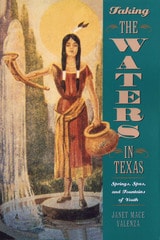
Taking the Waters in Texas
Springs, Spas, and Fountains of YouthBy Janet Mace Valenza
University of Texas Press, 2000
"It is well known that Southern Texas possesses a greater variety of Mineral Waters than any other country on the globe" enthused a promotion for one of Texas' many watering spas of the nineteenth century. Though most are closed and nearly forgotten today, Texas spas and resorts once drew thousands of visitors from across the country, seeking healing of body and spirit in the rejuvenating mineral waters.
This book offers the first comprehensive history of Texas' healing springs. Janet Valenza tracks the rise, popularity, and decline of the "water cure" from the 1830s to the present day. She follows the development of major spas and resorts, such as Mineral Wells and Indian Hot Springs near El Paso, as well as of smaller, family-run springs. She also describes how mineral waters influenced patterns of settlement, transportation routes, commerce, and people's attitudes toward the land. Period photos and quotes from those seeking cures offer vivid glimpses into the daily life at the springs, which Valenza lists and describes county-by-county in the appendix.
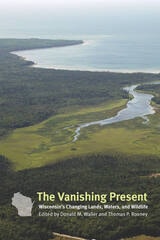
The Vanishing Present
Wisconsin's Changing Lands, Waters, and WildlifeEdited by Donald M. Waller and Thomas P. Rooney
University of Chicago Press, 2008
The Vanishing Present brings together a distinguished set of contributors—including scientists, naturalists, and policy experts—to examine how human pressures on Wisconsin’s changing lands, waters, and wildlife have redefined the state’s ecology. Though they focus on just one state, the authors draw conclusions about changes in temperate habitats that can be applied elsewhere, and offer useful insights into future of the ecology, conservation, and sustainability of Wisconsin and beyond.
A fitting tribute to the home state of Aldo Leopold and John Muir, The Vanishing Present is an accessible and timely case study of a significant ecosystem and its response to environmental change.

The Waters of Star Lake
A NovelSara Rath
University of Wisconsin Press, 2012
Newly widowed Natalie Waters expects only nostalgia and solitude at her quiet, rustic cabin. But the wilderness conceals more than one perilous mystery. Where in Wisconsin’s Northwoods did the notorious gangster John Dillinger hide $210,000 following a violent FBI shootout? And why do the local timberwolves incite so much rage among Natalie’s neighbors?
As predators circle and howl in the dark, Ginger, the bartender at the nearby Star Lake Saloon, draws Natalie deep into the secrets not only of Dillinger but of the ecologies of family, forest, and heart. With the reluctant support of her granddaughter and advice from a handsome wolf biologist, Natalie is forced to choose between adversity and adventure.
Sara Rath continues her popular Northwoods saga in this affirming and often humorous tale of romance, betrayal, and danger.

Waters of Oregon
A Source Book on Oregon's Water and Water ManagementRick Bastasch
Oregon State University Press, 1998

Waters of the World
The Story of the Scientists Who Unraveled the Mysteries of Our Oceans, Atmosphere, and Ice Sheets and Made the Planet WholeSarah Dry
University of Chicago Press, 2019
From the glaciers of the Alps to the towering cumulonimbus clouds of the Caribbean and the unexpectedly chaotic flows of the North Atlantic, Waters of the World is a tour through 150 years of the history of a significant but underappreciated idea: that the Earth has a global climate system made up of interconnected parts, constantly changing on all scales of both time and space. A prerequisite for the discovery of global warming and climate change, this idea was forged by scientists studying water in its myriad forms. This is their story.
Linking the history of the planet with the lives of those who studied it, Sarah Dry follows the remarkable scientists who summited volcanic peaks to peer through an atmosphere’s worth of water vapor, cored mile-thick ice sheets to uncover the Earth’s ancient climate history, and flew inside storm clouds to understand how small changes in energy can produce both massive storms and the general circulation of the Earth’s atmosphere. Each toiled on his or her own corner of the planetary puzzle. Gradually, their cumulative discoveries coalesced into a unified working theory of our planet’s climate.
We now call this field climate science, and in recent years it has provoked great passions, anxieties, and warnings. But no less than the object of its study, the science of water and climate is—and always has been—evolving. By revealing the complexity of this history, Waters of the World delivers a better understanding of our planet’s climate at a time when we need it the most.

god’s breath hovering across the waters
Henry Israeli
Four Way Books, 2016