Results by title
2 books match the query 'Watkins, Joe'
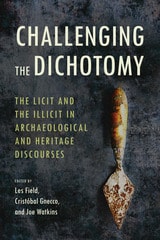
Challenging the Dichotomy
The Licit and the Illicit in Archaeological and Heritage DiscoursesEdited by Les Field, Cristóbal Gnecco, and Joe Watkins
University of Arizona Press, 2016
Challenging the Dichotomy explores how dichotomies regarding heritage dominate the discourse of ethics, practices, and institutions. Examining issues of cultural heritage law, policy, and implementation, editors Les Field, Cristóbal Gnecco, and Joe Watkins guide the focus to important discussions of the binary oppositions of the licit and the illicit, the scientific and the unscientific, incorporating case studies that challenge those apparent contradictions.
Utilizing both ethnographic and archaeological examples, contributors ask big questions vital to anyone working in cultural heritage. What are the issues surrounding private versus museum collections? What is considered looting? Is archaeology still a form of colonialization? The contributors discuss this vis-à-vis a global variety of contexts and cultures from the United States, South Africa, Argentina, New Zealand, Honduras, Colombia, Palestine, Greece, Canada, and from the Nasa, Choctaw, and Maori nations.
Challenging the Dichotomy underscores how dichotomies—such as licit/illicit, state/nonstate, public/private, scientific/nonscientific—have been constructed and how they are now being challenged by multiple forces. Throughout the eleven chapters, contributors provide examples of hegemonic relationships of power between nations and institutions. Scholars also reflect on exchanges between Western and non-Western epistemologies and ontologies.
The book’s contributions are significant, timely, and inclusive. Challenging the Dichotomy examines the scale and scope of “illicit” forms of excavation, as well as the demands from minority and indigenous subaltern peoples to decolonize anthropological and archaeological research.
[more]
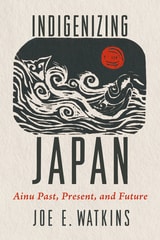
Indigenizing Japan
Ainu Past, Present, and FutureJoe E. Watkins
University of Arizona Press, 2025
In Indigenizing Japan, archaeologist Joe E. Watkins provides a comprehensive look at the rich history and cultural resilience of the Ainu, the Indigenous people of Hokkaido, Japan, tracing their journey from ancient times to their contemporary struggles for recognition.
Relaying the deep history of the islands of Japan, Watkins tells the archaeological story from the earliest arrivals some 40,000 years ago to 16,000 years ago when local cultures began utilizing pottery and stone tools. About 2,300 years ago, another group of people immigrated from the Korean peninsula into the Japanese archipelago, bringing wet rice agriculture with them. They intermarried with the people who were there, forming the basis of the contemporary Japanese majority culture. As the Japanese state developed on the central Islands of Honshu, Ryukyu, and Shikoku, the people of Hokkaido continued developing along a different trajectory with minimal interaction with the mainland until colonization in the mid-nineteenth century, when the people known as the Ainu came under Japanese governmental policy.
Watkins’s insightful analysis highlights the Ainu’s enduring spirit and their resurgence as part of the global Indigenous movement. Key events such as the 1997 Nibutani Dam case and the 2007 recognition of the Ainu as Japan’s Indigenous people are explored in depth, showcasing the Ainu’s ongoing fight for cultural preservation and self-determination. By situating the Ainu’s experiences within broader global colonial histories, Indigenizing Japan underscores the shared struggles and resilience of Indigenous communities worldwide.
[more]