Results by title
2 books match the query 'Waunana Indians'
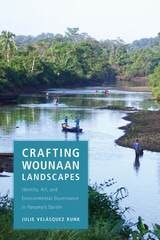
Crafting Wounaan Landscapes
Identity, Art, and Environmental Governance in Panama's DariénJulie Velásquez Runk
University of Arizona Press, 2017
Panama’s Darién is a name many conservationists know. Renowned for its lowland tropical forests, its fame is more pronounced because a road that should be there is not: environmentalists have repeatedly, and remarkably, blocked all attempts to connect the Americas via the Pan American Highway. That lacuna, that absence of a road, also serves to occlude history in the region as its old-growth forests give the erroneous impression of a peopleless nature.
In Crafting Wounaan Landscapes, Julie Velásquez Runk upends long-standing assumptions about the people that call Darién home, and she demonstrates the agency of the Wounaan people to make their living and preserve and transform their way of life in the face of continuous and tremendous change. Velásquez Runk focuses on Wounaan crafting—how their ability to subtly effect change has granted them resilience in a dynamic and globalized era. She theorizes that unpredictable landscapes, political decisions, and cultural beliefs are responsible for environmental conservation problems, and she unpacks environmental governance efforts that illustrate what happens when conservation is confronted with people in a purportedly peopleless place.
The everyday dangers of environmental governance without local crafting include logging, land grabbing, and loss of carbon in a new era of carbon governance in the face of climate change. Crafting Wounaan Landscapes provides recognition of local ways of knowing and being in the world that may be key to the future of conservation practice.
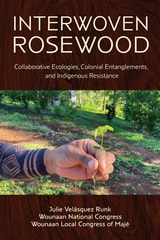
Interwoven Rosewood
Collaborative Ecologies, Colonial Entanglements, and Indigenous ResistanceJulie Velásquez Runk, the Wounaan National Congress, and the Wounaan Local Congress of Majé
University of Arizona Press, 2026
Interwoven Rosewood is a collaborative exploration of the global rosewood trade and its entanglements with Indigenous lifeways, colonial histories, and environmental crises. Co-authored by Julie Velásquez Runk and members of the Wounaan National Congress and its Local Congress of the Majé community, this book traces the story of cocobolo rosewood from Wounaan lands in Panama to international markets, revealing how centuries of settler colonialism and extractive capitalism continue to shape landscapes, livelihoods, and relationships. At its heart, the book is a meditation on well-being and belonging—how people live in relation to land, each other, and the more-than-human world.
Drawing on more than a decade of community-based research and six collaborative book workshops, the authors weave together first-person narratives, ecological analysis, historical context, and Indigenous knowledge. The result is a richly textured account that challenges dominant narratives of environmental degradation by centering Wounaan experiences of joy, resistance, and conviviality. The book’s structure reflects its method: interwoven chapters authored or spoken by Wounaan colleagues, grounded in consent protocols and shaped by ancestral storytelling traditions.
Accessibly written, Interwoven Rosewood is ideal for courses in environmental conservation, Indigenous studies, anthropology, Latin American studies, and political ecology. With its interdisciplinary reach and classroom-ready discussion questions, the book invites readers to reflect on the global forces behind environmental catastrophe—and the enduring power of Indigenous ways of knowing, being, and becoming.