Results by title
6 books match the query 'Wayne, Mike'

England's Discontents
Political Cultures and National IdentitiesMike Wayne
Pluto Press, 2018
England’s political-economic scene is a battleground of competing ideologies, all under the umbrella of neoliberalism. From conservatism to socialism, what forces have historically shaped these political cultures and people’s attachment to them?
Examining five political ideologies at play in England—conservatism, liberalism, economic liberalism, social democracy, and socialism—Mike Wayne unearths the historical rationale for their relationship to cultural identities, including rural England, gentlemanly capitalism, industrialism, and Empire. By revealing how national identity, class, and political economy intersect, Wayne is able to elucidate England’s enduring attachment to the neoliberal economic system.
Grounding his cultural and material perspective in Gramscian and Marxist theory, Wayne illuminates the cultural dimensions of English political life in the last century.
[more]
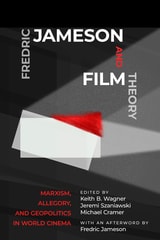
Fredric Jameson and Film Theory
Marxism, Allegory, and Geopolitics in World CinemaKeith B. Wagner
Rutgers University Press, 2022
Frederic Jameson and Film Theory is the first collection of its kind, it assesses and critically responds to Fredric Jameson’s remarkable contribution to film theory. The essays assembled explore key Jamesonian concepts—such as totality, national allegory, geopolitics, globalization, representation, and pastiche—and his historical schema of realism, modernism, and postmodernism, considering, in both cases, how these can be applied, revised, expanded and challenged within film studies. Featuring essays by leading and emerging voices in the field, the volume probes the contours and complexities of neoliberal capitalism across the globe and explores world cinema's situation within these forces by deploying and adapting Jamesonian concepts, and placing them in dialogue with other theoretical paradigms. The result is an innovative and rigorously analytical effort that offers a range of Marxist-inspired approaches towards cinemas from Asia, Latin America, Europe, and North America in the spirit of Jameson's famous rallying cry: 'always historicize!'.
[more]
Marxism and Media Studies
Key Concepts and Contemporary TrendsMike Wayne
Pluto Press, 2003
[more]
Political Film
The Dialectics of Third CinemaMike Wayne
Pluto Press, 2001
Third Cinema is a cinema committed to social and cultural emancipation. In this book, Mike Wayne argues that Third Cinema is absolutely central to key debates concerning contemporary film practices and cultures. As a body of films, Third Cinema expands our horizons of the medium and its possibilities. Wayne develops Third Cinema theory by exploring its dialectical relations with First Cinema (dominant,commercial) and Second Cinema (arthouse,auteur). Discussing an eclectic range of films, from Evita to Dollar Mambo, The Big Lebowski to The Journey, Amistad to Camp de Thiaroye, Political Film explores the affinities and crucial political differences between First and Third Cinema. Third Cinema’s relationship with Second Cinema is explored via the cinematic figure of the bandit (Bandit Queen, The General, Eskiya). The continuities and differences with European precursors such as Eisenstein, Vertov, Lukacs, Brecht and Walter Benjamin are also assessed. The book is a polemical call for a film criticism that is politically engaged with the life of the masses.
[more]

Politics of Contemporary European Cinema
Mike Wayne
Intellect Books, 1995
How does contemporary European Cinema reflect the drive for political and economic integration and recent trends in globalisation, if at all? This book is a valuable excursion into the politics of European cinema and extensively addresses questions like this.
Mike Wayne identifies some key themes pertinent to a study of the contemporary cultural and political dynamics of European cinema from the mid-1980's, including the fall of the Berlin wall and the end of the Soviet Empire.
Throughout the book, issues are raised that question European culture and the nature of national cinema, including;
• The cultural relationship with Hollywood;
• Debates over cultural plurality and diversity;
• The disintegration of nation states along the eastern flank;
• Postcolonial travels and the hybridisation of the national formation.
[more]
Understanding Film
Marxist PerspectivesEdited by Mike Wayne
Pluto Press, 2005
"Marxism and Film share at least one thing in common: they are both interested in the masses."
From the introduction
Film remains one of the most dominant cultural forms in the world today. Crossing classes and cultures, it permeates many aspects of our consciousness. In film, perhaps more than any other medium, we can read the politics of time and place, past and present. The history of Marxism has intersected with film in many ways and this book is a timely reminder of the fruits of that intersection, in film theory and film practice. Marxist film theory returns to film studies some of the key concepts which make possible a truly radical, political understanding of the medium and its place both within capitalism and against it. This book shows how questions of ideology, technology and industry must be situated in relation to class – a category which academia is distinctly uncomfortable with. It explores the work of some of the key theorists who have influenced our understanding of film, such as Adorno, Althusser, Benjamin, Brecht, Gramsci, Jameson and others. It shows how films must be situated in their social and historical contexts, whether Hollywood, Russian, Cuban, Chinese or North Korean cinema. The authors explore the political contradictions and tensions within dominant cinema and discuss how Marxist filmmakers have pushed the medium in new and exciting directions.
[more]