Results by title
5 books match the query 'We'

"We, the Barbarians"
Three Mexican Writers in the Twenty-First CenturyMabel Moraña; Translated by Stephanie L. Kirk
Vanderbilt University Press, 2024
Characterized by the fragmentation of civil society and the decomposition of the myths that accompanied the consolidation of the modern nation, Mexican visual and literary arts have explored a myriad of representational avenues to approach the phenomena of violence, institutional decay, and political instability. The critical and theoretical approaches in “We, the Barbarians” explore a variety of alternative symbolic representations of topics such as nationalism, community, and affect in times impacted by systemic violence, precariousness, and radical inequality. Moraña perceives the negotiations between regional/local imaginaries and global scenarios characterized by the devaluation and resignification of life, both at individual and collective levels. Though it uses three authors as its focus, this book seeks to more broadly theorize the question of the relationship between literature and the social in the twenty-first century.
We the Elites
Why the US Constitution Serves the FewRobert
Pluto Press, 2022
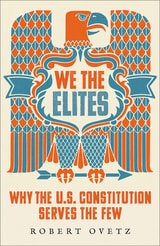
An adroit collection of essays exposing the constitution for what it really is – a rulebook to protect capitalism for the elites.
Written by 55 of the richest white men of early America, and signed by only 39 of them, the constitution is the sacred text of American nationalism. Popular perceptions of it are mired in idolatry, myth, and misinformation - many Americans have opinions on the constitution but have no idea what’s in it.
The misplaced faith of social movements in the constitution as a framework for achieving justice actually obstructs social change - incessant lengthy election cycles, staggered terms, and legislative sessions have kept social movements trapped in a redundant loop. This stymies progress on issues like labor rights, public health, and climate change, projecting the American people and the rest of the world towards destruction.
Robert Ovetz’s reading of the constitution shows that the system isn’t broken. Far from it. It works as it was designed.
We, Too, Are Americans
African American Women in Detroit and Richmond, 1940-54Megan Taylor Shockley
University of Illinois Press, 2003
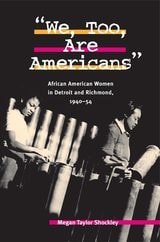
As demands on them intensified, the women working to provide American troops with clothing, medical supplies, and other services became increasingly aware of their key role in the war effort. A considerable number of the African Americans among them began to use their indispensability to leverage demands for equal employment, welfare and citizenship benefits, fair treatment, good working conditions, and other considerations previously denied them.
Shockley shows that as these women strove to redefine citizenship, backing up their claims to equality with lawsuits, sit-ins, and other forms of activism, they were forging tools that civil rights activists would continue to use in the years to come.

We, the People
Politics of National Peculiarity in Southeastern EuropeDiana Mishkova
Central European University Press, 2009
We
Reviving Social HopeRonald Aronson
University of Chicago Press, 2017
Beneath today’s crisis Aronson examines our heartbreaking story: a century of catastrophic violence and the bewildering ambiguity of progress—all of which have contributed to the evaporation of social hope. As he shows, we are now in a time when hope is increasingly privatized, when—despite all the ways we are connected to each other—we are desperately alone, struggling to weather the maelstrom around us, demoralized by the cynicism that permeates our culture and politics, and burdened with finding personal solutions to social problems.
Yet, Aronson argues, even at a time when false hopes are rife, social hope still persists. Carefully exploring what we mean when we say we “hope” and teasing hope apart from its dangerously misconstrued sibling, “progress,” he locates seeds of real change. He argues that always underlying our experience—even if we completely ignore it—is the fact of our social belonging, and that this can be reactivated into a powerful collective force, an active we. He looks to various political movements, from the massive collective force of environmentalists to the movements around Sanders and Jeremy Corbyn, as powerful examples of socially energized, politically determined, and actionably engaged forms of hope. Even in this age of Donald Trump, the result is an illuminating and inspiring call that anyone can clearly hear: we can still create a better future for everyone, but only if we resist false hopes and act together.