Results by title
10 books match the query 'We Are'
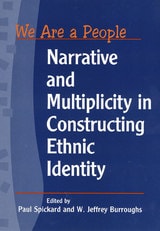
We Are A People
Paul Spickard
Temple University Press, 2000
The growing recognition that ethnicity is not fixed and inherent, but elastic and constructed, fuels the essays in this collection. Regarding identity as a dynamic, on-going, formative and transformative process, We Are a People considers narrative -- the creation and maintenance of a common story -- as the keystone in building a sense of peoplehood. Myths of origin, triumph over adversity, migration, and so forth, chart a group's history, while continual additions to the larger narrative stress moving into the future as a people.
Still, there is more to our stories as individuals and groups. Most of us are aware that we take on different roles and project different aspects of ourselves depending on the situation. Some individuals who have inherited multiple group affiliations from their families view themselves not as this or that but all at once. So too with ethnic groups. The so-called hyphenated Americans are not the only people in the world to recognize or embrace their plurality. This relatively recent acknowledgment of multiplicity has potentially wide implications, destabilizing the limited (and limiting) categories inscribed in, for example, public policy and discourse on race relations.
We Are a People is a path-breaking volume, boldly illustrating how ethnic identity works in the real world.
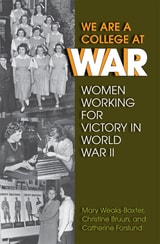
We Are a College at War
Women Working for Victory in World War IIMary Weaks-Baxter, Christine Bruun, and Catherine Forslund
Southern Illinois University Press, 2010
We Are a College at War weaves together the individual World War II experiences of students and faculty at the all-female Rockford College (now Rockford University) in Rockford, Illinois, to draw a broader picture of the role American women and college students played during this defining period in U.S. history. It uses the Rockford community’s letters, speeches, newspaper stories, and personal recollections to demonstrate how American women during the Second World War claimed the right to be everywhere—in factories and other traditionally male workplaces, and even on the front lines—and links their efforts to the rise of feminism and the fight for women’s rights in the 1960s and 1970s.
We Are a People in This World
The Lakota Sioux and the Massacre at Wounded KneeConger Beasley Jr.
University of Arkansas Press, 1997
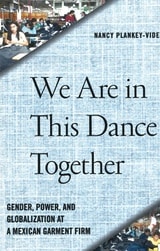
We Are in This Dance Together
Gender, Power, and Globalization at a Mexican Garment FirmPlankey-Videla, Nancy
Rutgers University Press, 2012
Changes in the global economy have real and contradictory outcomes for the everyday lives of women workers. In 2001, Nancy Plankey-Videla had a rare opportunity to witness these effects firsthand. Having secured access to one of Latin America's top producers of high-end men's suits in Mexico for participant-observer research, she labored as a machine operator for nine months on a shop floor made up, mostly, of women. The firm had recently transformed itself from traditional assembly techniques, to lean, cutting-edge, Japanese-style production methods. Lured initially into the firm by way of increased wages and benefits, workers had helped shoulder the company's increasing debts. When the company's plan for successful expansion went awry and it reneged on promises it had made to the workforce, women workers responded by walking out on strike.
Building upon in-depth interviews with over sixty workers, managers, and policy makers, Plankey-Videla documents and analyzes events leading up to the female-led factory strike and its aftermath—including harassment from managers, corrupt union officials and labor authorities, and violent governor-sanctioned police actions. We Are in This Dance Together illustrates how the women's shared identity as workers and mothers—deserving of dignity, respect, and a living wage—became the basis for radicalization and led to further civic organizing against the state, the company, and the corrupt union to demand justice.
We Are the Face of Oaxaca
Testimony and Social MovementsLynn Stephen
Duke University Press, 2013
The movement was met with violent repression. Participants were imprisoned, tortured, and even killed. Lynn Stephen emphasizes the crucial role of testimony in human rights work, indigenous cultural history, community and indigenous radio, and women's articulation of their rights to speak and be heard. She also explores transborder support for APPO, particularly among Oaxacan immigrants in Los Angeles. The book is supplemented by a website featuring video testimonials, pictures, documents, and a timeline of key events.
We Are the Stars
Colonizing and Decolonizing the Oceti Sakowin Literary TraditionSarah Hernandez
University of Arizona Press, 2023
Women and land form the core themes of the book, which brings tribal and settler colonial narratives into comparative analysis. Divided into two parts, the first section of the work explores how settler colonizers used the printing press and boarding schools to displace Oceti Sakowin women as traditional culture keepers and culture bearers with the goal of internally and externally colonizing the Dakota, Nakota, and Lakota nations. The second section focuses on decolonization and explores how contemporary Oceti Sakowin writers and scholars have started to reclaim Dakota, Nakota, and Lakota literatures to decolonize and heal their families, communities, and nations.
We Are the State!
Barrio Activism in Venezuela’s Bolivarian RevolutionCristobal Valencia
University of Arizona Press, 2015
The author offers an anthropological analysis of the state, social movements, and democracy as lived experiences of the poor, gendered, and racialized residents of two parishes in Caracas, Venezuela, and Afro-Venezuelan communities nearby. Ethnographic research reveals the shift in relationships of power and the evolving political practices among the Chavistas, the Chávez government, and the opposition. Examining the subjective experiences of barrio residents in everyday processes of state formation, this book provides a new perspective on the Chavistas, arguing that they are a broad-based social movement and driving force behind a revolution struggling to transfer state power to organized civil society.
Through his intense engagement with the constantly changing social, political, and economic dynamics, Valencia dramatically challenges top-down understandings of the state and power in Venezuela. He shows the unequal relationships between sectors of civil society, and he shows state formation as a process enmeshed in the struggles for social justice, demonstrating that the state is a sociopolitical entity that acts through civil society, rather than above it.
We Are the Union
Democratic Unionism and Dissent at BoeingDana L. Cloud
University of Illinois Press, 2011
We Are the Union is grounded in on-site research and interviews and focuses on the efforts by Unionists for Democratic Change to reform unions from within. Incorporating theory and methods from the fields of organizational communication as well as labor studies, Cloud methodically uncovers and analyzes the goals, strategies, and dilemmas of the dissidents who, while wanting to uphold the ideas and ideals of the union, took up the gauntlet to make it more responsive to workers and less conciliatory toward management, especially in times of economic stress or crisis. Cloud calls for a revival of militant unionism as a response to union leaders' embracing of management and training programs that put workers in the same camp as management, arguing that reform groups should look to the emergence of powerful industrial unions in the United States for guidance on revolutionizing existing institutions and building new ones that truly accommodate workers' needs.
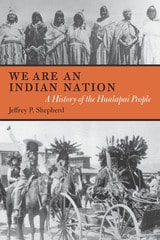
We are an Indian Nation
A History of the Hualapai PeopleJeffrey P. Shepherd
University of Arizona Press, 2010
This book focuses on the historical construction of the Hualapai Nation in the face of modern American colonialism. Drawing on archival research, interviews, and participant observation, Jeffrey Shepherd describes how thirteen bands of extended families known as The Pai confronted American colonialism and in the process recast themselves as a modern Indigenous nation.
Shepherd shows that Hualapai nation-building was a complex process shaped by band identities, competing visions of the past, creative reactions to modernity, and resistance to state power. He analyzes how the Hualapais transformed an externally imposed tribal identity through nationalist discourses of protecting aboriginal territory; and he examines how that discourse strengthened the Hualapais’ claim to land and water while simultaneously reifying a politicized version of their own history. Along the way, he sheds new light on familiar topics—Indian–white conflict, the creation of tribal government, wage labor, federal policy, and Native activism—by applying theories of race, space, historical memory, and decolonization.
Drawing on recent work in American Indian history and Native American studies, Shepherd shows how the Hualapai have strived to reclaim a distinct identity and culture in the face of ongoing colonialism. We Are an Indian Nation is grounded in Hualapai voices and agendas while simultaneously situating their history in the larger tapestry of Native peoples’ confrontations with colonialism and modernity.

We are the People
The Rise of the AfD in GermanyPenny Bochum
Haus Publishing, 2020
We are the People analyzes the sudden growth and radicalization of the AfD, from its Euroskeptic beginnings in 2013 to its increasing extremism. Penny Bochum shows us how the leaders’ use of inflammatory, xenophobic, and even Nazi-era language mirrors that of emerging far-right forces across much of the Western world. At the same time, through a lucid examination of the group’s ideology, Bochum shows how their brand of populism is distinct and based on German experiences and history.