Results by title
12 books match the query 'Web'

A Different Kind of Web
New Connections Between Archives and Our UsersKate Theimer
American Library Association, 2011
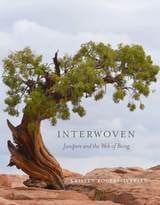
Interwoven
Junipers and the Web of BeingKristen Rogers-Iversen
University of Utah Press, 2017
Throughout prehistory and history, junipers have influenced ecosystems, cultures, mythologies, economics, politics, and environmental controversies. In terms of their effects on human lives the juniper may be the most significant tree in the interior West. Interwoven explores these interconnecting aspects of junipers. Ghost beads, biotic communities, gin, tree masticators, Puebloan diapers, charcoal, folklore, historic explorers, spiral grain, tree life cycles, spirituality, packrat middens, climate changes, wildfire, ranching, wilderness, and land management policies are among the many different threads the book follows. These and other topics shed light on a fascinating organism, but the book is more than a compilation of facts. At once a scientific, experiential, historical, and metaphorical walk among junipers and their interrelationships, Interwoven may change readers’ experiences with these trees and the natural world.
Finalist for the Utah State Historical Society Best Book Award.
Finalist for the 2019 ASLE Book Award for excellence in ecocriticism and environmental creative writing.
Named a “notable book” by the prize committee of the 2018 Sigurd F. Olson Nature Writing Award.
Linked Data Tools
Connecting on the WebKaren American Library Association
American Library Association, 0
Morphology and the Web of Grammar
Essays in Memory of Steven G. LapointeEdited by C. Orhan Orgun and Peter Sells
CSLI, 2003
The Internet and the Madonna
Religious Visionary Experience on the WebPaolo Apolito
University of Chicago Press, 2005
But how has this potent new mix of technology and religiosity changed the way Catholics view their faith? And what challenges do the autonomous qualities of the Internet pose to the broader authority of Catholicism? Does the democratic nature of access to digital technologies constitute a return to a more archaic and mystical form of Catholicism that predates the modernizing reforms of the Second Vatican Council?
In working through these questions, Apolito considers visions of Mary on the Web over the past two decades, revealing a great deal about religion as it is now experienced through new information technologies. The Internet, he explains, has made possible a decentralized community of the devoted, even as it has absorbed God into the shifts and complexities of electronic circuitry. And this profound development in religious life will only accelerate as use of the Internet spreads around the world.
An indispensable guide to the future of Catholicism, The Internet and the Madonna offers a compelling glimpse into the spiritual life of the connected soul.
The Web of Differing Versions
Where Africa Ends and America BeginsReid Gómez
University of Minnesota Press, 2026
A visionary reckoning with prophecy, possession, and the grammar of liberation
A bold, experimental intervention in literary and theoretical discourse of colonialism and diaspora, The Web of Differing Versions engages with Leslie Marmon Silko’s 1991 Almanac of the Dead as literature, prophecy, and philosophy. Reid Gómez makes “The Indian Connection” that Silko prophesizes—Land Back!—and offers a prescient response to Silko’s enduring question: who has spiritual possession of the Américas?
Realizing the great capacity of Black and Native studies, Gómez crafts a visionary mode of scholarship that resists acknowledging conceptual, political, spiritual, formal, or linguistic borders. Rather than comparing or separating, she demonstrates how to stop telling things apart: Black|Indian, slavery|colonization, and writing|translation. Gómez shifts focus from racialized identities to the prophesied world itself, working with music, literature, and language to elaborate the connections that exist between racialized bodies, land, and sea as she emphasizes the ubiquity of escape, revolt, and beauty/hózhǫ́.
A theoretical composition, this book enacts a practice of re-visioning that uses Silko’s Almanac to challenge the limits of thought, language, and the very idea of scholarship. Attending the multiplicity of time into times, past into pasts, future into futures, The Web of Differing Versions offers a new grammar for a shared and violent world.
Retail e-book files for this title are screen-reader friendly.
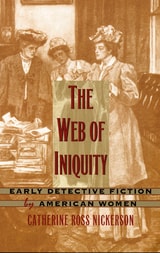
The Web of Iniquity
Early Detective Fiction by American WomenCatherine Ross Nickerson
Duke University Press, 1998
This subgenre allowed women writers to participate in postbellum culture and to critique other aspects of a rapidly changing society. Domestic detective fiction combined elements of sensationalist papers, popular nonfiction crime stories, and the domestic novel. Nickerson shows how it also incorporated the gothic tropes found in the work of Harriet Beecher Stowe, Louisa May Alcott, and Charlotte Brontë and influenced the work of Pauline Hopkins. Mid-nineteenth-century writer Metta Fuller Victor, who represented such important areas of cultural conflict as the role of professions in the formation of class identity and the possibility of women's independence and self-determination, paved the way for the appearance of women detectives in the late-nineteenth-century fiction of Anna Katharine Green. Nickerson credits Mary Roberts Rinehart, in particular, for bringing sophistication to the subgenre by amplifying the humorous, terrifying, and feminist elements inherent in earlier detective novels by women. Throughout the volume, Nickerson focuses on the narrative qualities of the domestic novel tradition and the ways in which it reflected ideologies of domesticity and gender. Also included are a discussion of various rewritings of the Lizzie Borden scandal in this tradition and an afterword on the relation of domestic detective fiction to the hard-boiled style.
The Web of Iniquity places the detective fiction written by women between 1850 and 1940 into ongoing discussions regarding women, culture, and literature and will appeal to scholars and students of women's studies, American studies, and literary history.

The Web of Violence
From Interpersonal to GlobalEdited by Jennifer Turpin and Lester Kurtz
University of Illinois Press, 1996
Violence is a topic of concern everywhere--in the media, in churches, in the halls of governments. In every land and in every culture violence is considered by most to be taboo, a last resort. Yet under certain conditions, from the level of the family to the level of nations, violence is used as a mechanism of social control. Various rationalizations thus emerge to distinguish between legitimate and illegitimate violence.
The Web of Violence explores the interrelationship among personal, collective, national, and global levels of violence. This unique collection brings together a number of internationally known contributors to address the genesis and manifestations of violence in the search for a remedy for this confounding social problem.
As the global community becomes more intimate, we must better understand the nature of violence. The Web of Violence supports this aim by examining the dangerous human phenomenon from many perspectives, at different levels, and using multiple methodologies.
Contributors: Robert Jay Lifton, Christopher G. Ellison, John P. Bartkowski, Yuan-Horng Chu, Philip Smith, Robert Elias, Birgit Brock-Utne, Riane Eisler, Johan Galtung
Threads from the Web of Life & The Shark and the Jellyfish
Stories in Natural HistoryStephen Daubert
Vanderbilt University Press, 2019
One niche moves across a world of flowers that reaches its earliest peak bloom in the low valleys and then peaks later among the slopes of the foothills—a rolling habitat. Another hop-scotches across the ocean floor, compelling its occupants to migrate from the fallen body of one dead whale to the next. Yet another appears in the aftermath of typhoons, requiring its inhabitants to search the tropical coastline for the latest storm landfall.
These tales are filled with no less intrigue than other literary works, but they transpire out of the sight of most readers. Once known only to ecologists, in Threads from the Web of Life and The Shark and the Jellyfish, available for the first time in a single deluxe paperback, these stories become accessible to everyone with an interest in natural history.
Threads from the Web of Life
Stories in Natural HistoryStephen Daubert
Vanderbilt University Press, 2006
In sixteen stories Steve Daubert pulls the reader into the mystery and immediacy of ecological processes spanning a range from microscopic to tectonic, from microscopic to cosmic forces. Each tale brings the reader into the moment to witness an episode of survival in the wild first-hand. The material is presented on a level of intimacy and detail not usually encountered in other styles of natural history writing.
These creative non-fiction stories provide not just a bird's eye view (though that's true for the owls, warblers, condors, and hummingbirds in the book), but a wasp's eye view, a mouse's, a sea turtle's, a squid's. Sometimes the focus is as small as the detritus on the forest floor, or a single beat of the wing of a gull. Other stories range across evolutionary time. From whales and dinosaurs to creatures invisible to the naked eye, author and illustrator bring to life the dynamic interplay of living, evolving creatures and the natural forces that have shaped their worlds.
The book includes chapter notes that document the scientific basis for each story and describe the controversies still surrounding some of them -- a splendid resource for families to read and share.

WEB OF FANTASIES
Gaze, Image, & Gender in Ovid’s MetamorphosesPatricia B Salzman-Mitchell
The Ohio State University Press, 2005
The book observes that while feminist models of the gaze can create productive readings of the poem, these models are too limited and reductive for such a protean and complex text as Metamorphoses. This work brings forth the pervasive importance of the act of looking in the poem which will affect future readings of Ovid’s epic.
Web as History
Using Web Archives to Understand the Past and the PresentEdited by Niels Brügger and Ralph Schroeder
University College London, 2017