Results by title
6 books match the query 'Weigl, Bruce'
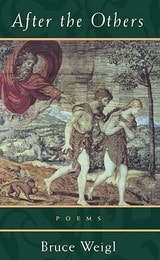
After the Others
PoemsBruce Weigl
Northwestern University Press, 1999
In his twelfth volume of poetry, Bruce Weigl continues his quest for emotional and spiritual enlightenment. Quiet and moving, these poems combine an intimate voice with a searingly direct look at suffering and senseless violence, at human desire and love, and at man's relationship with nature.
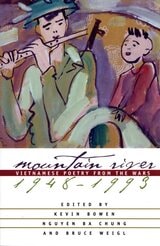
Mountain River
Vietnamese Poetry from the Wars, 1948-1993Kevin Bowen
University of Massachusetts Press, 1998
This landmark bilingual collection presents a comprehensive selection of Vietnamese poetry spanning nearly fifty years of warfare and its aftermath, from the Indochinese War (1946-1954) through the Vietnam War (1961-1975) and into the post-war period. Edited and translated by renowned Vietnam War scholars and poets Kevin Bowen and Bruce Weigl, in collaboration with Vietnamese poet and editor Nguyen Ba Chung, this volume captures the voices of Vietnamese writers who experienced, witnessed, or processed the transformative conflicts that shaped modern Vietnam.
Encompassing poetry from multiple generations, these poems reflect on the diverse responses to conflict: some express patriotic commitment, others grapple with loss and trauma, while many explore the intimate human experiences of war. Mountain River demonstrates how Vietnamese poets drew upon a rich literary tradition while creating new forms of expression to address the unprecedented scale of modern warfare. The result is a collaborative effort that represents a significant achievement in postwar Vietnamese-American literary relations and cross-cultural translation.

Poems from Captured Documents
A Bilingual EditionThanh T. Nguyen
University of Massachusetts Press, 1994
Written in journals and notebooks by ordinary soldiers who fought against American forces in Vietnam, the poems collected in this volume fill a longstanding void in the literature of that war. In addition to offering a revealing window into another culture – a culture that prizes poetry as an integral part of social life – the pieces provide a rare look at the conflict from the perspective of those who served in the National Liberation Front, the People’s Armed Forces, and the People’s Army of Vietnam.
The format of this edition is bilingual, to enable both Vietnamese and American readers to share and appreciate these poignant and deeply personal documents, which were often written under fire and always in the face of death.
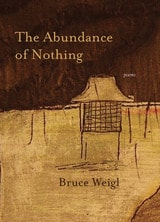
The Abundance of Nothing
PoemsBruce Weigl
Northwestern University Press, 2012
Finalist, 2013 Pulitzer Prize for Poetry
Throughout his award-winning career, Bruce Weigl has proven himself to be a poet of extraordinary emotional acuity and consummate craftsmanship. In The Abundance of Nothing, these qualities are on full display, animating and informing poems that combine rich, metaphoric imagery with direct, powerful language. Deftly weaving history and everyday experience, Weigl transports readers from the front lines of the Vietnam War and all the tangled cultural and emotional scenes of that time to the slow winds of the American Midwest that softly ease the voice of the veteran returning home. Though the poems struggle with themes of mortality and illness, violence and forgiveness, the poet’s voice never wavers in its meditative calm, poise, and compassion. Elegiac yet agile, ethereal yet embodied, The Abundance of Nothing is a work of searching openness, generous insight, and remarkable grace.
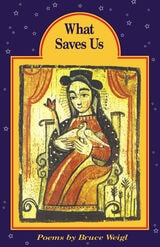
What Saves Us
Bruce Weigl
Northwestern University Press, 1994
In these wrenching, elegant poems, Bruce Weigl writes out of uncompromising memory and vision. His subject is both the transport and anguish of being open to the lived and living moment. From bars and bedrooms, in Ohio and Nicaragua and Vietnam, his voice rises through the noise of history and habit to reach us with impeccable grace and remarkable invention.
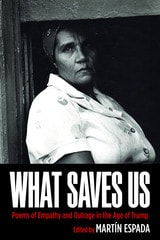
What Saves Us
Poems of Empathy and Outrage in the Age of TrumpEdited by Martín Espada
Northwestern University Press, 2019
This is an anthology of poems in the Age of Trump—and much more than Trump. These are poems that either embody or express a sense of empathy or outrage, both prior to and following his election, since it is empathy the president lacks and outrage he provokes.
There is an extraordinary diversity of voices here. The ninety-three poets featured include Elizabeth Alexander, Julia Alvarez, Richard Blanco, Carolyn Forché, Aracelis Girmay, Donald Hall, Juan Felipe Herrera, Yusef Komunyakaa, Naomi Shihab Nye, Marge Piercy, Robert Pinsky, Danez Smith, Patricia Smith, Brian Turner, Ocean Vuong, Bruce Weigl, and Eleanor Wilner. They speak of persecuted and scapegoated immigrants. They bear witness to violence: police brutality against African Americans, mass shootings in a school or synagogue, the rage inflicted on women everywhere. They testify to poverty: the waitress surviving on leftovers at the restaurant, the battles of a teacher in a shelter for homeless mothers, the emergency-room doctor listening to the heartbeats of his patients. There are voices of labor, in the factory and the fields. There are prophetic voices, imploring us to imagine the world we will leave behind in ruins lest we speak and act.
However, this is not merely a collection of grievances. The poets build bridges. One poet steps up to translate in Arabic at the airport; another walks through the city and sees her immigrant past in the immigrant present; another declaims a musical manifesto after the hurricane that devastated his island; another evokes a demonstration in the street, shouting in an ecstasy of defiance. The poets take back the language, resisting the demagogic corruption of words themselves. They assert our common humanity in the face of dehumanization.