Results by title
4 books match the query 'Weinberger, Leon J.'
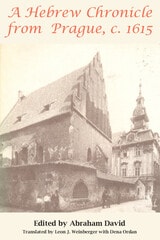
A Hebrew Chronicle from Prague, C. 1615
Abraham David
University of Alabama Press, 1993
"This slender anonymous work, spanning 1389 to 1611, presents the priorities and concerns of a Jewish community straddling the late medieval and early modern periods. Ample footnotes and explanations provide the lay reader with sufficient background to understand the references to historical events and figures, to ideologies and to institutions. A comprehensive introduction presents the realities of Prague and Bohemia, as well as offering a helpful discussion of the chronicle and other contemporary Jewish accounts."
—Conservative Jewish Quarterly
"In about 1615 an anonymous Jew from Prague composed a short Hebrew chronicle to recount 'the expulsions, miracles, and other occurrences befalling [the Jews] in Prague and the other lands of our long exile.' Abraham David discovered the manuscript [and] added glosses, historical notes, and an introduction. . . . The chronicle, with its brief annual entries, is not a continuous narrative, but does give a feeling of immediacy, like a newspaper."
—Polin: Studies in Polish Jewry
Bulgaria's Synagogue Poets
The KastoreansEdited by Leon J. Weinberger
University of Alabama Press, 1983
Critical Edition with introduction and commentary by Leon J. Weinberger
This is the first in-depth study of three 11th- to 12th-century poets from Balkan Byzantium. Included are all of the known works by Moses b. Hiyya, Joseph b. Jacob Qalai, and Isaac b. Judah, collected from rare manuscripts and printed editions and from Geniza collections at Oxford and Cambridge. These works provide the evidence that the Balkan synagogue poets favored distinctive literary forms even as they show the strong influence of the Hispanic-Hebrew writers. Completing the volume are indexes of rabbinic, Aramaic, and payyetanic usages and tables of metonymical terms.Published by the Hebrew Union College Press, distributed by The University of Alabama Press.
Jewish Prince in Moslem Spain
Selected Poems of Samuel Ibn NagrelaSamuel Ibn Nagrela
University of Alabama Press, 2005
Of all the Hebrew poets of the 'Golden Age' in Spain, Samuel Ibn Nagrela (993-1056 A.D.) remains perhaps the most fascinating personality. A leading statesman in the kingdom of Granada, he was as successful in court as on the battlefield, maintaining a position of power for several decades while walking a political tightrope. Endowed with great literary talents, he opened up new paths in Hebrew poetry, and his mastery of its metrical intricacies was as consummate as his political and military skill.
Twilight of a Golden Age
Selected Poems of Abraham Ibn EzraWeinberger, Leon J.
University of Alabama Press, 1997