Results by title
3 books match the query 'Weiss-Wendt, Anton'
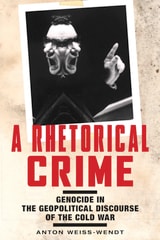
A Rhetorical Crime
Genocide in the Geopolitical Discourse of the Cold WarWeiss-Wendt, Anton
Rutgers University Press, 2018
A Rhetorical Crime shows how genocide morphed from a legal concept into a political discourse used in propaganda battles between the United States and the Soviet Union. Over the course of the Cold War era, nearly eighty countries were accused of genocide, and yet there were few real-time interventions to stop the atrocities committed by genocidal regimes like the Cambodian Khmer Rouge.
Renowned genocide scholar Anton Weiss-Wendt employs a unique comparative approach, analyzing the statements of Soviet and American politicians, historians, and legal scholars in order to deduce why their moral posturing far exceeded their humanitarian action.
On the Margins
Essays on the History of Jews in EstoniaAnton Weiss-Wendt
Central European University Press, 2017
Estonia is perhaps the only country in Europe that lacks a comprehensive history of its Jewish minority. Spanning over 150 years of Estonian Jewish history, On the Margins is a truly unique book. Rebuilding a life beyond so-called Pale of Jewish Settlement in the Russian Empire, the Jewish cultural autonomy in interwar Estonia, and the trauma of Soviet occupation of 1940–41 are among the issues addressed in the book but most profoundly, the book wrestles with the subject of the Holocaust and its legacy in Estonia.
Specifically, it examines the quasi-legal system of murder instituted in Nazi-occupied Estonia, confiscation of Jewish property, and Jewish forced labor camps and develops an analysis of the causes of collaboration during the Holocaust. The book also explores the dynamics of war crimes trials in the Soviet Union since the 1960s and so-called denaturalization trials in the United States in the 1980s. The haunting memory of Soviet and Nazi rule, the book concludes, prevents a larger segment of today’s Estonian population from facing up to the Holocaust and the universal message that it carries.E
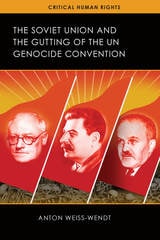
The Soviet Union and the Gutting of the UN Genocide Convention
Anton Weiss-Wendt
University of Wisconsin Press, 2017
Based on extensive archival research, Anton Weiss-Wendt reveals in detail how the political aims of the superpowers rendered the convention a weak instrument for addressing abuses against human rights. The Kremlin viewed the genocide treaty as a political document and feared repercussions. What the Soviets wanted most was to keep the subjugation of Eastern Europe and the vast system of forced labor camps out of the genocide discourse. The American Bar Association and Senate Committee on Foreign Relations, in turn, worried that the Convention contained vague formulations that could be used against the United States, especially in relation to the plight of African Americans. Sidelined in the heated discussions, Weiss-Wendt shows, were humanitarian concerns for preventing future genocides.