Results by title

7 books match the query 'Western Culture'
cover of Amythia: Crisis in the Natural History of Western Culture

Amythia

Crisis in the Natural History of Western Culture

Loyal D. Rue

University of Alabama Press, 1989

A provocative analysis of the ways our culture suffers amythia
 
Amythia results when cosmology and morality are not effectively integrated by a root metaphor, and the only possibility for the future is to transpose the old Christian God as Person to a root metaphor that is even older in origin, the concept of the Covenant tradition inherited from Israel but now understood in a nonsupernaturalist manner.
 
Rue asserts that amythia is a critical condition within the natural history of Western culture. The argument of the book begins with a theoretical perspective on the place of human culture within the scope of natural history and proceeds to establish the conceptual foundations for a natural history of culture.
 
Following an overview of the natural history of Western culture to expose the origins and depth of the contemporary intellectual and moral crisis, Rue moves on to specify and justify the limits of distinctiveness and plausibility appropriate for the task of transposing Covenant tradition. Finally, an appeal is made to the mythmakers of contemporary culture to take up the challenge of amythia.
 
[more]
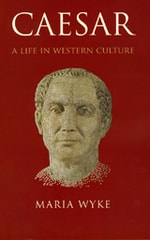
cover of Caesar: A Life in Western Culture

Caesar

A Life in Western Culture

Maria Wyke

University of Chicago Press, 2008
More than two millennia have passed since Brutus and his companions murdered Julius Caesar—and inaugurated his legend. Though the assassins succeeded in ending Caesar’s dictatorship, they could never have imagined that his power and influence would only grow after his death, reaching mythic proportions and establishing him as one of the central icons of Western culture, fascinating armchair historians and specialists alike.
 
With Caesar, Maria Wyke takes up the question of just why Julius Caesar has become such an exalted figure when most of his fellow Romans have long been forgotten. Focusing on key events in Caesar’s life, she begins with accounts from ancient sources, then traces the ways in which his legend has been adapted and employed by everyone from Machiavelli to Madison Avenue, Shakespeare to George Bernard Shaw. Napoleon and Mussolini, for example, cited Caesar’s crossing of the Rubicon in defense of their own dictatorial aims, while John Wilkes Booth fancied himself a new Brutus, ridding America of an imperial scourge. Caesar’s personal life, too, has long been fair game—but the lessons we draw from it have changed: Suetonius derided Caesar for his lustfulness and his love of luxury, but these days he and his lover Cleopatra serve as the very embodiment of glamour, enticingly invoked everywhere from Caesars Palace in Las Vegas to the hit HBO series Rome.
 
Caesar is the witty and perceptive work of a writer who is as comfortable with the implications of Xena: Warrior Princess as with the long shadow cast by the Annals of Tacitus. Wyke gives us a Caesar for our own time: complicated, hotly contested, and perpetually, fascinatingly renewed.
 
[more]
cover of Ethics through Literature: Ascetic and Aesthetic Reading in Western Culture

Ethics through Literature

Ascetic and Aesthetic Reading in Western Culture

Brian Stock

Brandeis University Press, 2008
Why do we read? Drawing from a series of lectures delivered at the Historical Society of Israel in 2005, Brian Stock presents a model for relating ascetic and aesthetic principles in Western reading practices. He begins by establishing the primacy of the ethical objective in the ascetic approach to literature in Western classical thought from Plato to Augustine. This is understood in contrast to the aesthetic appreciation of literature that finds pleasure in the reading of the text in and of itself. Examples of this long-standing tension as displayed in a literary topos, first outlined in these lectures, which describes “scenes of reading,” are found in the works of Peter Abelard, Dante, and Virginia Woolf, among others. But, as this original and often surprising work shows, the distinction between the ascetic and aesthetic impulse in reading, while necessary, is often misleading. As he writes, “All Western reading, it would appear, has an ethical component, and the value placed on this component does not change much over time.” Tracing the ascetic component of reading from Late Antiquity through the Renaissance and beyond, to Coleridge and Schopenhauer, Stock reveals the ascetic or ethical as a constant with the aesthetic serving as opposition, parallel force, and handmaiden, underscoring the historical consistency of the reading experience through the ages and across various media.
[more]
cover of Fiction Sets You Free: Literature, Liberty, and Western Culture

Fiction Sets You Free

Literature, Liberty, and Western Culture

Russell A. Berman

University of Iowa Press, 2007

In what can only be called a genuine intellectual adventure, Russell Berman raises fundamental questions long ignored by literary scholars: Why does literature command our attention at all? Why would society want to cultivate a sphere of activity devoted to the careful study of literary ?ction? Written as a tonic to what he calls the debilitating cultural relativism of contemporary literary studies, Fiction Sets You Free advances the innovative argument that literature and capitalism, rather than representing merely commercialization, actually belie a long and positive association: literary autonomy is a central part of modern Western culture, thoroughly intertwined with political democracy and free-market capitalism.

Berman particularly challenges the issue of periodization, in which current scholarship emphasizes historical context over the integrity of a literary work and thus neglects the capacity of literature to remain interesting in other times and contexts. By moving from the origins of human language through the development of written alphabets and sacred texts, eventually probing the role of public literature in the creation of community, Berman elegantly and cogently surveys the intellectual landscape of Western societies. By giving us the license to dream and envision other worlds, literature sets us free.

[more]
cover of Postmodernism and the Other: New Imperialism of Western Culture

Postmodernism and the Other

New Imperialism of Western Culture

Ziauddin Sardar

Pluto Press, 1997

This controversial work examines postmodernism from a non-Western perspective, and exposes its claims as a sham. Sardar makes a systematic assessment of the salient spheres of postmodernism - from philosophy and architecture, to film, music and new age religions - and reveals that, contrary to commonly-held notions, postmodernism operates to further marginalise the reality of the non-West and confound its aspirations.
[more]
cover of Stanzas: Word and Phantasm in Western Culture

Stanzas

Word and Phantasm in Western Culture

Georgio Agamben

University of Minnesota Press, 1992
Stanzas is a fascinating blend of philology, medieval physics and psychology, the psychoanalysis of toys, and contemporary linguistics and philosophy. In this unique work, Giorgio Agamben attempts to reconfigure the epistemological foundation of Western culture. He rereads Freud and Saussure to discover the impossibility of metalanguage and of synthesis that could be reflected in the transparency of signs. There is no "superior language" that can read the obscure scenes of the unconscious, and the "symbol" is always the return of the repressed in an improper signifier. This impossibility leads Agamben to the problem of representation. He argues that because language is the locus of the production and storage of phantasms, all real objects are fractured by phantasmic itineraries that in turn divide poetry and philosophy, joy and knowledge. Giorgio Agamben teaches philosophy at the Collège International de Philosophie in Paris and at the University of Macerata in Italy. He is the author of Language and Death (1991), The Coming Community (1993), and Means without End (2000).
[more]
cover of The Ruins Lesson: Meaning and Material in Western Culture

The Ruins Lesson

Meaning and Material in Western Culture

Susan Stewart

University of Chicago Press, 2019

How have ruins become so valued in Western culture and so central to our art and literature? Covering a vast chronological and geographical range, from ancient Egyptian inscriptions to twentieth-century memorials, Susan Stewart seeks to answer this question as she traces the appeal of ruins and ruins images, and the lessons that writers and artists have drawn from their haunting forms.

Stewart takes us on a sweeping journey through founding legends of broken covenants and original sin, the Christian appropriation of the classical past, and images of decay in early modern allegory. Stewart looks in depth at the works of Goethe, Piranesi, Blake, and Wordsworth, each of whom found in ruins a means of reinventing his art. Lively and engaging, The Ruins Lesson ultimately asks what can resist ruination—and finds in the self-transforming, ever-fleeting practices of language and thought a clue to what might truly endure.
[more]