Results by title
9 books match the query 'Western Front'
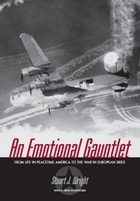
An Emotional Gauntlet
From Life in Peacetime America to the War in European SkiesStuart J. Wright
University of Wisconsin Press, 2008
In recounting the harrowing conditions and horrors of bombing missions over Europe, An Emotional Gauntlet emphasizes the interpersonal relationships within the crew and the spirit these men shared. Corky's crew served under Operations Officer Major James Stewart (the Hollywood movie star.) They often returned from arduous bombing missions to sleep in half-empty huts—their friends in other planes had not been so lucky. Pilot Jack Nortridge regularly assured his crew, "If you fly with me, I'm going to bring you home." This book is a testament to their strength and determination.
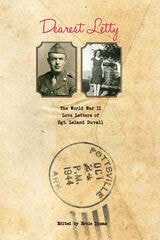
Dearest Letty
The World War II Love Letters of Sgt. Leland DuvallLeland Duvall
University of Arkansas Press, 2011

Death and Life in the Big Red One
A Soldier’s World War II Journey from North Africa to GermanyJoseph P. Olexa
University of North Texas Press, 2023
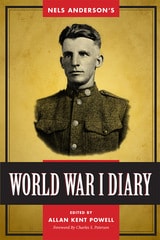
Nels Anderson’s World War I Diary
Allan Kent Powell
University of Utah Press, 2013
Nels Anderson’s World War I Diary provides a rare glimpse into the wartime experiences of one of the most well-respected sociologists of the twentieth century, the renowned author of The Hobo (1920) and Desert Saints: The Mormon Frontier in Utah (1942). Anderson, a keen observer of people, places, and events his entire life, joined the U.S. Army in 1918 at the age of 29 and was sent to Europe to fight as part of the Allied Expeditionary Force (AEF) under General Pershing. Because keeping a journal was strongly discouraged among American forces during WWI, particularly among the rank-and-file soldiers, Anderson’s diary stands as a rare gem. Furthermore, it is the only known account of war service during WWI by a member of the LDS Church. Anderson joined the Mormon faith after accepting the hospitality of an extended Mormon ranching family during his travels throughout the American West as a working hobo.
Anderson’s accounts of the St. Mihiel and Meuse-Argonne offensives are particularly remarkable given the challenges of keeping a detailed journal amidst the chaos and suffering of the war’s Western Front. His insights into the depravity and callousness of war are buttressed with intimate human portraits of those to whom he was closest. The war years provided many formative experiences that would prove to have a lasting influence on Anderson’s views regarding the working poor, authority, and human values; this would come to bear heavily on his later work as a pioneering sociologist at the University of Chicago, where he helped establish participant observation as a research method. The many introspective entries contained in this volume will be of reat interest to military historians and history buffs as well as to those in the social sciences looking to find the intellectual origins of Anderson’s later work in the burgeoning field of sociology.
Winner of the Army Historical Foundation Distinguished Writing Award for Journals, Memoirs, and Letters.

Normandy to the Bulge
An American GI in Europe During World War IIRichard Courtney
Southern Illinois University Press, 1997
Basing this compelling war memoir on his original World War II diary, Pfc. Richard D. Courtney tells what it was like to be a combat infantryman in the greatest and most destructive war in history.
The AEF in Print
An Anthology of American Journalism in World War IChris Dubbs
University of North Texas Press, 2018
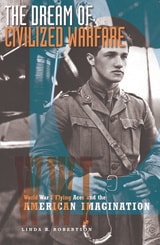
The Dream of Civilized Warfare
World War I Flying Aces and the American ImaginationLinda R. Robertson
University of Minnesota Press, 2005
Analyzes the link between “civilized warfare” and the American self-image
Linda R. Robertson argues that the development of the United States as a global military power arose from the influence of an image of air combat carefully constructed during World War I to mask the sordid realities of modern ground warfare. The Dream of Civilized Warfare carries this trajectory to its logical end, tracing the long history of the American desire to exert the nation’s will throughout the world without having to risk the lives of ground soldiers—a theme that continues to reverberate in public discussions, media portrayals, and policy decisions today.
Histories of American air power usually focus on World War II, when the air force became the foundation for the military strength of the United States. The equally fascinating story of World War I air combat is often relegated to a footnote, but it was the earlier war that first inspired the vision of the United States attaining dominance in world affairs through a massive air force. In The Dream of Civilized Warfare, Robertson presents the compelling story of the creation of the first American air force—and how, through the propaganda of the flying ace, a vision of “clean” or civilized combat was sold to politicians and the public. During World War I, air combat came to epitomize American ingenuity, technological superiority, adventure, leadership, and teamwork. Robertson reveals how the romantic and chivalric imagery associated with flying aces was a product of intentional propaganda and popular culture. Examining aviation history, military battles, films, literature, and political events, she looks at how the American public’s imagination was shaped—how flying aces offered not only a symbol of warfare in stark contrast to the muddy, brutal world of the trenches, but also a distraction to an American public resistant to both intervention in a European conflict and the new practice of conscription.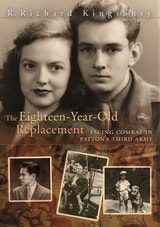
The Eighteen-Year-Old Replacement
Facing Combat in Patton's Third ArmyR. Richard Kingsbury
University of Missouri Press, 2008
When the United States entered the Second World War, eighteen-year-old enlistees were routinely assigned temporary duties and not sent into battle until they turned nineteen. But as the fighting dragged on, America was eventually forced to draft younger men into combat to replace wounded troops—and following the Battle of the Bulge, more than 300,000 eighteen-year-olds were sent as replacements to the army’s decimated divisions.
In The Eighteen-Year-Old Replacement, Richard Kingsbury brings an often-overlooked perspective to the annals of World War II. Torn from an ordinary teenager’s life in the Midwest, young Dick was drafted six weeks after D-Day and rushed with other eighteen-year-olds to the Siegfried Line to bolster Patton’s 94th Infantry Division. His reminiscence provides a moving, diarylike account of what he endured both physically and emotionally—and tells how he went from boyhood to manhood almost overnight.
In prose that is both succinct and evocative, Kingsbury recounts his experiences as a rifleman during the final bloody battles in Germany, giving readers a real feel for what combat was like for a raw recruit. He recalls his first night in a foxhole on the front line and the “unbelievable luxury” of sleeping in a barn’s hayloft. He relives freezing cold at the Bulge, which permanently damaged his legs, and the pounding of enemy artillery during Patton’s breakthrough of the German West Wall, which affected his hearing for life.
More poignantly, Kingsbury shares his anxieties over killing—as well as the distinct possibility of being killed as Wehrmacht tanks mercilessly blasted individual foxholes at Bannholz Woods. He vividly recalls Patton’s attack on Ludwigshafen, on the west bank of the Rhine, where he took a German bullet in his chest—and where three of the six newly arrived eighteen-year-olds were killed.
Interspersed with the accounts of battle are letters between Dick and Mary Jo, his sweetheart back home, capturing the blossoming of romance that transcended both distance and bloodshed. His book casts a new light on war—and courtship—in an era when boys were rushed from the home front to the front lines. By showing how crucial the contribution of these young men was to the war effort, this book gives the eighteen-year-old replacements the recognition they have long deserved.
Yesterday There Was Glory
With the 4th Division, A.E.F., in World War IGerald Andrew Howell
University of North Texas Press, 2018