Results by title
2 books match the query 'Western Law'
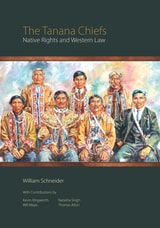
Tanana Chiefs
Native Rights and Western LawEdited by William Schneider
University of Alaska Press, 2018
At the turn of the twentieth century, life was changing drastically in Alaska. The gold rush brought an onslaught of white settlers to the area, railroad companies were pushing into the territory, and telegraph lines opened up new lines of communication. The Native groups who had hunted and fished on the land for more than a century realized that if they did not speak up now, they would lose their land forever.
This is the story of a historic meeting between Native Athabascan leaders and government officials, held in Fairbanks, Alaska in 1915. It was one of the first times that Native voices were part of the official record. They sought education and medical assistance, and they wanted to know what they could expect from the federal government. They hoped for a balance between preserving their way of life with seeking new opportunities under the law.
The Tanana Chiefs chronicles the efforts by Alaska Natives to gain recognition for rights under Western law and the struggles to negotiate government-to-government relationships with the federal government. It contains the first full transcript of the historic meeting as well as essays that connect that first gathering with the continued efforts of the Tanana Chiefs Conference, which continues to meet and fight for Native rights.
[more]
Western Law, Russian Justice
Dostoevsky, the Jury Trial, and the LawGary Rosenshield
University of Wisconsin Press, 2005
Gary Rosenshield offers a new interpretation of Dostoevsky's greatest novel, The Brothers Karamazov. He explores Dostoevsky's critique and exploitation of the jury trial for his own ideological agenda, both in his journalism and his fiction, contextualizing his portrayal of trials and trial participants (lawyers, jurors, defendants, judges) in the political, social, and ideological milieu of his time. Further, the author presents Dostoevsky's critique in terms of the main notions of the critical legal studies movement in the United States, showing how, over one hundred and twenty years ago, Dostoevsky explicitly dealt with the same problems that the law-and-literature movement has been confronting over the past two decades. This book should appeal to anyone with an interest in Russian literature, Russian history and culture, legal studies, law and literature, narratology, or metafiction and literary theory.
[more]