Results by title
3 books match the query 'Whalers (Persons)'
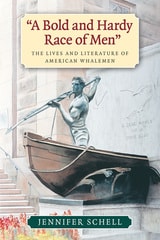
"A Bold and Hardy Race of Men"
The Lives and Literature of American WhalemenJennifer Schell
University of Massachusetts Press, 2013
In his novel Miriam Coffin, or The Whale-Fishermen (1834), Joseph C. Hart proclaimed that his characters were “a bold and hardy race of men,” who deserved the “expressive title of American Whale-Fishermen.” Hart was not the only American author to applaud these physical laborers as the embodiment of national manhood. Heroic portraits of whalers first appeared in American literature during the 1780s, and they proliferated across time. Writers as various as Lydia Howard Huntley Sigourney, Frederick Douglass, and Walt Whitman celebrated the talents of the seafarers who transformed the New England whale fishery into a globally dominant industry. But these images did not go unchallenged. Alternative visions—some of which undermined the iconic status of the trade and its workers—began to proliferate. Even so, these depictions did very little to dismantle the notion that whaling men were prime exemplars of a proud American work ethic.
To explain why this industry had such a widespread and enduring impact on American literature, Jennifer Schell juxtaposes and analyzes a wide array of eighteenth- and nineteenth-century whaling narratives. Drawing on various studies of masculinity, labor history, and transnationalism, Schell shows how this particular type of maritime work, and the traits and values associated with it, helped to shape the American literary, cultural, and historical imagination. In the process, she reveals the diverse, flexible, and often contradictory meanings of gender, class, and nation in nineteenth-century America.
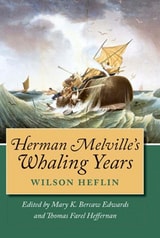
Herman Melville's Whaling Years
Wilson Heflin
Vanderbilt University Press, 2004
During his time in the Pacific, Melville served on three whaling ships, as well as on a U.S. Navy man-of-war. As a deserter from one whaleship, he spent four weeks among the cannibals of Nukahiva in the Marquesas, seeing those islands in a relatively untouched state before they were irrevocably changed by French annexation in 1842. Rebelling against duty on another ship, he was held as a prisoner in a native calaboose in Tahiti. He prowled South American ports while on liberty, hunted giant tortoises in the Galapagos Islands, and explored the islands of Eimeo (Moorea) and Maui. He also saw the Society and Sandwich (Hawaiian) Islands when the Western missionary presence was at its height.
Heflin combed the logbooks of any ship at sea at the time of Melville's voyages and examined nineteenth-century newspaper items, especially the marine intelligence columns, for mention of Melville's vessels. He also studied British consular records pertaining to the mutiny aboard the Australian whaler Lucy Ann, an insurrection in which Melville participated and which inspired his second novel, Omoo.
Distilling the life's work of a leading Melville expert into book form for the first time, this scrupulously edited volume is the most in-depth account ever published of Melville's years on whaleships and how those singular experiences influenced his writing.
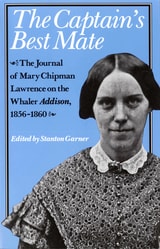
The Captain’s Best Mate
The Journal of Mary Chipman Lawrence on the Whaler Addison, 1856–1860Mary Chipman. Lawrence
University Press of New England, 1986