Results by title

4 books match the query 'What Does It Mean'

cover of What Does It Mean to Be Human?

What Does It Mean to Be Human?

Elizabeth Minnich

Temple University Press, 2027

What does it mean to be human? It has long been a tantalizing question for religious figures, scientists, political leaders, artists, and autocrats, among others. Noted philosopher Elizabeth Minnich claims, “There are no answers to such a question (although we all have favored responses).”

In What Does It Mean to Be Human?, Minnich invites us to reclaim our freedom from the dangerously distorted rationales for supremacism. She explores how the simplest mistakes in responses to “what does it mean to be human?” have enabled deadly historical errors, totalizing regimes, colonialisms, genocides, and enslavement. Paying close attention to the languages, logics, and nonsense of authoritative pronouncements, Minnich considers ways of thinking that affect and reflect meaning. She offers a fresh understanding of how mistakenly limited definitions of “human being” can be. 

What Does It Mean to Be Human? emerges from Minnich’s ongoing effort to find, think through, and dissolve past mistakes that keep resurfacing to disastrous effect.
[more]
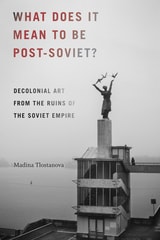
cover of What Does It Mean to Be Post-Soviet?: Decolonial Art from the Ruins of the Soviet Empire

What Does It Mean to Be Post-Soviet?

Decolonial Art from the Ruins of the Soviet Empire

Madina Tiostanova

Duke University Press, 2018
In What Does It Mean to Be Post-Soviet? Madina Tlostanova traces how contemporary post-Soviet art mediates this human condition. Observing how the concept of the happy future—which was at the core of the project of Soviet modernity—has lapsed from the post-Soviet imagination, Tlostanova shows how the possible way out of such a sense of futurelessness lies in the engagement with activist art. She interviews artists, art collectives, and writers such as Estonian artist Liina Siib, Uzbek artist Vyacheslav Akhunov, and Azerbaijani writer Afanassy Mamedov who frame the post-Soviet condition through the experience and expression of community, space, temporality, gender, and negotiating the demands of the state and the market. In foregrounding the unfolding aesthesis and activism in the post-Soviet space, Tlostanova emphasizes the important role that decolonial art plays in providing the foundation upon which to build new modes of thought and a decolonial future.
[more]
cover of What Does It Mean to Grow Old?: Reflections from the Humanities

What Does It Mean to Grow Old?

Reflections from the Humanities

Thomas R. Cole and Sally Gadow, eds.

Duke University Press, 1986
In What Does It Mean to Grow Old? essayists come to grips as best they can with the phenomenon of an America that is about to become the Old Country. They have been drawn from every relevant discipline—gerontology, social medicine, politics, health, anthropology, ethics, law—and asked to speak their mind. Most of them write extremely well [and their] sharply individual voices are heard.
[more]
cover of What Does It Mean to be a Christian?: A Debate

What Does It Mean to be a Christian?

A Debate

John F. Crosby

St. Augustine's Press, 2016

This book presents a correspondence between two friends who disagree about how to answer the question, “What does it mean to be a Christian?” Crosby argues that Christians understand themselves as hearing a definitive word of revelation spoken by God and intended for all human beings. But Betty sees Christianity as one of several options, usually the preferred way for those born in the faith, but no more unique or special than Hinduism or Buddhism. It is a debate over the kind of initiative the Christian God takes, or does not take, toward human beings. Throughout the debate Crosby alleges that Betty’s God is a very finite god, an all-too-human god, and for that very reason is something different from the God venerated by Christians, while Betty maintains that his theism remains within the Christian orbit and is a much needed corrective to a religion with exclusivist tendencies.

The debate between the two friends is presented here in the form of a correspondence they conducted over a period of two years (and did not originally intend for publication). It has undergone very little editing and revision; the authors have wanted to preserve the spontaneous give and take of their exchange. Together they have produced a work of philosophical dialogue that is unusually fruitful in its ability to clarify some fundamental issues of religion.

[more]