Results by title
3 books match the query 'What Happens'
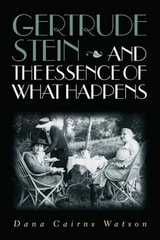
Gertrude Stein and the Essence of What Happens
Dana Cairns Watson
Vanderbilt University Press, 2005
Seeking to sustain Stein's lively, pleasant, populist spirit, Watson shows how the writer's playful entanglement of sight and sound--of silent reading and social speaking--reveals the crucial ambiguity by which reading and conversation build communities of meaning, and thus form not only personal relationships but also our very selves and the larger political structures we inhabit. Stein reminds us that the residual properties of words and the implications behind the give-and-take of ordinary conversation offer alternatives to linear structures of social order, alternatives especially precious in times of political oppression. For example, her novels Mrs. Reynolds and Brewsie and Willie, both written in embattled Vichy France, contemplate the speech patterns of totalitarian leaders and the ways in which everyday discourse might capitulate to--or resist--such verbal tyranny.
Like recent theorists, Stein recognized the repressiveness of conventional order--carried in language and thus in thought and social organization--but as Watson persuasively shows, she also insisted that the free will of individuals can persist in language and enable change. In the play of literary aesthetics, Stein saw a liberating force.
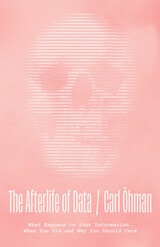
The Afterlife of Data
What Happens to Your Information When You Die and Why You Should CareCarl Öhman
University of Chicago Press, 2024
A short, thought-provoking book about what happens to our online identities after we die.
So much of our lives takes place online—but what about our afterlives? Thanks to the digital trails that we leave behind, our identities can now be reconstructed after our death. In fact, AI technology is already enabling us to “interact” with the departed. Sooner than we think, the dead will outnumber the living on Facebook. In this thought-provoking book, Carl Öhman explores the increasingly urgent question of what we should do with all this data and whether our digital afterlives are really our own—and if not, who should have the right to decide what happens to our data.
The stakes could hardly be higher. In the next thirty years alone, about two billion people will die. Those of us who remain will inherit the digital remains of an entire generation of humanity—the first digital citizens. Whoever ends up controlling these archives will also effectively control future access to our collective digital past, and this power will have vast political consequences. The fate of our digital remains should be of concern to everyone—past, present, and future. Rising to these challenges, Öhman explains, will require a collective reshaping of our economic and technical systems to reflect more than just the monetary value of digital remains.

What Happens in Literature
Edward W. Rosenheim Jr.
University of Chicago Press, 2000