Results by title
6 books match the query 'What Makes'
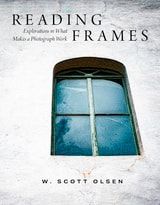
Reading Frames
Explorations in What Makes a Photograph WorkW. Scott Olsen
University of Utah Press, 2026
A collaboration between English professor and photographer W. Scott Olsen and Tomasz Trzebiatowski, founder of Frames magazine, Reading Frames gathers sixty-nine photographs first featured in Frames’ digital companion. Olsen’s essays interrogate the compositional and aesthetic elements of the photographs, but rather than offering technical instruction, Olsen writes with a literary sensibility, tracing how light, tone, color, and line evoke mood, meaning, and story. The essays ask us to linger with each photograph, guiding readers toward attentiveness, presence, and conversation with the image itself. Suited both to introductory photography classes and to general readers, this book is an example of how truly seeing an image is not the same as looking at it.
What Makes a Carmelite a Carmelite
Exploring Carmel's CharismKeith J. Egan
Catholic University of America Press, 2022

What Makes a Man?
Sex Talk in Beirut and BerlinRashid al-Daif and Joachim Helfer. Translated by Ken Seigneurie and Gary Schmidt
University of Texas Press, 2015
In 2003, Lebanese writer Rashid al-Daif spent several weeks in Germany as part of the “West-East Divan” program, a cultural exchange effort meant to improve mutual awareness of German and Middle Eastern cultures. He was paired with German author Joachim Helfer, who then returned the visit to al-Daif in Lebanon. Following their time together, al-Daif published in Arabic a literary reportage of his encounter with Helfer in which he focuses on the German writer’s homosexuality. His frank observations have been variously read as trenchant, naïve, or offensive. In response, Helfer provided an equally frank point-by-point riposte to al-Daif’s text. Together these writers offer a rare exploration of attitudes toward sex, love, and gender across cultural lines. By stretching the limits of both fiction and essay, they highlight the importance of literary sensitivity in understanding the Other.
Rashid al-Daif’s “novelized biography” and Joachim Helfer’s commentary appear for the first time in English translation in What Makes a Man? Sex Talk in Beirut and Berlin. Also included in this volume are essays by specialists in Arabic and German literature that shed light on the discourse around sex between these two authors from different cultural contexts.
What Makes or Breaks a Democracy
Lessons from HungaryAndras Schweitzer
Central European University Press, 2026
Hungary is unique in that it democratized quickly and thoroughly in 1989–1990, then, after two decades, it turned into an electoral autocracy. A new democratic era could be in the making after the April 2026 election. This book evaluates potential factors involved in these turnarounds by analyzing the post-1989 Hungarian trajectory and comparing it to other countries of the region.
If the dramatic backsliding is connected to social cultural aspects, how could democracy take root after 1989? If constitutional arrangements helped the subsequent autocratization, how was the Hungarian setup different from that in neighboring countries? Did Budapest mismanage the economy? Is Viktor Orbán unique? The findings in this book lead to universal lessons on how to build and protect democracy.
When Bad Things Happen to Privileged People
Race, Gender, and What Makes a Crisis in AmericaDara Z. Strolovitch
University of Chicago Press, 2023
A deep and thought-provoking examination of crisis politics and their implications for power and marginalization in the United States.
From the climate crisis to the opioid crisis to the Coronavirus crisis, the language of crisis is everywhere around us and ubiquitous in contemporary American politics and policymaking. But for every problem that political actors describe as a crisis, there are myriad other equally serious ones that are not described in this way. Why has the term crisis been associated with some problems but not others? What has crisis come to mean, and what work does it do?
In When Bad Things Happen to Privileged People, Dara Z. Strolovitch brings a critical eye to the taken-for-granted political vernacular of crisis. Using systematic analyses to trace the evolution of the use of the term crisis by both political elites and outsiders, Strolovitch unpacks the idea of “crisis” in contemporary politics and demonstrates that crisis is itself an operation of politics. She shows that racial justice activists innovated the language of crisis in an effort to transform racism from something understood as natural and intractable and to cast it instead as a policy problem that could be remedied. Dominant political actors later seized on the language of crisis to compel the use of state power, but often in ways that compounded rather than alleviated inequality and injustice. In this eye-opening and important book, Strolovitch demonstrates that understanding crisis politics is key to understanding the politics of racial, gender, and class inequalities in the early twenty-first century.
When Bad Things Happen to Privileged People
Race, Gender, and What Makes a Crisis in AmericaDara Z. Strolovitch
University of Chicago Press, 2023
A deep and thought-provoking examination of crisis politics and their implications for power and marginalization in the United States.
From the climate crisis to the opioid crisis to the Coronavirus crisis, the language of crisis is everywhere around us and ubiquitous in contemporary American politics and policymaking. But for every problem that political actors describe as a crisis, there are myriad other equally serious ones that are not described in this way. Why has the term crisis been associated with some problems but not others? What has crisis come to mean, and what work does it do?
In When Bad Things Happen to Privileged People, Dara Z. Strolovitch brings a critical eye to the taken-for-granted political vernacular of crisis. Using systematic analyses to trace the evolution of the use of the term crisis by both political elites and outsiders, Strolovitch unpacks the idea of “crisis” in contemporary politics and demonstrates that crisis is itself an operation of politics. She shows that racial justice activists innovated the language of crisis in an effort to transform racism from something understood as natural and intractable and to cast it instead as a policy problem that could be remedied. Dominant political actors later seized on the language of crisis to compel the use of state power, but often in ways that compounded rather than alleviated inequality and injustice. In this eye-opening and important book, Strolovitch demonstrates that understanding crisis politics is key to understanding the politics of racial, gender, and class inequalities in the early twenty-first century.