Results by title
2 books match the query 'What Works'
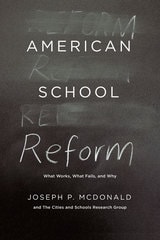
American School Reform
What Works, What Fails, and WhyJoseph P. McDonald and the Cities and Schools Research Group
University of Chicago Press, 2014
Dissecting twenty years of educational politics in our nation’s largest cities, American School Reform offers one of the clearest assessments of school reform as it has played out in our recent history. Joseph P. McDonald and his colleagues evaluate the half-billion-dollar Annenberg Challenge—launched in 1994—alongside other large-scale reform efforts that have taken place in New York, Chicago, Philadelphia, and the San Francisco Bay Area. They look deeply at what school reform really is, how it works, how it fails, and what differences it can make nonetheless.
McDonald and his colleagues lay out several interrelated ideas in what they call a theory of action space. Frequently education policy gets so ambitious that implementing it becomes a near impossibility. Action space, however, is what takes shape when talented educators, leaders, and reformers guide the social capital of civic leaders and the financial capital of governments, foundations, corporations, and other backers toward true results. Exploring these extraordinary collaborations through their lifespans and their influences on future efforts, the authors provide political hope—that reform efforts can work, and that our schools can be made better.
McDonald and his colleagues lay out several interrelated ideas in what they call a theory of action space. Frequently education policy gets so ambitious that implementing it becomes a near impossibility. Action space, however, is what takes shape when talented educators, leaders, and reformers guide the social capital of civic leaders and the financial capital of governments, foundations, corporations, and other backers toward true results. Exploring these extraordinary collaborations through their lifespans and their influences on future efforts, the authors provide political hope—that reform efforts can work, and that our schools can be made better.
[more]
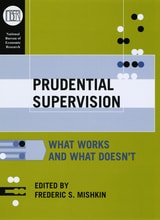
Prudential Supervision
What Works and What Doesn'tEdited by Frederic S. Mishkin
University of Chicago Press, 2001
Since banking systems play a crucial role in maintaining the overall health of the economy, the adverse effects of poorly supervised systems may be quite severe. Without some form of vigilant external oversight, banking systems could fall prey to excessive risk taking, moral hazard, and corruption. Prudential supervision provides that oversight, using government regulation and monitoring to ensure the soundness of the banking system and, by extension, the economy at large.
The contributors to this thoughtful volume examine the current state of prudential supervision, focusing on fundamental issues and key pragmatic concerns. Why is prudential supervision so important? What kinds of excess must it guard against? What particular forms does it take? Which of these are the most effective deterrents against mismanagement and system overload in today's rapidly shifting financial climate? The contributors foresee a continued movement beyond simple regulatory rules in banking and toward a more active evaluation and supervision of a bank's risk management practices.
The contributors to this thoughtful volume examine the current state of prudential supervision, focusing on fundamental issues and key pragmatic concerns. Why is prudential supervision so important? What kinds of excess must it guard against? What particular forms does it take? Which of these are the most effective deterrents against mismanagement and system overload in today's rapidly shifting financial climate? The contributors foresee a continued movement beyond simple regulatory rules in banking and toward a more active evaluation and supervision of a bank's risk management practices.
[more]