Results by title
5 books match the query 'White, Welsh S.'
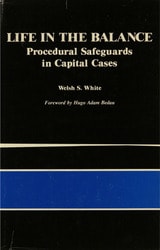
Life in the Balance
Procedural Safeguards in Capital CasesWelsh S. White. Foreword by Hugo Adam Bedau
University of Michigan Press, 1984
Life in the Balance is a critical examination of our system of capital punishment. Individual essays carefully scrutinize legal rules that are of particular significance when a defendant’s life is at stake. One essay discusses the admissibility of confessions obtained by police trickery; another, the admissibility of government psychiatric testimony; and still another, the constitutional problems raised by the practice of death-qualifying juries in capital cases. In addition, the introduction places these issues in a proper context by explaining how the Supreme Court has erected a particular system of capital punishment, and delineating the legal issues that are likely to be especially significant in the future. Particularly directed to law professors and lawstudents, the book should be of interest as well to lawyers and judges who are involved in litigating issues related to capital punishment; and it should appeal to readers who are interested either in the death penalty or in the way in which the legal system seeks to provide procedural safeguards for those accused of serious offenses.
[more]

Litigating in the Shadow of Death
Defense Attorneys in Capital CasesWelsh S. White
University of Michigan Press, 2005
"Anyone who cares about capital punishment should read this compelling, lucid account of the obstacles defense attorneys face and the strategies they adopt."
--John Parry, University of Pittsburgh School of Law
"With its compelling narratives of cases, strategies, and ethical dilemmas, Litigating in the Shadow of Death is difficult to put down. . . . This pathbreaking book encapsulates the experience of the most respected capital defenders in America and shows how they save even the worst of the worst from execution. It also shows how sleeping and otherwise incompetent lawyers bring death sentences to their clients. Litigating in the Shadow of Death explores the lawyers' tasks at every stage of the criminal process--investigation, client interviewing, conferring with victims' families, plea bargaining, trial, appeal, and post-conviction proceedings."
--Albert W. Alschuler, Julius Kreeger Professor of Law and Criminology, University of Chicago
"A unique and profoundly important contribution to the literature on the death penalty. White allows the leading capital defense attorneys to speak in their own voices. His work reveals a new source of arbitrariness in the death system--whether the penalty is imposed turns more on who is your lawyer than on how evil was your deed or your character. Litigating in the Shadow of Death offers concrete guidelines for better lawyering, protection of the innocent, and understanding the artistry of the best capital attorneys. This is vivid, gripping stuff."
--Andrew Taslitz, Professor of Law, Howard University
"A most illuminating book by a splendid writer and an eminent critic of the capital punishment system."
--Yale Kamisar, Professor of Law, University of San Diego
"Welsh White has written another excellent book on the death penalty--this one on how defense attorneys in capital cases successfully prevent the state from executing their clients. Based on original research, Litigating in the Shadow of Death is informative and insightful. This is a book that all serious students of American capital punishment must read."
--Richard Leo, University of California, Irvine
Welsh S. White was Bessie McKee Walthour Endowed Chair and Professor of Law at the University of Pittsburgh.
[more]
Miranda's Waning Protections
Police Interrogation Practices after DickersonWelsh S. White
University of Michigan Press, 2003
Did the Supreme Court's upholding of Miranda in 2000 adversely impact law enforcement, as conservatives have complained, or was it a reaffirmation of individual rights?
Welsh S. White looks at both sides of the issue, emphasizing that Miranda represents just one stage in the Court's ongoing struggle to accommodate a fundamental conflict between law enforcement and civil liberties, and assessing whether the Court's present decisions (including Miranda) strike an appropriate balance between promoting law enforcement's interest in obtaining reliable evidence and the individual's interest in being protected from overreaching police practices.
Welsh S. White is Professor of Law, University of Pittsburgh School of Law. He is best known for his work on capital punishment and has published and lectured on the death penalty for the past twenty years.
[more]
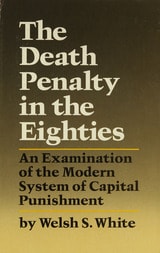
The Death Penalty in the Eighties
An Examination of the Modern System of Capital PunishmentWelsh S. White
University of Michigan Press, 1987
The Death Penalty in the Eighties: An Examination of the Modern System of Capital Punishment by Welsh S. White delivers a probing and accessible analysis of capital punishment in the United States following its reinstatement in 1976. Blending legal scholarship, case studies, and practical insights, White explains the major Supreme Court decisions that have shaped the administration of the death penalty and critically examines whether the modern system has succeeded in reducing the arbitrariness and discrimination of the past.White explores a range of pressing topics within the capital punishment system, including plea bargaining, the intricacies of penalty trials, defendants who choose execution, and the controversial “death-qualified” jury. Throughout, compelling case studies—detailing issues of racial bias, prosecutorial discretion, and the lived experiences of those on death row—offer readers an unflinching look at how the death penalty is applied in practice.Recognized as a leading voice in the field, White meticulously evaluates enduring concerns about fairness and reliability in capital sentencing, the psychological and procedural complexities facing courts and defendants, and the political and public pressures influencing prosecutors and the judiciary. Ultimately, The Death Penalty in the Eighties challenges readers to assess whether reforms have meaningfully improved justice, or whether deep risks of error and inequity remain embedded in the system.A vital resource for legal professionals, policy makers, and anyone interested in the realities of the death penalty in America, this book provides both detailed analysis and an essential historical perspective on one of the nation’s most contentious issues.
[more]
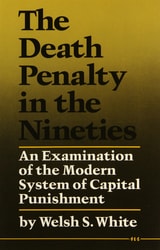
The Death Penalty in the Nineties
An Examination of the Modern System of Capital PunishmentWelsh S. White
University of Michigan Press, 1991
The Death Penalty in the Nineties: An Examination of the Modern System of Capital Punishment by Welsh S. White is a thoroughly updated and incisive assessment of America’s evolving system of capital punishment at the close of the twentieth century. Building on his acclaimed earlier work, White offers readers a clear and in-depth examination of major legal developments, Supreme Court decisions, and practical realities shaping the administration of the death penalty.Addressing dramatic changes in both the law and in patterns of execution, White explores topics such as racial discrimination, plea bargaining, the challenges of presenting mitigating evidence, prosecutorial arguments, and the controversial practice of “death-qualification” of juries. Drawing from interviews with attorneys and close analysis of real cases—such as those of Roosevelt Green and Gary Gilmore—White illuminates how the American justice system works in practice, and exposes the ongoing tensions between fairness, efficiency, public opinion, and political pressure.White’s analysis highlights not only the Supreme Court’s shifting stance—first towards expanding protections for capital defendants and then towards prioritizing expeditious executions and limiting federal review—but also the persistent issues of arbitrariness and error. He critically examines whether modern capital punishment procedures measure up to the standards of justice that a democratic society should demand.Written with clarity and balance, The Death Penalty in the Nineties is essential reading for legal scholars, practitioners, policy makers, and concerned citizens who seek to understand both the letter and the complex reality of the death penalty in the United States.
[more]