Results by title
7 books match the query 'White authors'
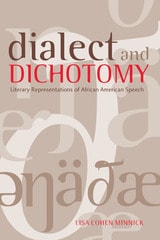
Dialect and Dichotomy
Literary Representations of African American SpeechLisa Cohen Minnick
University of Alabama Press, 2007
Applies linguistics methods for a richer understanding of literary texts and spoken language.
Dialect and Dichotomy outlines the history of dialect writing in English and its influence on linguistic variation. It also surveys American dialect writing and its relationship to literary, linguistic, political, and cultural trends, with emphasis on African American voices in literature.
Furthermore, this book introduces and critiques canonical works in literary dialect analysis and covers recent, innovative applications of linguistic analysis of literature. Next, it proposes theoretical principles and specific methods that can be implemented in order to analyze literary dialect for either linguistic or literary purposes, or both. Finally, the proposed methods are applied in four original analyses of African American speech as represented in major works of fiction of the American South—Mark Twain's Adventures of Huckleberry Finn, Charles W. Chesnutt's The Conjure Woman, William Faulkner's The Sound and the Fury, and Zora Neale Hurston's Their Eyes Were Watching God.
Dialect and Dichotomy is designed to be accessible to audiences with a variety of linguistic and literary backgrounds. It is an ideal research resource and course text for students and scholars interested in areas including American, African American, and southern literature and culture; linguistic applications to literature; language in the African American community; ethnicity and representation; literary dialect analysis and/or computational linguistics; dialect writing as genre; and American English.
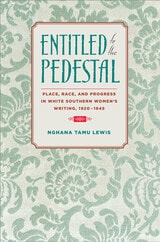
Entitled to the Pedestal
Place, Race, and Progress in White Southern Women’s Writing, 1920–1945Nghana tamu Lewis
University of Iowa Press, 2007
In this searching study, Nghana Lewis offers a close reading of the works and private correspondences, essays, and lectures of five southern white women writers: Julia Peterkin, Gwen Bristow, Caroline Gordon, Willa Cather, and Lillian Smith. At the core of this work is a sophisticated reexamination of the myth of southern white womanhood.
Lewis overturns the conventional argument that white women were passive and pedestal-bound. Instead, she argues that these figures were complicit in the day-to-day dynamics of power and authorship and stood to gain much from these arrangements at the expense of others.
At the same time that her examination of southern mythology explodes received wisdom, it is also a journey of self-discovery. As Lewis writes in her preface, “As a proud daughter of the South, I have always been acutely aware of the region’s rich cultural heritage, folks, and foodstuffs. How could I not be? I was born and reared in Lafayette, Louisiana, where an infant’s first words are not ‘da-da’ and ‘ma-ma’ but ‘crawfish boil’ and ‘fais-do-do.’ . . . I have also always been keenly familiar with its volatile history.” Where these conflicting images—and specifically the role of white southern women as catalysts, vindicators, abettors, and antagonists—meet forms the crux of this study. As such, this study of the South by a daughter of the South offers a distinctive perspective that illuminates the texts in novel and provocative ways.
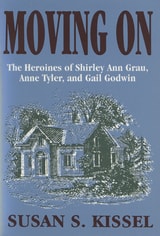
Moving On
The Heroines of Shirley Ann Grau, Anne Tyler, and Gail GodwinSusan S. Kissel
University of Wisconsin Press, 1996
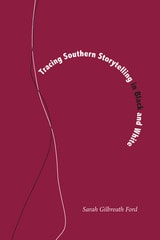
Tracing Southern Storytelling in Black and White
Sarah Gilbreath Ford
University of Alabama Press, 2014
Exploring the shared storytelling traditions that shaped Southern literature across racial lines.
Tracing Southern Storytelling in Black and White is a study of the historical use of oral storytelling by southern writers in written works. In each chapter, Sarah Gilbreath Ford pairs a white and an African American writer to highlight points of confluence in black and white southern oral traditions. She argues that the connections between white and African American southern writers run deeper than critics have yet explored, and she uses textual comparisons to examine the racial mixing of oral culture.
On porches, in kitchens, and on the pages of their work, black and white southerners exchanged not just stories but strategies for telling stories. As a boy, Joel Chandler Harris listened to the stories of African American slaves, and he devised a framework to turn the oral stories into written ones. Harris’s use of the frame structure influenced how Charles Chesnutt recorded oral stories, but it led Alice Walker to complain that her heritage had been stolen. Mark Twain listened to African American storytellers as a child. His use of oral dialects then impacts how Ralph Ellison and William Faulkner employ oral storytelling and how Toni Morrison later writes in response to Faulkner. The interactions are not linear, not a chain of influence, but a network of interactions, borrowings, and revisions.
Ford’s pairings lead to new readings that reveal how the writers employ similar strategies in their narratives, due in part to shared historical context. While Zora Neale Hurston and William Faulkner, for example, use oral storytelling in the 1930s to examine the fear of racial mixing, Ellen Douglas and Ernest Gaines use it in the 1970s to build bridges between the races. Exploring the cultural crossing that occurs in the use of oral storytelling, Ford offers a different view of this common strategy in southern narrative and a new perspective on how culture is shared.
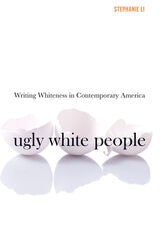
Ugly White People
Writing Whiteness in Contemporary AmericaStephanie Li
University of Minnesota Press, 2023
Whiteness revealed: an analysis of the destructive complacency of white self-consciousness
White Americans are confronting their whiteness more than ever before, with political and social shifts ushering in a newfound racial awareness. And with white people increasingly seeing themselves as distinctly racialized (not simply as American or human), white writers are exposing a self-awareness of white racialized behavior—from staunch antiracism to virulent forms of xenophobic nationalism. Ugly White People explores representations of whiteness from twenty-first-century white American authors, revealing white recognition of the ugly forms whiteness can take.
Stephanie Li argues that much of the twenty-first century has been defined by this rising consciousness of whiteness because of the imminent shift to a “majority minority” population and the growing diversification of America’s political, social, and cultural institutions. The result is literature that more directly grapples with whiteness as its own construct rather than a wrongly assumed norm. Li contextualizes a series of literary novels as collectively influenced by changes in racial and political attitudes. Turning to works by Dave Eggers, Sarah Smarsh, J. D. Vance, Claire Messud, Ben Lerner, and others, she traces the responses to white consciousness that breed shared manifestations of ugliness. The tension between acknowledging whiteness as an identity built on domination and the failure to remedy inequalities that have proliferated from this founding injustice is often the source of the ugly whiteness portrayed through these narratives.
The questions posed in Ugly White People about the nature and future of whiteness are vital to understanding contemporary race relations in America. From the election of Trump and the rise of white nationalism to Karen memes and the war against critical race theory to the pervasive pattern of behavior among largely liberal-leaning whites, Li elucidates truths about whiteness that challenge any hope of national unity and, most devastatingly, the basic humanity of others.
Retail e-book files for this title are screen-reader friendly.
White Liberal Identity, Literary Pedagogy, and Classic American Realism
AND CLASSIC AMERICAN REALISMPhillip Barrish
The Ohio State University Press, 2005
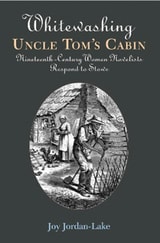
Whitewashing Uncle Tom's Cabin
Nineteenth-Century Women Novelists Respond to StoweJoy Jordan-Lake
Vanderbilt University Press, 2005