Results by title
11 books match the query 'White nationalism'
Beyond Sanctuary
The Humanism of a World in MotionAnanya Roy and Veronika Zablotsky, editors
Duke University Press, 2025
Contributors. Leisy Abrego, Damon Azali-Rojas, Amy Sara Carroll, Sharad Chari, Nicholas De Genova, Ricardo Dominguez, Lorgia García-Peña, Sarah Haley, Gaye Theresa Johnson, Moon-Kie Jung, Maria Kaika, Saree Makdisi, Kyle T. Mays, Ananya Roy, Charles Sepulveda, SA Smythe, Vanessa E. Thompson, Charalampos Tsavdaroglou, João H. Costa Vargas, Rinaldo Walcott, Veronika Zablotsky, Maite Zubiaurre

Christian America and the Kingdom of God
White Christian Nationalism from the Puritans through January 6, 2021Richard T. Hughes and Christina Littlefield
University of Illinois Press, 2025
A timely new edition of the acclaimed work, Christian America and the Kingdom of God spotlights how the centuries-long pursuit of a Christian America has bred an aggressive white Christian nationalism that twists faith, unleashes unchristian behavior, and threatens the nation.
Deflective Whiteness
Co-Opting Black and Latinx Identity PoliticsHannah Noel
The Ohio State University Press, 2022
White deflection offers a script for how social justice rhetoric and the emotions of victimization are appropriated to conjure a hegemonic White identity. Using derivative language, deflection claims Whiteness as the aggrieved social status. Through case studies of cultural moments and archives including Twitter, country music, the Black Lives Matter movement, and more, Deflective Whiteness exposes the various forms of tacit White supremacy that operate under the alibi of injury and that ultimately serve to deepen racial inequities. By understanding how, where, and why White deflection is used, Noel argues, scholars and social justice advocates can trace, tag, and deconstruct covert White supremacy at its rhetorical foundations.
Global White Supremacy
Anti-Blackness and the University as ColonizerChristopher S. Collins
Rutgers University Press, 2023
Hard Right
Muscular Rhetoric and the New NationalismCasey Ryan Kelly
The Ohio State University Press, 2026
A groundbreaking examination of far-right rhetoric around fitness and the human body and how such rhetoric serves white nationalist, masculinist aims.
In recent years, far-right, white-nationalist groups in the US have churned out streams of discourse glorifying “muscularity” as the ideal masculine form. This preoccupation with physical fitness—along with expressed fears of declining testosterone levels in men, race-mixing, and transgender women—all reveal the masculine bodily fantasies and anxieties that underwrite the political unconscious of the far right. In Hard Right, Casey Ryan Kelly examines the link between extreme fitness culture and fascist organizations, arguing that the human body operates as a privileged signifier of national belonging in the rhetoric of the far right.
Drawing from psychoanalytic theory, Kelly shows that far-right rhetoric constructs fantasies of recovering the “natural” or primal masculine body. These fantasies are frequently accompanied by anxieties about “soft,” disabled, and ambiguously gendered bodies, all of which are seen as signs of degeneracy that must be transformed, exiled, or eradicated for the sake of national and racial health. Through its examination of “Red Pill” fitness influencers, “bro science” conspiracy theories, far-right podcasts, and more, Hard Right ultimately shows how the cultural logics of men’s health and physical fitness converge with the political logics of white nationalism and late fascism.
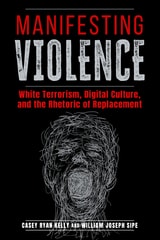
Manifesting Violence
White Terrorism, Digital Culture, and the Rhetoric of ReplacementCasey Ryan Kelly and William Joseph Sipe
University of Alabama Press, 2025
When communication becomes the engine of white supremacist violence.
Manifesting Violence: White Terrorism, Digital Culture, and the Rhetoric of Replacement by Casey Ryan Kelly and William Joseph Sipe is a compelling exploration of how the digital world has become a fertile ground for white supremacist ideology. Through an in-depth analysis of white supremacist manifestos, online rhetoric, and the myth of “white genocide,” Kelly and Sipe uncover the disturbing ways in which digital culture facilitates the spread of racist ideology and the radicalization of individuals. By examining the language of white nationalism—calls to defend the white race, family, and children—Kelly and Sipe reveal how these messages, often disguised as entertainment or humor, gradually transform passive consumers into active participants in a dangerous ideology.
Manifesting Violence sheds light on the alarming shift from organized white supremacist groups to a decentralized digital arena where hate speech is disguised as humor and online conversations foster a culture of violence. Kelly and Sipe’s thorough investigation of this growing digital ecosystem offers a chilling glimpse into the dark underbelly of online extremism. A must-read for anyone seeking to understand the growing threat of hate-motivated violence and the urgent need to address its roots in digital culture, Kelly and Sipe offer rich insights to readers, researchers, academics, and policymakers concerned about extremism, online radicalization, and white supremacy.
Nothing Has to Make Sense
Upholding White Supremacy through Anti-Muslim RacismSherene H. Razack
University of Minnesota Press, 2022
How Western nations have consolidated their whiteness through the figure of the Muslim in the post-9/11 world
While much has been written about post-9/11 anti-Muslim racism (often termed Islamophobia), insufficient attention has been given to how anti-Muslim racism operates through law and is a vital part of law’s protection of whiteness. This book fills this gap while also providing a unique new global perspective on white supremacy. Sherene H. Razack, a leading critical race and feminist scholar, takes an innovative approach by situating law within media discourses and historical and contemporary realities. We may think of law as logical, but, argues Razack, its logic breaks down when the subject is Muslim.
Tracing how white subjects and majority-white nations in the post-9/11 era have consolidated their whiteness through the figure of the Muslim, Razack examines four sites of anti-Muslim racism: efforts by American evangelical Christians to ban Islam in the school curriculum; Canadian and European bans on Muslim women’s clothing; racial science and the sentencing of Muslims as terrorists; and American national memory of the torture of Muslims during wars and occupations. Arguing that nothing has to make sense when the subject is Muslim, she maintains that these legal and cultural sites reveal the dread, phobia, hysteria, and desire that mark the encounter between Muslims and the West.
Through the prism of racism, Nothing Has to Make Sense argues that the figure of the Muslim reveals a world divided between the deserving and the disposable, where people of European origin are the former and all others are confined in various ways to regimes of disposability. Emerging from critical race theory, and bridging with Islamophobia/critical religious studies, it demonstrates that anti-Muslim racism is a revelatory window into the operation of white supremacy as a global force.
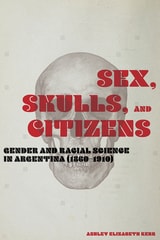
Sex, Skulls, and Citizens
Gender and Racial Science in Argentina (1860-1910)Ashley Elizabeth Kerr
Vanderbilt University Press, 2020
PROSE Awards Subject Category Finalist—Biological Anthropology, Ancient History, and Archaeology, 2021
Best Nineteenth-Century Book Award, Latin American Studies Association Nineteenth-Century Section, 2021
Analyzing a wide variety of late-nineteenth-century sources, Sex, Skulls, and Citizens argues that Argentine scientific projects of the era were not just racial encounters, but were also conditioned by sexual relationships in all their messy, physical reality.
The writers studied here (an eclectic group of scientists, anthropologists, and novelists, including Estanislao Zeballos, Lucio and Eduarda Mansilla, Ramón Lista, and Florence Dixie) reflect on Indigenous sexual practices, analyze the advisability and effects of interracial sex, and use the language of desire to narrate encounters with Indigenous peoples as they try to scientifically pinpoint Argentina's racial identity and future potential.
Kerr's reach extends into history of science, literary studies, and history of anthropology, illuminating a scholarly time and place in which the lines betwixt were much blurrier, if they existed at all.
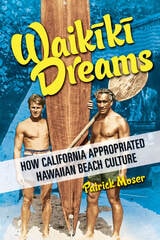
Waikiki Dreams
How California Appropriated Hawaiian Beach CulturePatrick Moser
University of Illinois Press, 2024
Despite a genuine admiration for Native Hawaiian culture, white Californians of the 1930s ignored authentic relationships with Native Hawaiians. Surfing became a central part of what emerged instead: a beach culture of dressing, dancing, and acting like an Indigenous people whites idealized.
Patrick Moser uses surfing to open a door on the cultural appropriation practiced by Depression-era Californians against a backdrop of settler colonialism and white nationalism. Recreating the imagined leisure and romance of life in Waikīkī attracted people buffeted by economic crisis and dislocation. California-manufactured objects like surfboards became a physical manifestation of a dream that, for all its charms, emerged from a white impulse to both remove and replace Indigenous peoples. Moser traces the rise of beach culture through the lives of trendsetters Tom Blake, John “Doc” Ball, Preston “Pete” Peterson, Mary Ann Hawkins, and Lorrin “Whitey” Harrison while also delving into California’s control over images of Native Hawaiians via movies, tourism, and the surfboard industry.
Compelling and innovative, Waikīkī Dreams opens up the origins of a defining California subculture.

Warring Genealogies
Race, Kinship, and the Korean WarJoo Ok Kim
Temple University Press, 2022
Warring Genealogies examines the elaboration of kinships between Chicano/a and Asian American cultural production, such as the 1954 proxy adoption of a Korean boy by Leavenworth prisoners. Joo Ok Kim considers white supremacist expressions of kinship—in prison magazines, memorials, U.S. military songbooks—as well as critiques of such expressions in Chicana/o and Korean diasporic works to conceptualize racialized formations of kinship emerging from the Korean War.
Warring Genealogies unpacks writings by Rolando Hinojosa (Korean Love Songs, The Useless Servants) and Luis Valdez (I Don’t Have to Show You No Stinking Badges, Zoot Suit) to show the counter-representations of the Korean War and the problematic depiction of the United States as a benevolent savior. Kim also analyzes Susan Choi’s The Foreign Student as a novel that proposes alternative temporalities to dominant Korean War narratives. In addition, she examines Chicano military police procedurals, white supremacist women’s organizations, and the politics of funding Korean War archives.
Kim’s comparative study Asian American and Latinx Studies makes insightful connections about race, politics, and citizenship to critique the Cold War conception of the “national family.”
White Enclosures
Racial Capitalism and Coloniality along the Balkan RoutePiro Rexhepi
Duke University Press, 2022